Monday, November 06, 2006


When good ideas go Breasts Vertical
As mentioned a few posts back, I mentioned problems I'd been having on two key projects. The first was the feature I proposed to write for my script development workshop at college. In a stroke of genius I tried to turn a drama into a rom-com and screwed the pooch in the process. I'm still deciding whether to resurrect the original idea as a drama - it's definitely got legs, so I think I probably will. The second Breasts Vertical Incident involved the concept I'd been developing as a returning drama series for the mentoring project. I still like the central conceit, but the more work I put into it, the less comfortable I became with where it was headed.
My problem was a combination of clashing tone and mixed genres. The original idea was a high concept, outrageous slice of spy-fi - so far, so good. Light of tone, certain of genre. But in trying to invest this with depth and gravitas and characterisation, I starteds slowly twisting the project into something else. I had a light, fluffy souffle and I was trying to construct a skyscraper on top of it. It got to a point where I wanted to abandon my initial conceit and write a straight drama, but couldn't bring myself to admit it. The foundations weren't strong enough to sustain the story I wanted to tell.
Perhaps the problems started at the beginning of the mentoring project. All three of the mentees brought along a fistful of ideas, from which we each chose one to develop further. I honestly didn't know which one I wanted to write from my selection. Ultimately, I plumped for my high concept idea as it seemed to excite the most interest. But all my attempts to mind-map the central characters and find the essence of my story created more problems than they solved. I got lost in the process, couldn't remember what it was I wanted to achieve.
So, time to restate my objectives: by the end of the mentoring project I want to have a pilot script for a new returning drama series, along with some paragraphs describing how it could be developed. Crucially, I want a pilot script that demonstrates my voice, the best qualities of my writing, that acts as a calling card for my abilities as a writer. Doing things like radio drama labs and an MA in screenwriting have showed me that I write best when I write without worrying about trying to second guess what other people want. Don't overthink it, trust to instinct and whatever natural talent for storytelling I have.
One of my favourite films of all time is Ron Shelton's Bull Durham. Maybe you haven't seen it [hell, maybe you haven't heard of it], but don't let the fact the movie is sent in the world of minor league baseball put you off. The film isn't about sport and it isn't about baseball, minor league or otherwise. Bull Durham is about life, about being an adult, about falling in love, about sex and about so many other things. It's also chock full of great lines and observations. I recall lines from Bull Durham every week, as they fit so many situations. One such example applies here: 'Don't think - you'll only hurt the ball club.'
Anyways, I came to the conclusion that I was developing the wrong story for my mentoring project. I called my mentor and we talked about why it wasn't working for me, and what I wanted to do instead. I'd already made my decision, my choice, but it was good to have my mentor support that decision. So, I've gone right back to square one and am starting again. I should be dejected at having wasted three months to get this far, but sometimes you have to kiss a few toads to meet a princess, right?
Sunday, November 05, 2006
The King of Procrastination
I thought I was good, until I read this blog entry on work avoidance at the hilarious How to Write Screenplays. Badly. [Thanks to English Dave for the link.] At least I don't spend al my time scoffing cinnamon eggs, mostly because I don't like eggs. Now, cinnamon, that's another matter - you can never have enough cinnamon. Or lemon juice. Or chocolate. That's got to three major food groups right there, right?
The ubiquitous Michael Caine returns - again.
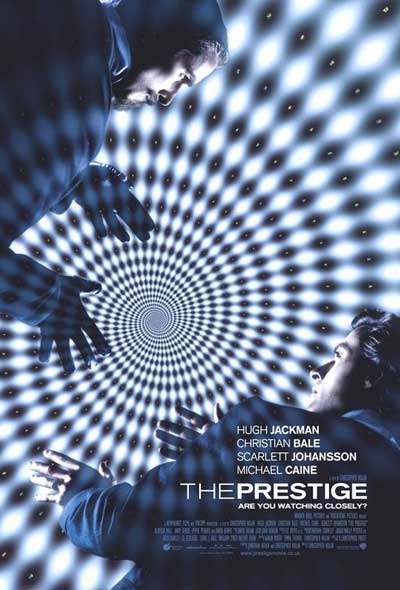 Regular readers will know I wrote a book about the films of Michael Caine three years back. It covered every feature film the iconic British actor had appeared in from Zulu up to The Actors, with brief anticipatory entries for Secondhand Lions [which turned out rather good, I thought] and The Statement [not so successful, IMHO]. Caine works in fits and starts, taking a year off every now and then before making another clutch of movies. So his only feature released in 2004 was Around the Bend [haven't seen it yet, got the DVD but reviews aren't promising].
Last year saw three Caine movies in cinemas - Batman Begins [good], The Weather Man [flawed] and Bewitched [god awful, apparently - I've yet to see it]. Now Sir Michael is back with another Christopher Nolan-directed feature, The Prestige [see the groovy poster above]. The actor was on Parkinson last night, doing his bit to promote the movie and I've heard plenty of good things about it, so I must make the effort to see it. Despite a dozen recommendations, I've managed to miss on seeing Children of Men at the cinema, which also has a Caine appearance in it. Tsk! Guess I'll be waiting for the DVD of that one.
Hype: Criminal by Ed Brubaker and Sean Phillips
 A few months back I was asked to write a guest column for the 200th issue of Comics International. I use to bash out a regular column every issue for CI when I first went freelance but eventually jacked it in when I got too busy with other projects and felt my interest in comics was waning. Anyways, CI #200 finally appeared a week or two back and I read my column, having little memory of what I had produced.
Among my comments I made mention of not having a reason to go into a comic shop regularly any more because none of the current crop of titles excited me. I'm content to wait for the trades on The Walking Dead, while i get 2000 AD and the Judge Dredd Megazine on subscription. Now those talented bastards Ed Brubaker and Sean Phillips have come up with Criminal, a grippng new crime title published through Marvel's Icon imprint. Issue two came out this week and it's even better than issue one. Bastards. Now I've got a reason to go back into comic shops. Damn you, Brubaker and Phillips!
Saturday, November 04, 2006

Remembering that writing is fun, not a chore
So I spent Thursday and Friday at a BBC Radio drama lab in Edinburgh. It was the first section of what will be a five and a half day workshop about writing, creativity and writing drama creatively for radio. I wasn't sure what to expect and was almost dreading it a little when I walked in. I'd had a bad seven days with my writing, several projects were coming apart at the seams [I've save the details about that for tomorrow's blog posting] and I've got several deadlines looming in a particularly nasty fashion. All in all, the last thing I needed to be doing was spending five and a half days at a workshop about writing, when I should be at room doing some bloody writing, right? Wrong. So wrong.
The first two days of the lab have reminded me why I'm a writer - the joy of creativity, the moment when you have a notion that blossoms into idea and then grows into a story. I saw two words juxtaposed on Friday afternoon and my brain start ticking. Within twenty minutes I had a plot, an intriguing central character and even a great title for the story. I'm not sure if it's right for radio, but it's definitely a story I want to write for whatever medium it suits. It was such a breakthrough, to rediscover the joy of writing, the excitement of ideas colliding, the thrill of anything being possible, the thought that a blank page is an opportunity and not a thing of tyranny to be feared and fretted over.
Day one of the lab was full of games and roleplaying, listening and talking, exploring and discovering. The lab's being run by David Ian Neville - who produced, directed and nurtured my first radio play, Island Blue: Ronald - and another BBC Radio Scotland drama producer, Kirsteen Cameron. There are eight writers including me, all experienced in a variety of fields and most with at least one radio credit under their belt. It's an exciting group of people, all with different life experiences and backgrounds, but we're meshing remarkably well. Our homework after the first day was reading Angela Carter's short story The Kitchen Child and imagining how we would dramatise that for radio.
Day two started with our discussion about The Kitchen Child, before we heard the finished radio play [due for broadcast later this month and much recommended]. It was fascinating to hear how much the adapter had changed - and yet remained faithful to the spirit of the source material, the language of Angela Carter's prose and kept the essence of it at the heart of the radio play. I think it opened a lot of the writer's eyes [and ears, obviously] about how brave and bold an adaptation has to be. Funnily enough, adaptation is the subject I'm writing about for the first piece of assessed work on my screenwriting MA this term, so it was already much in my mind.
In the afternoon guest writer Louise Ironside came in and banished any post-lunch stupors with her vitality and passion for writing. I first met Louise at an Adrian Mead TV drama writing seminar and she was very helpful with advice about how fledgling scribes should approach the BBC Scotland soap opera River City. [Louise is a regular writer for the show and has an episode being broadcast on Tuesday.] She was also one of the writers on the Island Blue radio project, so it was great to meet her again and catch up. I think my schedule is busy but she puts me in the shade.
Her session was chock full of useful exercises and exciting methods of sparking creativity when you're feeling drained and hollow - brilliant stuff. Peerhaps my favourite sequence was when each of us wrote a short monologue based on 26 random supplied words, which had to be used in alphabetical order. I was in tears of hysterical laughter by the time I get halfway through reading mine out loud. The others were creepy, moving or twice as funny as my effort. By the end of the afternoon we were all buzzing, and would happily have stayed for more.
Our homework for next Thursday's session is writing a three minute scene that will - after much rewriting, I suspect - be recorded in a studio by professional actors. We're being asked to challenge ourselves, experiment, test our emotional levels, and not play safe or be lazy with this opportunity. My only problem now - what the hell do I write?
Second season of the sinister 'Dexter'
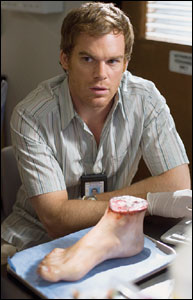 Excellent news in Variety yesterday - Showtime has ordered a second season of its quirky new crime drama series Dexter. The US subscription network has only broadcast five episodes of the first, 12-part season but the show is already Showtime's most popular drama. Dexter features a serial killing forensics expert who solves crimes and it's funny, dark and challenges so many of storytelling preconceptions about the nature of the protagonist - cracking stuff.
Friday, November 03, 2006
Films of Michael Caine #7: Hurry Sundown
Had a fascinating day at the BBC Radio drama lab yesterday and there's another full day of activities, interactions and fascinations ahead. So, it's back into the archives for another extract from my tome on the films of Michael Caine - and this one is a doozy. A movie that has to be seen to be believed: Sir Michael as a deep fried bastard, with Jane Fonda wrapping her laughing gear round his saxophone. If music be the food of love, prepare for indigestion... HURRY SUNDOWN (1967)
Cast: Michael Caine (Henry Warren), Jane Fonda (Julie Ann Warren), John Phillip Law (Rad McDowell), Diahann Carroll (Vivien Thurlow), Robert Hooks (Reeve Scott), Faye Dunaway (Lou McDowell), Burgess Meredith (Judge Purcell), Robert Reed (Lars Finchley), George Kennedy (Sheriff Coombs), Frank Converse (Clem De Lavery), Loring Smith (Thomas Elwell).
Crew: Otto Preminger (director and producer), Thomas C Ryan and Horton Foote (writers), Hugo Montenegro (music), Milton Krasner and Loyal Griggs (cinematography), Louis R Loeffler and James D Wells (editors), Gene Callahan (production designer).
Synopsis: Georgia farmer Rad McDowell returns home after serving in the Second World War. A new development has bought up all the surrounding land, except for the farms owned by Rad and his black neighbours, Rose Scott and her son Reeve. Rad refuses to sell his land, endangering a deal brokered by his ambitious cousin, Henry Warren. Rad is unhappy that his eldest son, Charles, is close to Henry. Henry sends his wife Julie to persuade Rose, who was her nanny years earlier. But Rose refuses and dies of a heart attack. Reeve and Rad form an alliance to improve their land by blasting irrigation channels. Henry’s troubled son Colie seriously injures himself while Henry tries to stop the blasting. Henry blames Reeve for the injury and tries to have the black farmer evicted, enlisting Julie’s help. The case goes to court where a bigoted judge sides with Henry. But Rad provides documents that prove Reeve owns the disputed land. Julie discovers Henry lied about the cause of Colie’s injury. She decides to divorce Henry. Determined to get revenge, he plants explosives above Rad’s farm. But Charles is accidentally killed in the blast. Henry runs away, distraught. The local black community helps Rad reclaim his flooded land…
Hurry Sundown was originally a thousand-page novel by K. B. Gilden, first published as two volumes in 1964. Noted director/producer Otto Preminger acquired the film rights and commissioned screenwriters Thomas C Ryan and Horton Foote to adapt the sprawling epic. Preminger made a surprising choice for the leading role, casting London-born Caine as Southern bigot Henry Warren. The filmmaker approached him while Caine was in Hollywood shooting Gambit (1966) with Shirley MacLaine.
Mastering a Southern accent proved challenging for Caine. Preminger sent him voice tapes to practise with while the actor was working on Funeral in Berlin (1966). As soon as Caine finished the second Harry Palmer picture, he was flown to Louisiana to start work on Hurry Sundown. British journalist David Lewin visited the set and interviewed the leading man. Caine said he was not afraid playing a racist would harm his public image. ‘What I do is show the sadness of the man… The sadness of a man who destroys others and destroys himself. Nazis and racialists are yesterday’s news. Everyone knows about them. I just feel sad for them.’
The production used black and white actors. This caused problems during filming in Louisiana, where the civil rights movement was making headlines. The cast and crew had to be guarded by policemen and state troopers to protect them from the racist Ku Klux Klan organisation. One hotel initially refused to let black and white actors use the same swimming pool, until Preminger threatened to move everyone to another hotel. In the dining room black actors were insulted by other guests. Crew members were threatened with guns and production vehicles had tyres slashed. ‘We live in the compound of the hotel,’ Caine told Lewin. ‘It is like a stockade with armed guards on patrol.'
Austrian-born director Preminger was infamous for his fiery temper, but the leading man did not have problems. ‘Otto was nice to me on Hurry Sundown but I didn’t like how nasty he was to everyone else,’ Caine told Time Out magazine in 1992. ‘He was particularly nasty to Faye Dunaway and I pulled him up on it. My attitude was if he says anything to me I’ll fucking deck him.’ Dunaway was making her movie debut on this picture.
Hurry Sundown opened in America during February 1967, attracting positive reviews. Critics were full of praise for Caine’s Southern accent. In Britain reaction to the A-rated movie was less favourable, with Caine taking a drubbing from UK critics. Reviewers seemed unable or unwilling to see the actor as anything other than his Cockney public persona. A similar situation arose more than 30 years later when Caine adopted a New England accent for his role as Dr Larch in The Cider House Rules (1999).
Hurry Sundown has never been released on VHS or DVD in the UK. A brief clip from it appears as part of a flashback sequence in Austin Powers in Goldmember (2002)
Reviews: ‘Melodrama on a grand scale … performances are swamped by a script like this. Michael Caine, despite a fair shot as a Southern drawl, is way out of his depth.’ – MFB
‘Otto Preminger has created an outstanding, tasteful but hard-hitting, and handsomely-produced film about racial conflict in Georgia circa 1945 … Michael Caine leads the stars, and delivers an excellent performance…’ – Variety
Verdict: They don’t make them like this anymore. Hurry Sundown is a sprawling, melodramatic epic about racism where everything is writ large. The bad people are very bad and the good are very good, verging on the saintly. The contrast is so stark, it leaves little room for subtlety. A painfully slow first hour puts all the pieces in place, before events build to a series of unconvincing climaxes. Caine’s Southern accent isn’t bad, it just sounds odd coming from his mouth. Despite this, he gives a solid performance in an unsympathetic part. Hurry Sundown is best viewed for its curiosity value. How many films can you see where Jane Fonda simulates fellatio on a saxophone to arouse Michael Caine?
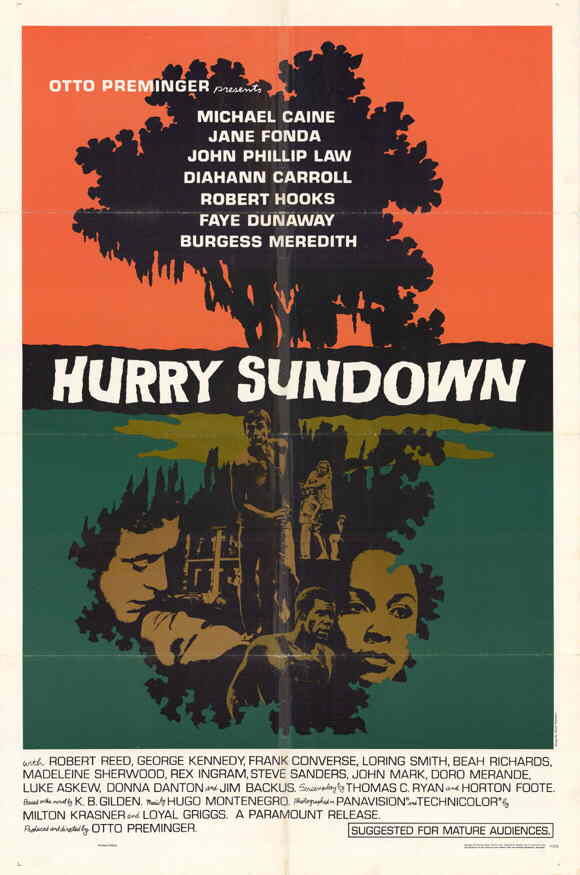 HURRY SUNDOWN (1967)
Cast: Michael Caine (Henry Warren), Jane Fonda (Julie Ann Warren), John Phillip Law (Rad McDowell), Diahann Carroll (Vivien Thurlow), Robert Hooks (Reeve Scott), Faye Dunaway (Lou McDowell), Burgess Meredith (Judge Purcell), Robert Reed (Lars Finchley), George Kennedy (Sheriff Coombs), Frank Converse (Clem De Lavery), Loring Smith (Thomas Elwell).
Crew: Otto Preminger (director and producer), Thomas C Ryan and Horton Foote (writers), Hugo Montenegro (music), Milton Krasner and Loyal Griggs (cinematography), Louis R Loeffler and James D Wells (editors), Gene Callahan (production designer).
Synopsis: Georgia farmer Rad McDowell returns home after serving in the Second World War. A new development has bought up all the surrounding land, except for the farms owned by Rad and his black neighbours, Rose Scott and her son Reeve. Rad refuses to sell his land, endangering a deal brokered by his ambitious cousin, Henry Warren. Rad is unhappy that his eldest son, Charles, is close to Henry. Henry sends his wife Julie to persuade Rose, who was her nanny years earlier. But Rose refuses and dies of a heart attack. Reeve and Rad form an alliance to improve their land by blasting irrigation channels. Henry’s troubled son Colie seriously injures himself while Henry tries to stop the blasting. Henry blames Reeve for the injury and tries to have the black farmer evicted, enlisting Julie’s help. The case goes to court where a bigoted judge sides with Henry. But Rad provides documents that prove Reeve owns the disputed land. Julie discovers Henry lied about the cause of Colie’s injury. She decides to divorce Henry. Determined to get revenge, he plants explosives above Rad’s farm. But Charles is accidentally killed in the blast. Henry runs away, distraught. The local black community helps Rad reclaim his flooded land…
Hurry Sundown was originally a thousand-page novel by K. B. Gilden, first published as two volumes in 1964. Noted director/producer Otto Preminger acquired the film rights and commissioned screenwriters Thomas C Ryan and Horton Foote to adapt the sprawling epic. Preminger made a surprising choice for the leading role, casting London-born Caine as Southern bigot Henry Warren. The filmmaker approached him while Caine was in Hollywood shooting Gambit (1966) with Shirley MacLaine.
Mastering a Southern accent proved challenging for Caine. Preminger sent him voice tapes to practise with while the actor was working on Funeral in Berlin (1966). As soon as Caine finished the second Harry Palmer picture, he was flown to Louisiana to start work on Hurry Sundown. British journalist David Lewin visited the set and interviewed the leading man. Caine said he was not afraid playing a racist would harm his public image. ‘What I do is show the sadness of the man… The sadness of a man who destroys others and destroys himself. Nazis and racialists are yesterday’s news. Everyone knows about them. I just feel sad for them.’
The production used black and white actors. This caused problems during filming in Louisiana, where the civil rights movement was making headlines. The cast and crew had to be guarded by policemen and state troopers to protect them from the racist Ku Klux Klan organisation. One hotel initially refused to let black and white actors use the same swimming pool, until Preminger threatened to move everyone to another hotel. In the dining room black actors were insulted by other guests. Crew members were threatened with guns and production vehicles had tyres slashed. ‘We live in the compound of the hotel,’ Caine told Lewin. ‘It is like a stockade with armed guards on patrol.'
Austrian-born director Preminger was infamous for his fiery temper, but the leading man did not have problems. ‘Otto was nice to me on Hurry Sundown but I didn’t like how nasty he was to everyone else,’ Caine told Time Out magazine in 1992. ‘He was particularly nasty to Faye Dunaway and I pulled him up on it. My attitude was if he says anything to me I’ll fucking deck him.’ Dunaway was making her movie debut on this picture.
Hurry Sundown opened in America during February 1967, attracting positive reviews. Critics were full of praise for Caine’s Southern accent. In Britain reaction to the A-rated movie was less favourable, with Caine taking a drubbing from UK critics. Reviewers seemed unable or unwilling to see the actor as anything other than his Cockney public persona. A similar situation arose more than 30 years later when Caine adopted a New England accent for his role as Dr Larch in The Cider House Rules (1999).
Hurry Sundown has never been released on VHS or DVD in the UK. A brief clip from it appears as part of a flashback sequence in Austin Powers in Goldmember (2002)
Reviews: ‘Melodrama on a grand scale … performances are swamped by a script like this. Michael Caine, despite a fair shot as a Southern drawl, is way out of his depth.’ – MFB
‘Otto Preminger has created an outstanding, tasteful but hard-hitting, and handsomely-produced film about racial conflict in Georgia circa 1945 … Michael Caine leads the stars, and delivers an excellent performance…’ – Variety
Verdict: They don’t make them like this anymore. Hurry Sundown is a sprawling, melodramatic epic about racism where everything is writ large. The bad people are very bad and the good are very good, verging on the saintly. The contrast is so stark, it leaves little room for subtlety. A painfully slow first hour puts all the pieces in place, before events build to a series of unconvincing climaxes. Caine’s Southern accent isn’t bad, it just sounds odd coming from his mouth. Despite this, he gives a solid performance in an unsympathetic part. Hurry Sundown is best viewed for its curiosity value. How many films can you see where Jane Fonda simulates fellatio on a saxophone to arouse Michael Caine?
Thursday, November 02, 2006
2000 AD in award-winning short film
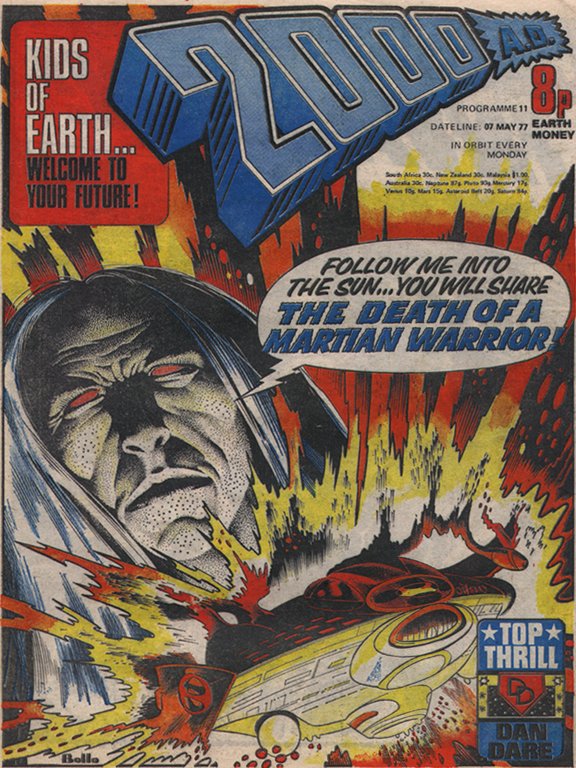 Wednesday night at the London Film Festival SILENCE IS GOLDEN won the TCM Classic Shorts competition. The short features a cameo appearance by an issue of 2000 AD and is some weird-ass stuff. Click here to see Silence is Golden for yourself. Here's what the film festival judges had to say about the film: “Wonderfully surreal” - Imelda Staunton; “Technically extremely impressive, full of wit and imagination” - Stephen Poliakoff; “A wonderful combination of mixed media, strong storytelling and talented actors” - Matthew Modine; “Terrific, strong, non-sentimental kid’s story” - Terry Gilliam.
Films of Michael Caine #6: Funeral in Berlin
Off to Edinburgh for the first day of a BBC Radio drama lab, hosted by the Scottish Book Trust, so no time for my usual ramblings. Instead, here's another extract from my tome Starring Michael Caine, coming off the subs bench to save the day.
FUNERAL IN BERLIN (1966)
Cast: Michael Caine (Harry Palmer), Paul Hubschmid (Johnnie Vulkan), Oscar Homolka (Stok), Eva Renzi (Samantha Steel), Guy Doleman (Ross), Hugh Burden (Hallam), Heinz Schubert (Levine), Wolfgang Volz (Werner), Thomas Holtzmann (Reinhardt), Gunter Meisner (Kreutzman).
Crew: Guy Hamilton (director), Charles Kasher (producer), Evan Jones (writer), Konrad Elfers (music), Otto Heller (cinematography), John Bloom (editor), Ken Adam (production designer).
Synopsis: British agent Harry Palmer is sent to Berlin. A local operative, Johnnie Vulkan, claims Colonel Stok of the KGB wants to defect. Palmer meets Stok, who is in charge of the Berlin Wall. The colonel says he will defect but wants the operation run by Kreutzman, who has supervised some of the most daring escapes across the wall. Harry is picked up by Samantha Steel, an Israeli secret agent. Vulkan arranges for Harry to meet with Kreutzman, who agrees to run the defection. The price is sixty thousand American dollars and a set of genuine British identity papers. The defection proves to be a trap for Kreutzman, but the identity papers are another matter. The Israelis want them to retrieve two million dollars of Jewish money looted by a Nazi called Paul Louis Broum during the war. Palmer learns his old friend Vulkan used to be Broum, a German guard at a concentration camp. Harry tricks Vulkan into the open, where the former Nazi is gunned down by the Israelis…
The film of The Ipcress File (1965) proved a success in Britain and the US. By the time it reached cinemas, author Len Deighton had already written two further novels featuring his nameless British spy – christened Harry Palmer for the big screen. Producer Harry Saltzman wasted no time exercising his option on another of the Deighton novels, selecting the third book of the series, Funeral in Berlin. Saltzman hoped the Palmer films might grow to rival the James Bond films, which he co-produced with Cubby Broccoli.
Evan Jones was chosen to adapt the complex plot of the novel into a screenplay. Guy Hamilton came on board as director, replacing the more mercurial Sidney J. Furie. Hamilton had excelled on the third 007 extravaganza Goldfinger (1966) for Saltzman and Broccoli. Many of the team that had worked on The Ipcress File returned for the new Palmer movie, including production designer Ken Adam, cinematographer Otto Heller and producer Charles Kasher. Saltzman had Caine under contract so his participation was assured, but his asking price had jumped to £100,000 for this picture. Joining him in front of the cameras again was Guy Doleman as Harry’s superior Colonel Ross.
The bulk of location work was filmed in West Berlin, with the crew constructing a replica of Checkpoint Charlie, the famous crossing point between east and west. Studio work took place at Pinewood back in Britain. Shooting near the Berlin Wall was problematic, with border guards on the eastern side deliberately disrupting filming by shining a mirror at the camera lenses. Caine told Esquire magazine that the city was different from any place he’d been. ‘Here there’s no such thing as anybody being pleased to see you … I don’t want to be unfair to anybody, so let’s just say we’re dancing to different tunes. It’s not my scene.’ Caine filled some of his time off set practising a Southern American accent for his next film, Hurry Sundown (1867). Director Otto Preminger had sent the Londoner tapes to help him master the distinctive speech patterns.
Funeral in Berlin received mediocre reviews in Britain when it opened in late 1966, rated A. Despite this, the new film made enough money for Saltzman to green-light a third Harry Palmer picture. Funeral in Berlin reached the US in 1967 where reviews were more favourable. The film was released on video in the UK during 1988, reclassified as PG. It was reissued as a budget price tape in 2001. In the US the picture is also available on DVD.
Reviews: ‘Funeral in Berlin piles it on thick and fast with a plot which has so many twists that even Sherlock Holmes might have been baffled.’ – MFB
‘It is difficult to imagine the first film without Mr Caine ... In the case of the second it is impossible: the actor makes the film.’ – The Sunday Times
Verdict: Funeral in Berlin is a drab, downbeat film with a complex plot that requires consideration concentration without offering much in return. Almost all the characters are unsympathetic, either utterly amoral or murderous zealots, making it hard to care what happens to them. In the midst of this, Caine repeats the assurance of his previous performance as Harry Palmer, but adds few new shadings to the part. He only comes alive on screen playing opposite his old nemesis Ross or his new enemy Stok. Homolka shines as the KGB colonel, stealing all his scenes with ease. Director Guy Hamilton replaces the eye-catching techniques of Sidney J. Furie with more mundane imagery, reducing this film to a conventional espionage tale. That’s adequate on its own terms, but a disappointment after The Ipcress File (1965).
Wednesday, November 01, 2006
Pokemon goes willy-nilly, flatulence called
What follows may be the net equivalent of an urban myth, but it tickled my fancy, so maybe it'll tickle yours, too. The Washington Post allegedly runs a competition each year, inviting readers to submit new definitions for common words. The best are selected from many, many entries and published in the Post. Below is a selection from a recent crop of winners...
1. coffee, n. the person upon whom one coughs.
2. flabbergasted, adj. appalled by discovering how much weight one has gained.
3. abdicate, v. to give up all hope of ever having a flat stomach.
4. esplanade, v. to attempt an explanation while drunk.
5. willy-nilly, adj. impotent.
6. negligent, adj. absentmindedly answering the door when wearing only a nightgown.
7. lymph, v. to walk with a lisp.
8. gargoyle, n. olive-flavored mouthwash.
9. flatulence, n. emergency vehicle that picks up someone who has been run over by a steamroller.
10. balderdash, n. a rapidly receding hairline.
11. testicle, n. a humorous question on an exam.
12. rectitude, n. the formal, dignified bearing adopted by proctologists.
13. pokemon, n. a Rastafarian proctologist.
Copious Spare Time
In our house we like to laughingly talk about Copious Spare Time - or simply CST, if we haven't got enough time left to say the phrase Copious Spare Time. CST is that imaginary 25th hour in the day when we do the things we don't have time to do otherwise. Like remembering to get the chimney swept or finding time to go and pay the council tax [and my quarterly National Insurance Contributions from freelancers, come to that]. CST is when you do some ironing, or have a nice long soak in the bath, or cut the lawn, or read a book for pleasure, or watch a weekly TV drama when it's actually being broadcast - instead of on DVD a year later.
Despite everything else I should be doing, I've been trying to carve out a little slice of CST every day. A few minutes here and there, some downtime from fretting about the dozen different projects I should be progressing. Writing and creating and plotting and writing some more are all very well, but I can't help thinking you need to let the well of inspiration stand idle every now and then, in the hope it'll fill up some more. Usually these moments get filled by replying to email Q&A interview requests, or watching trash on the TV. Having given up performing for the next six months, that should free up some CST for other activities, too.
The last few days I've been reading Birb by Bird: Some Instructions on Writing and Life by Anne Lamott. Despite the pompous title, it's a wonderfully informal and frequently droll book about the life of a writer and how to survive it. Lamott peppers it with anecdotes about how life and experience, as both a prose fiction scribe and teacher of creative writing. Some sections of the book I disagree with, but it's healthy to have your own prejudices and habits challenged. For example, Lamott writes character-driven novels, but my work is most definitely plot-driven. I'm trying to inject more character and thematic content into my writing, but without a clear plot before I start I am lost.
Best of all, she's produced some cracking chapters on subjects that writers of all denominations will recognise: Shitty First Drafts, False Starts, Finding Your Voice and - best of all - Jealousy. I doubt a writer would be human if they hadn't felt pangs of jealousy at the success of another writer. How can they have a bestseller and I don't? How come they find writing so easy and I struggle? How did they get that prize/bursary/opportunity and I didn't? All those feelings certainly run through my mind, eating at the creative soul like a gnawing, hungry cancer. So, Lamott's got some good advice on how to cope with jealousy, though she offers no easy solutions. Perhaps my favourite sentence in the whole book is about perfectionism, something she describes as the voice of the oppressor: 'Perfectionism will ruin your writing, blocking inventiveness and playfulness and life force [these are words we are allowed to use in California].'
Lamott also offers a simple mnemonic for writing short stories, one she heard a writer called Alice Adams mention in a lectur: ABDCE - compelling Action to start, delve into the Background of the situation and your characters, Developing the people and plot, bringing everything to a Climax before delivering the Ending. Simple, but neat. I think that could just as easily be applied to so many other kinds of creative writing, with added structural carpentry to sustain that progression over the necessary length. So, anyways, that's what I've been spending my CST on lately, re-reading Bird by Bird. Makes a nice change from Stephen King's On Writing.
Tuesday, October 31, 2006
Studio 60 circling the drain?
Reports from the US suggest West Wing creator Aaron Sorkin's new drama, Studio 60 on the Sunset Strip, may be circling the drain before its host network cancels the series. The show opened with 13 million viewers and that number has halved in a matter of weeks, while the programme on before it - Heroes - is picking up momentum. More scripts of Studio 60 have been ordered, but if the network had real confidence it would place an order for more episodes. From what I've seen of Studio 60, it's not a patch on The West Wing and doesn't match up to Sorkin's first TV series, a sitcom based around a sports news show called Sports Night.
It's not as funny as either show, not as heartfelt as TWW and doesn't seem to know what it's trying to say. What is the theme of Studio 60? What's the big issue, the conflict engine that drives the show? Essentially, the programme is about trying to keep a failing TV show on the air. Perhaps there's some insanely clever meta-structure at work here, but Studio 60 is essentially a failing TV show about a failing TV show. Stop me when we reach infinite recursion.
Closer to home, I spent Saturday listening to radio drama in preparation for the BBC Radio drama lab I start in two days' time [yikes]. Producer David Ian Neville sent out three recent radio plays for those attending to hear in advance of the lab. Kitty Elizabeth Must Die by Louise Ironside was broadcast back in July, as part of The Wire on Radio 3. The Wire's a strand that commissions more cutting edge material and gets broadcast after the watershed, enabling more adult content. I first met Louise at a seminar in February, where she talked about breaking in as a writer on River City.
Only afterwards did I realise she was one of the other writers on the Women's Hour drama strand to which I was contributing, Island Blue. Louise's star seems to be in the ascendent. She's become a regular contributor to River City, with a script on screen once a month at the moment, and her episodes are fast emerging as among my favourites on the Scottish soap. I decided to listen to her radio play first and Kitty Elizabeth Must Die did not disappoint - funny, wry and thought-provoking.
Next up was The Sensitive by Alastair Jessiman, an afternoon play about a psychic who sometimes helps the police solve missing persons cases. That was gripping stuff, though I got confused about keeping all the characters separate in my head by the end. I suspect that was a lack of concentration on my part, but must radio plays are meant to be clearly comprehensible for people doing two tasks at once - guess I must have been doing three tasks. The last play of the three supplied was not to my taste, but I won't badmouth it by name here. It had an interesting central notion, but I found it hard to like or care about any of the characters, so it didn't engage or sustain my interest. My loss, I guess.
Sunday I spent watching Spooks for my spy-fi project, while yesterday morning was devoted to reworking a feature for the Megazine. The editor wanted a more diverse, thematic approach to the material, whereas my first effort was more chronological and thus a little dry. Plus Matt encouraged me to include more opinion, something that - perhaps surprisingly for anyone who reads this blog - doesn't come easily to me. As a trainee journalist I had all trace of subjectivity thrashed out of me. In New Zealand, reporters are trained to be objective above all else, and never to include themselves in a story if at all possible. Overcoming that sort of indoctrination from early in life is never easy, at least not for me. Yesterday afternoon I started watching Tora! Tora! Tora as reference for my next novel. Today it'll be From Here to Eternity, and some documentaries about WWII in the Pacific. So, no prizes for guessing what my next novel is about.
Monday, October 30, 2006
Spooks Season One: Show Me the Funny
Having finished off the final seasonn of The West Wing on DVD, it was time to choose our next viewing pleasure. The Street has been sat atop the TV for weeks, along with Season One of The Wire, recently joined by Season Two of Lost and a fistful of films. In the end we opted for Spooks Series 1 [known by the more politically correct title of MI5 in the US, where the term 'spooks' can mean something other than spies]. Ripped through the first series in no time at all, although the incredibly annoying DVD menu did its best to slow us down [shame on you, Contender bods], and have now started the second series.
The idea I'm developing for the mentoring project has some spy-fi elements, so I wanted to make sure there weren't too many points of similarity with Spooks. One thing stuck out of the first series - how lacking in humour it was. By comparison series two seems to be making a conscious effort to bring the funny. I did watch the show when it was first broadcast back near the start of this decade, but gave up towards the end of series 2. That was probably more to do with a scheduling clash than any rampant dislike of how the series was developing. Inertia is a big impediment in my life. If I don't watch something within a day or two of recording it, chances are I'll never watch it. The recent return of Cracker is a case in point - that's been on the DVD recorder hard drive for weeks and I haven't gotten close to watching it yet.
Still, my watching of Spooks has convinced me I need to include some humour in Alter Ego. I know most of my own writing is filled with staring into the abyss nihilism and downbeat endings, but I can bring the funny in the right circumstances. Not intentionally, sometimes, but given the first alignment of the planets a little humour can be found amidst the bone-crushing horrors. Alas, I don't think my next novel offers much opportunity for japery. Death, destruction and doom in abundance are more likely to be the order of the day. In the meantime, must get back to reworking my Megazine feature, so I can empty that section of my brain for fresh facts.
Hype: Night People hits Scottish cinemas
Night People, the debut feature by writer-director Adrian Mead, gets a Scottish cinema release this week. I'd post a bunch of pictures to show you what it looks like, but Blogger's been spurning my efforts to upload visuals lately. Instead, here's what other people have said about Night People, details of where you can go and see it, and a little background to the film itself...
Night People - winner of the BAFTA Scotland Audience Award 2005 • On release in Scotland from Friday, 3rd November 2006.
"A lushly photographed portrait of the night time ecosystem of a modern city. Night People is a very moving account of a network of care and disregard. It is brutally honest but full of hope. A gleaming film of real power and insight."
MARK COUSINS, broadcaster, film writer, author: The Story of Film
Great characters, cracking script…. Four stars!
MATTHEW TURNER, rottentomatoes.com
See a trailer for Night People here.
EDINBURGH • Tues 31st Oct • Filmhouse, time 8pm. Showing as part of the Reels Scottish/Irish Film festival for one night only.
EDINBURGH Cineworld (UGC) Fountainbridge • Fri 3rd Nov • On release for at least a week.
GLASGOW From Sun 5th Nov - Tues 7th Nov Glasgow Film Theatre (GFT), Rose St.
Sun 5.15pm • Mon 1.45pm • Tues 8.40pm – Scottish Screenwriter meeting before at 6.30pm, a chance to hear from Robbie Allen (new development exec at Scottish Screen) and also from Karen O’Hare about GMAC’s plans for the future.
********************************************
Night People takes us on a journey across the city of Edinburgh, introducing a cast of characters for whom there will be no sleep. Each of them is faced with a dilemma that ranges from the hilarious to the heartbreaking and they have until the next morning to make a decision that will change their lives forever.
Stewart is struggling to be a good, single Dad. He's just acquired a large, pedigree dog he thinks he can sell for £500 and so give his soon to be eight-year-old son the best birthday ever.
Matthew is a missionary to Scotland, all the way from Africa and guilty of the sin of pride. He meets Mary who will challenge and perhaps restore his faith, but it's going to take all night.
Thirteen-year-old David is on the run. He's waiting for the first bus to London. At the bus station he meets Josh, a world-weary seventeen-year-old rent boy who may be able to show him a new life.
Jane has been let down by her babysitter and has her five year old daughter Alison in the back of the taxi she drives for a living, though this is no ordinary taxi. She spins a fairytale to keep Alison amused, but finally has to decide just who she's kidding.
A blind man is struggling across the city on the last journey he promised to a dear friend. He runs out of energy and looks for a taxi, he finds Jane.
Night People brings together an exceptional cast of newcomers to tell a tale of hope.
Director: Adrian Mead • Producer: Clare Kerr
Writers: Jack Dickson and Adrian Mead
Cast: Anthony Beselle, Katrina Bryan, Alan Mccafferty, Kellyanne Farquhar, Anthony Martin, Michael Mackenzie, Neil Mackay, Cara Shandley.
Executive Producers: Carole Sheridan and Agnes Wilkie
A MeadKerr Production for Scottish Screen, Scottish Television and Grampian Television. New Found Films 2005
Sunday, October 29, 2006
Films of Michael Caine #5: Gambit
GAMBIT (1966)
Cast: Shirley MacLaine (Nicole), Michael Caine (Harry), Herbert Lom (Shahbandar), Roger C Carmel (Ram), Arnold Moss (Abdul), John Abbott (Emile), Richard Angarola (Colonel Salim), Maurice Marsac (Hotel Clerk).
Crew: Ronald Neame (director), Leo L Fuchs (producer), Jack Davies and Alvin Sargent (writers), Maurice Jarre (music), Clifford Stine (cinematography), Alma Macrorie (editor), Alexander Golitzen and George C Webb (art directions).
Synopsis: Eurasian dancer Nicole is hired by British thief Harry to help him steal a priceless marble bust from the penthouse of the world’s richest men, Shahbandar. Nicole has a striking resemblance to the princess depicted in the bust, and to Shahbandar’s late wife. Harry is assisted by French sculptor Emile. But almost nothing goes according to Harry’s plan and he is forced to improvise, with help from Nicole. While Harry prepares to steal the bust, Nicole discovers Shahbandar has laid a trap for thieves. Nicole helps Harry get the statue but accidentally triggers the alarm system. She flees but Harry stays behind long enough to see the real bust is kept in a secret safe. News flashes around the world about the priceless statue’s theft. Nicole is captured by the police. Shahbandar sends her to Harry with a message – return the bust or suffer the consequences. But Harry never stole the real bust. He concealed it within Shahbandar’s penthouse. The fake bust was made for Shahbandar by Emile two years earlier. All Harry wanted was the publicity about the theft. Now he can make a fortune selling another replica of the bust made by Emile. Nicole is so disappointed by this duplicity, Harry smashes the replica to win her heart. After they have gone, Emile opens a cupboard to reveal three more replicas…
By the mid 1960s American actress Shirley MacLaine was a powerful player within Hollywood, able to select her own directors and leading men. She expressed an interest in having Sidney J. Furie direct Gambit and watched a screening of his most recent film, The Ipcress File (1965). Furie proved to be unavailable, but MacLaine’s eye was caught by the actor playing British spy Harry Palmer. She choose Caine to be her partner in crime for the caper movie. The screenplay by Jack Davies and Alvin Sargent was based on a Sidney Carroll story.
Gambit gave Caine his first experience of working on a Hollywood film, with the picture shot at Universal Studios. Having been paid just £7000 for his role in The Ipcress File, Gambit pushed the actor’s price up to £50,000. Caine gave an interview to the Sunday Express during filming in February 1966, saying how much he liked Hollywood: ‘A lot of people knock this place, I know, but I don’t get it. There’s plenty to eat and the sun is shining and there are lots of birds. What more can you want? Oh, I miss things about London, of course. The theatre, for instance. But how much time can you spend in the theatre? What about the time you spend walking around trying to keep warm?’ During production Caine dated Hollywood star Natalie Wood and Frank Sinatra’s daughter Nancy. The actor played up his Alfie (1966) persona: ‘They seem convinced that we English are just a bunch of Limey fags and I’m determined to change the image.’
Gambit was a hit with critics and audiences when it was released late in 1966. MacLaine, Caine and the film were all nominated for Golden Globes. Caine lost out to Alan Arkin in The Russians Are Coming! The Russians Are Coming! (1966). Gambit was also nominated for three technical awards – costumes, art direction and sound - at the Oscars. It was nearly quarter of a century before the film was released on video in the UK and US, finally emerging with a U rating in 2000. No DVD version is currently available.
In January 2002 Variety reported that brothers Joel and Ethan Coen were getting a seven-figure deal to script a remake of Gambit. The makers of Fargo (1996) and Blood Simple (1984) were commissioned by producer Michael Lobell to write the script as a potential star vehicle for British actor Hugh Grant. In November 2002 Variety reported director Burr Steers was attached to the project and would be rewriting the Coens’ script. Steers had won critical acclaim for his work on the feature Igby Goes Down (2002). ‘It [Gambit] is a wickedly funny piece that is ready to go,’ Steers said. ‘I’ll do a rewrite, but I’m working from a script by the Coens that makes you laugh out loud. It’s a great mix of updated screwball comedy and sophisticated slapstick. The trick will be to find a cast with the chemistry that Michael Caine and Shirley MacLaine had in the original.’
Reviews: ‘Shirley MacLaine and Michael Caine star in a first-rate suspense comedy, cleverly scripted, expertly directed and handsomely mounted.’ – Variety
‘The film has an originality of its own in the way that reality keeps asserting itself to shatter Harry’s illusions about his perfectly planned crime.’ – MFB
Verdict: Gambit is a lightweight crime caper that delights from start to finish. A clever opening sets out the masterplan for the theft. Then comes a twist where reality intrudes on Harry’s fantasy of a perfect crime, generating humour and suspense. The relationship between the two leads develops into a true partnership, with MacLaine and Caine sparking off each other well. Neame directs with verve and panache, despite the obviously studio-bound setting. Gambit is not a renowned film from Caine’s long career, but it’s one of his most enjoyable.
Saturday, October 28, 2006
Right story, wrong genre
So, yesterday in our script development workshop I presented the latest derivation of my feature idea. I'd written a four page plot synopsis that took the story to its act one climax, as suggested by the previous week's guest speaker, and softened the protagonist to make him more likable. Wrong, wrong, wrong, wrong and wrong again, it seems. I spent half an hour in the workshop getting what I'd written pulled apart, with our tutor at the front of the queue waiting to tear my writing to piece. A chastening experience, to put it mildly, and one that played heavily on my mind as I drove back home at hyperspeed to get ready for last night's opera performance. [At least that went well, a great audience and good fun for all involved.]
About halfway through the tearing and rending, I voiced the obvious problem afflicting what I'd written. In my head, I initially conceived the story as a rom-com - an outrageous and unlikely rom-com, but a rom-com nevertheless. When I was writing my plot synopsis, it became apparent I had a romance at the heart of my story, but little or no comedy. Despite this, I pressed on, creating plot contrivances and forcing characters to act in unlikely ways to fulfil the conventions of the rom-com genre. I've made this kind of mistake before, most obviously on a Doctor Who novel called The Domino Effect. I had my story and it was king, so I bent everything else about the book out of shape to fit that story. End result: one shite novel.
You know how people sometimes talk wistfully about the path not taken, the opportunity they didn't pursue and now regret? Not me. I can talk with confidence about the wrong path taken. I now realise my feature idea is - if written well - a strong, dramatic love story. But I need to throw away almost everything I've done up to this point, work my way backwards to first principles and start again, recreating the entire narrative as a drama. Most of the characters will survive, but freed of the need to be lovable and cuddly rom-com types, I can push them to opposite extremes, get them as far apart as possible before they begin the long journey to loving each other. Then it's a question of whether I can make that love story work within the genre of an issue-based drama.
Call me fragile, but I find half an hour of pointed criticism hard to take when it's happening. It's a form of rejection and it hurts. But once I've given myself 24 hours of self loathing and stewing in my own juice, my storytelling head begins processing all the constructive points and seeing how they can be applied to the project in question. It's tempting to cast the whole thing aside and start on something fresh, to give up when the going gets tough. But that's rank cowardice. Besides, one of the reasons for doing the screenwriting MA is to give myself a safe environment in which to fall flat on my face [hopefully not too often]. Yesterday felt like one of those days. Time to get up off the floor and learn a lesson, however painful it may be.
Friday, October 27, 2006
Films of Michael Caine #4: The Wrong Box
 THE WRONG BOX (1966)
Cast: John Mills (Masterman Finsbury), Ralph Richardson (Joseph Finsbury), Michael Caine (Michael Finsbury), Peter Cook (Morris Finsbury), Dudley Moore (John Finsbury), Nanette Newman (Julia Finsbury), Tony Hancock (The Detective), Peter Sellers (Doctor Pratt), Cicely Courtneidge (Major Martha), Wilfrid Lawson (Peacock).
Crew: Bryan Forbes (director and producer), Larry Gelbart and Burt Shevelove (writers), John Barry (music), Gerry Fisher (cinematography), Alan Osbiston (editor), Ray Simm (art direction).
Synopsis: Elderly brothers Joseph and Masterman Finsbury are the last surviving members of a tontine. Whoever outlives the other will receive more than £111,000. The siblings live in adjoining houses but have not spoken for 40 years. Masterman believes he is dying and has his adopted grandson Michael send for Joseph. The other brother is in Bournemouth on holiday with his two adopted grandsons, Morris and John Finsbury. They have kept Joseph alive solely so they can inherit the tontine. All three leave for London by train. On board Joseph’s hat and coat are stolen by a murderer known as the Bournemouth Strangler. The train crashes, killing the fiend. But Morris and John mistake the Strangler for their grandfather. Fearful of losing the tontine, they hatch a scheme to secure the money with a fraudulent death certificate. The pair stuff the body in a barrel and post it to their home address. Confusion reigns as attempts are made to dispose of the corpse and of Masterman’s still living body. The police, two firms of undertakers and a casket containing the cash from the tontine become embroiled in the chaos. Eventually everyone meets at a graveyard where the truth is revealed but the bickering continues…
Quirky comic novel The Wrong Box by Robert Louis Stevenson and Lloyd Osbourne was first published in 1889. More than 75 years later British director/producer Bryan Forbes chose the project as his next film, working from a script by Americans Larry Gelbart and Burt Shevelove. The pair had recently written a hit Broadway musical called A Funny Thing Happened on the Way to the Forum. The film attracted a cast of great British character actors, including distinguished thespians John Mills and Ralph Richardson. The Wrong Box gave comedians Peter Cook and Dudley Moore their film debuts and provided a final screen appearance for much loved comic Tony Hancock. Caine was given third billing as the nervous, naïve Michael Finsbury.
He took the role as a way to escape being typecast solely as a ladies’ man. ‘It was an antidote to Alfie,’ the actor is quoted as saying in William Hill’s biography, Arise Sir Michael Caine. ‘I wanted to play a shy man with glasses. It was a scene-stealer film – every time you walked on, there was Wilfrid Lawson or Tony Hancock or Cicely Courtneidge or Ralph Richardson doing their number, and you didn’t stand a chance. That picture was so English it went well everywhere except in Britain!’
The picture was shot at Pinewood Studios with location work in Bath, London, Buckinghamshire and Surrey. Caine found himself wooing the director’s actress wife, Nanette Newman, on screen. During filming Forbes told the Evening News he saw nothing wrong in casting his wife. ‘Would I dream of putting her in a role unless I as confident that it was ideal for her? After the bad notices she’d divorce me immediately.’ Caine and Newman had a narrow escape during shooting of the climatic chase sequence. Both were sat atop a horse-drawn hearse when the animals suddenly bolted. It took Caine two miles to get the brings under control.
Forbes was full of praise for Caine’s performance. ‘Michael proved that he is an extraordinary actor,’ the director was quoted as saying in the biography Michael Caine by Michael Freedland. ‘He always showed up, no side, no temperament … just does it. There’s too much preciousness surrounding acting. Most actors I’ve found, the greater the talent, the less the temperament. That’s true with Michael, as with John Mills, Katherine Hepburn, Ralph Richardson and Dame Edith Evans.’
 The Wrong Box was released during May 1966, rated U in Britain. Critics and the public were unmoved by the spectacle. But the film still won a BAFTA for its costumes and was nominated for two others – Richardson as best actor and art direction. The picture was released on video in the late 1980s. Long deleted in the UK, it remains available on tape in America. The movie has yet to make its DVD debut. Interviewed in 1999 by the reel.com website, Caine dismissed The Wrong Box in just four words: ‘an obscure British comedy.’
Reviews: ‘Some very funny moments … but they are just moments, buried in a quagmire of damp inventions which destroy a story already quite inventive enough.’ – MFB
‘This is a film in which the whole is considerably less than the sum of its parts.’ – The Observer
Verdict: The Wrong Box is a highly stylised mess festooned with mannered, over the top performances and laboured clowning. The script tries to turn a macabre comedy into a late Victorian farce, but Forbes has over-egged the pudding with all manner of tricks and devices. Pop art nouveau titles cards appear on screen, trying to evoke a bygone age. Half the cast are playing their roles straight while the rest gurn to their heart’s content, creating an ill-advised juxtaposition of acting styles. Caine gives a quiet, restrained performance among the eccentrics and makes little impression as a result. Unless you are a devotee of anyone involved, The Wrong Box is best forgotten.
Moments and transitions
Been a madcap three weeks of late in which I've done little writing of note. It begin with the final thrash to finish my Warhammer novel. I got that done the day before the local theatre workshop started performances of George Bernard Shaw's epic play Major Barbara. I say epic because we never managed to finish a performance before 10.45 each night. I had a supporting role in that, but was still left exhausted by the experience. From there the town plunged straight into the fourth annual Biggar Little Festival - nine days of events, performances and exhibitions. The festival now has 18 different venues and close to a hundred events - not bad for a town of only 2000 people.
Tonight I'm performing in Mostly Mozart, a workshop performance of popular opera excerpts. It's the third year this has been staged during the festival. First year I was helping backstage, last year I helped bulk out the chorus and this year I've been given a few lines in an ensemble. Never thought I'd be singing opera, even in a small scale workshop setting - strange the places life can take you sometimes. Mostly Mozart is my last performance for the year. I'm helping to produce the local pantomime, but am neither directing, writing nor acting in it. That's the first time in three years I've not been involved in at least one of those capacities, and I only missed it in 2003 because I went home to New Zealand to see the family.
I decided to withdraw from the panto and whatever the Biggar Theatre Workshop stages as its spring 2007 show due to pressure of work. It was starting the mentoring project that brought home to me how much more time, effort and creative energy I needed to put into my writing if I wanted to make progress with it. You have to make sacrifices in one area of your life if you want success in another. So I'm giving up acting and directing for the next six months, to make the most of my opportunities.
Yesterday was my third meeting with mentor Adrian Mead and the two other mentees. Had a horrendous journey into Glasgow, where a seven-mile tailback on the M8 forced me to drive through the city centre to reach the venue. I allowed 75 minutes for the drive, but it took double that time and I arrived an hour late - extremely frustrating. It kind of knocked me sideways and I struggled to focus on my own project, but I think I made some useful contributions to what the other two mentees are working on. They now have definite plots and structures for the scripts they're planning write, but mine still seems elusive.
I'm never comfortable on a project till I have my structure, my roadmap. Right now I'm vacillating between writing a premise pilot, telling the origin story of my lead character, or writing a typical episode as the pilot that teases out elements of the origin story as it goes along. I think the latter is the stronger option, but it's a tricky balancing act to pull off. Plus a cogent suggestion from Adrian has forced me to step back and rethink elements of my approach to the lead character. There's a danger the lead can become too high concept and cease to have a distinctive character of his own, stopping being somebody the audience can empathise with and care about what happens to him next. So, plenty of thinking to do before the next meeting.
Also developing the feature idea I'm writing for my screenwriting MA course. Back to college today, for a double session with tutor James Mavor. We had TV director Paul Holmes in last week and he pointed out something I hadn't noticed about my story, a weakness that needed addressing, so that was useful. I'll be missing at least three, if not four, of the next five Fridays at college. I'm on a radio drama lab the next three Thursdays and Friday, working with BBC Scotland development producer David Ian Neville. Then it's back to college for one week, before heading down to That Fancy London for the TAPS script editing course.
Somewhere in there I've got to write and submit two assignments at college; write the bulk of a novel for Black Flame; tweak a feature article for the Megazine; write a Phantom script for Egmont Sweden; and grud knows what else that I haven't remembered. And that's why tonight is my last performance on stage until next autumn. I've got six or seven months left on the mentoring project, and slightly longer on my MA course. I need to turn these opportunities into stepping stones. If this were a movie or a motivation talk, no doubt somebody would start playing Eminem's Lose Yourself in the background at this point. Anyway, this brief transitional period is coming to an end and hardcore writing resumes. Onwards!
Subscribe to:
Posts (Atom)