Showing posts with label Michael Caine. Show all posts

Friday, March 30, 2007

Bumper posting: Films of Michael Caine

I'm off to visit relatives for the weekend and won't be back until late on Monday, so below you'll find a bumper crop of entries from my book about the films of Michael Caine. The British actor's undergone a remarkable renaissance in the last ten years, when during the mid 90s his career was at one of its lowest ebbs. Personally, I think he was robbed not to get more attention round awards time for his work in Children of Men, but that whole film was criminally under-appreciated, in my humble opinion...

MISS CONGENIALITY (2000)
Cast: Sandra Bullock (Gracie Hart), Michael Caine (Victor Melling), Benjamin Bratt (Eric Matthews), Candice Bergen (Kathy Morningside), William Shatner (Stan Fields), Ernie Hudson (McDonald), John DiResta (Agent Clonsky), Heather Burns (Cheryl “Rhode Island”), Melissa De Sousa (Karen “New York”), Steve Monroe (Frank Tobin), Deirdre Quinn (Mary Jo “Texas”), Wendy Raquel Robinson (Leslie “California”).
Crew: Donald Petrie (director), Sandra Bullock (producer), Marc Lawrence and Katie Ford and Caryn Lucas (writers), Ed Shearmur (music), Laszlo Kovacs (cinematography), Billy Weber (editor), Peter Larkin (production designer).

Synopsis: Gracie Hart is a mannish agent for the FBI. The FBI receives a letter from the Citizen, a domestic terrorist, who threatens to attack the Miss United States beauty pageant in Texas. Gracie is chosen to go undercover as a contestant. The FBI employs a pageant consultant called Victor Melling to make Gracie a credible candidate. She gets a makeover and emerges as a beautiful woman, to the surprise of her boss Eric Matthews. Forensic tests suggest the threatening letter was sent by a woman. Gracie believes the pageant organiser, Kathy Morningside, is involved. But the FBI arrests the real terrorist in Nevada and close down the operation in Texas. Gracie decides to stay at the pageant, believing Kathy is planning a copycat bombing. Gracie realises the bomb is hidden in the winner’s tiara. She throws the tiara into the air just as Kathy detonates the bomb. Afterwards the other contestants give Gracie the title of Miss Congeniality…

+++++++++++++++++++++++++

This screwball comedy was created in 1999 as a vehicle for producer/actress Sandra Bullock. Donald Petrie was brought on board as director, having previous helmed hits like Mystic Pizza (1988) and Grumpy Old Men (1993). Caine was hired to play gay beauty pageant consultant Victor Melling soon after receiving his Oscar nomination as best supporting actor for The Cider House Rules (1999). ‘I couldn’t refuse working with Sandra Bullock,’ he told Variety.

In the film’s press book Caine discussed why he accepted the part: ‘What I liked about the role was that it was funny, it was different and it was a comedy. In my most recent films, I played the man who destroyed the Marquis de Sade, an abortionist and a very violent gangster. After reading the script and finding it such a great comedy, it was such a relief. I said, “I’ll do it. I’ll do it. I’ll do it.” I was just dying to get a laugh on set.’

He started work on the $45 million movie in May 2000, soon after finishing his performance as the lead in Shiner (2000). The bulk of Miss Congeniality was shot in Austin, Texas, with brief location work in San Antonio and New York. Caine studied with a Texan pageant expert for his role as Victor and also sought tips from wife Shakira, who came third in the 1967 Miss World contest. The picture reunited Caine with Candice Bergen, with whom he had co-starred more than thirty years earlier in The Magus (1968). The actor predicted significant success for Miss Congeniality. ‘It’s very funny. I think it will be a great vehicle for Sandra,’ he told Variety just before the picture opened.

The film was released across America in December 2000, rated PG-13. Reviews were mixed but Miss Congeniality became a Christmas hit at the box office, grossing more than $105 million – the biggest hit of Caine’s career at that time. This success was echoed around the world. In Britain the 12-rated movie opened in March 2001 and grossed more than $15 million. It was released on video and DVD later in the year. The DVD includes two commentary tracks, deleted scenes and documentaries. In 2002 some entertainment media reported work had already begun on a sequel in which Bullock’s character would use her new-found beauty queen skills to become a model and hunt for a serial killer. Producers were reported to be hopeful of persuading Caine to reprise his role.

Reviews: ‘Miss Congeniality is yet another miscalculated vehicle for the ever-feisty Sandra Bullock … Caine has a fine time as the makeover master even if he’s vastly overqualified for the modest assignment.’ – Variety
‘Gossamer-thin entertainment of the sort that would make for an inoffensive first-date movie. There is a complete inconsequential feel to the whole exercise.’ – Empire

Verdict: Miss Congeniality is a lightweight film that amuses you while its happening, but doesn’t stand up to any scrutiny. The movie wants to have its cake and eat it, scoring laughs from the baroque excesses of beauty pageants while still holding up the contestants as admirable for using their good looks to get ahead. The anorexic plot is just a vehicle for Bullock to exhibit her not inconsiderable comedic skills. Still, everyone hits their marks nicely, with Caine offering a delicate, understated performance as a disappointed gay man. Miss Congeniality is disposable fun – nothing more, nothing less.


LAST ORDERS (2001)
Cast: Michael Caine (Jack), Tom Courtenay (Vic), David Hemmings (Lenny), Bob Hoskins (Ray), Helen Mirren (Amy), Ray Winstone (Vince), J J Field (Young Jack), Cameron Fitch (Young Vic), Nolan Hemmings (Young Lenny), Anatol Yusef (Young Ray), Kelly Reilly (Young Amy), Stephen McCole (Young Vince), George Innes (Bernie).
Crew: Fred Schepisi (director), Elisabeth Robinson (producer), Fred Schepisi (writer), Paul Grabowsky (music), Brian Tufano (cinematography), Kate Williams (editor), Tim Harvey (production designer).

Synopsis: Three old friends meet in a South Londoner pub to remember their late friend Jack. The dead man’s son, Vince, drives the trio to Margate Pier so they can scatter Jack’s ashes. Meanwhile Jack’s widow Amy visits her retarded daughter June for the last time. During the day each person remembers incidents from their past, hidden truths and personal revelations about how they have shaped each other’s lives…

+++++++++++++++++++++++++

Graham Swift’s novel Last Orders was first published in 1996 and won the prestigious Booker Prize that year, arguably the highest honour in British fiction. Soon after film producer Elisabeth Robinson showed the book to Australian writer/director Fred Schepisi. The pair persuaded Swift to let them adapt it into a film. Schepisi began writing the screenplay with Swift providing critiques on each successive draft. The project got commitments from actors Caine, Tom Courtenay, Bob Hoskins and Ray Winstone, but it took another two years to raise sufficient finance to begin shooting.

In his DVD commentary, Schepisi remembers offering the key part of Jack to Caine: ‘He said “Oh damn, okay. Yes, I’ve got to do this. I knew I’d be playing my father one day.”’ Caine found himself acting the role of a man dying of cancer at St Thomas’s Hospital – just as his own father had done. There was another strong resonance for the actor. In the film Jack’s wife Amy visits her retarded daughter at a care home once a week for 50 years. Caine’s own mother had given birth to an illegitimate son in the 1920s who suffered from epilepsy. At the time the illness was treated as a form of insanity and the boy spent half a century in an asylum, secretly visited by his mother every week. Caine only learned about his half-brother after their mother had died. ‘It was a very personal reason for him doing this film,’ Schepisi says in the commentary.

The $12 million production was shot over nine weeks from October to December 2000, during the wettest autumn for nearly 250 years. (A pre-shoot had already taken place during summer in Kent for a sequence showing hop-picking.) Filming took place at locations around London and Kent, with studio work at Pinewood and in an unused warehouse in Peckham. Caine was only required for three weeks of the shoot, before flying to the South of France to join the cast of Quicksand (2002). Last Orders reunited him and old friend Bob Hoskins, with whom he had appeared in The Honorary Consul (1983), Sweet Liberty, Mona Lisa (both 1986) and Blue Ice (1992).

In 2002 Caine told the Hollywood Reporter he did low budget projects like Schepisi’s film when he liked them. ‘I was in Last Orders with all my friends. I was only on the picture for 10 days, but I do that – it’s not like the big movie star who doesn’t come out unless it’s a full budget and everything. Apart from being with my friends, a very good script and very good director, there was that thing of getting a British movie off the ground.’

The film received its world premiere at the Toronto Film Festival in September 2001, with a screening at the London Film Festival two months later. Last Orders opened in American cinemas during December 2001, rated R. Many critics gave it strong notices and the picture grossed nearly $2.5 million from a limited release. The cast won the US National Board of Review’s award for best ensemble performance. Last Orders was released to British cinemas in January 2002 with a 15 rating, gathering glowing reviews from critics and grossing $1.3 million. The film was a bigger hit in Australia, taking more than $1.7 million at the box office. Last Orders was issued on DVD and VHS in 2002.

Reviews: ‘Ambitious in structure and casting, it packs a lot into its screen time. Quality craftsmanship for a discerning crowd.’ – Empire
‘Schepisi’s intelligent and thoughtful adaptation ensures that the film works smoothly through a complex series of time shifts, and, though there’s plenty of humour, the film succeeds best on an emotional level.’ – Variety

Verdict: If you want action, adventure and high octane thrills, go elsewhere. If you want a moving, funny and emotionally satisfying film about life, love and friendship, then Last Orders is the picture for you. Schepisi succeeds in adapting a heartfelt, literary novel into a small gem of a movie, his script and direction effortlessly guiding you through a complex interweaving of narratives and flashbacks. Paul Grabowsky contributes a haunting, jazz-tinged score that never overwhelms or overstates, just like the rest of this classy feature. The cast is uniformly excellent, with Caine in fine form as a man facing his own mortality. If you can watch this film without shedding a tear, you must have a heart of stone. Never crass or sentimental, Last Orders is emotionally draining and life affirming at the same time.


AUSTIN POWERS IN GOLDMEMBER (2002)
Cast: Mike Myers (Austin Powers, Dr Evil, Fat Bastard, Goldmember), Beyoncé Knowles (Foxxy Cleopatra), Seth Green (Scott Evil), Michael York (Basil Exposition), Robert Wagner (Number Two), Mindy Sterling (Frau Farbissina), Verne Troyer (Mini-Me), Michael Caine (Nigel Powers), Fred Savage (Number Three), Diane Mizota (Fook Mi), Carrie Ann Inaba (Fook Yu), Nobu Matsuhisa (Mr Roboto).
Crew: Jay Roach (director), John S Lyons, Mike Myers, Eric McLeod, Demi Moore, Jennifer Todd and Suzanne Todd (producers), Mike Myers and Michael McCullers (writers), George S Clinton (music), Peter Deming (cinematography), Jon Poll and Greg Hayden (editors), Rusty Smith (production designer).

Synopsis: Britain secret agent Austin Powers captures his arch-enemy, Dr Evil, who is sentenced to 400 years in prison. Austin gets knighted but his father, super-spy Nigel Powers, misses the ceremony. Soon afterwards Nigel is kidnapped by a Dutch madman called Goldmember and taken to the year 1975. Austin time-travels to 1975 where he teams up with US agent Foxxy Cleopatra. But Goldmember flees to 2002, taking Nigel with him. Dr Evil escapes prison and shifts operations to a submarine off the coast of Japan. Goldmember and Dr Evil join forces, hatching a plan to flood the world unless an enormous ransom is paid. Austin and Foxxy rescue Nigel but Goldmember and Dr Evil escape. Austin and Foxxy infiltrate Dr Evil’s sub. Just as Austin is about to shoot his nemesis, Nigel walks in and reveals that Dr Evil and Austin are brothers. Dr Evil joins the good guys and helps them thwart Goldmember. Dr Evil’s own son Scott runs off, vowing revenge.

++++++++++++++++++++++++++

Austin Powers: International Man of Mystery was a minor hit in 1997, before developing a cult following on video. Two years later a sequel, Austin Powers: The Spy Who Shagged Me, was a box office smash, grossing more than $200 million in the US. Another sequel was inevitable and work began on the script in March 2001.

Mike Myers wrote a long letter to Caine, asking him to play England’s most famous spy, Nigel Powers. The creation of Austin Powers had been much inspired by Caine films from the 1960s. ‘The very first time I saw Austin Powers,’ Caine told interviewers, ‘I realised Mike had based it on a character I played many years ago. The 1960s, the glasses, and the accent – I knew it was me. Not only was I ideal to play it, I felt I was the only person who could play it.’ The actor accepted the role, having taken several months off after filming his exhausting role in The Quiet American (2002).
Production began in November 2001 and was shot predominantly on studio lots. Advance promotional material announced the film’s title, but this was withdrawn in January 2002 following court action by the owners of another spy character, James Bond. It was alleged that Goldmember was trading on the Bond franchise without permission. The film was temporarily renamed Austin Powers III but the original title was eventually reinstated.

The main cast were encouraged to ad lib during filming, creating considerably more material than required. Director Jay Roach’s first cut lasted three hours – double the length of the final picture. A brief excerpt of Caine from the film Hurry Sundown (1967) appears in the film during a flashback. On the Austin Powers in Goldmember DVD commentary track Roach says the hardest cut was removing a sequence where the main characters sing along with a version of the theme song to Caine’s 1966 film Alfie. ‘We were all sure it was going to be one of the highpoints … the audience just felt it slowed the movie down. We tried it in two previews and the movie took a big dip in momentum. It was brutal to cut something like that.’ The sequence is among more than 20 minutes of deleted scenes and outtakes on the DVD release.

Austin Powers in Goldmember was simultaneously released in the US (rated PG-13) and the UK (PG) on July 26, 2002 – four days after its premiere. The film proved even more successful than its predecessor, grossing $213 million in the US and another $36 million in Britain. Dripping with cameos by famous faces, it featured at least half a dozen Oscar winners amongst the cast. Among those making fleeting appearances was musician Quincy Jones, who provided the music for The Italian Job (1969). The picture was released on VHS and DVD at the end of 2002.

Reviews: ‘It’s strictly more of the same from the groovidelic shagmeister … usually fun even if it’s not terribly funny. Caine as Dad was an inspired casting idea...’ - Variety
‘Extravagant, uneven, retro-happy celebration of the movies as international setters of indelible style… The movie is remarkably spry and inspired...’ – Entertainment Weekly

Verdict: This is a broad comedy stuffed full of slapstick, in-jokes and hilarious homages. The opening superstar cameo sequence is the highpoint of the film, but Austin Powers in Goldmember doesn’t outstay its welcome. Director Roach keeps the pace moving while the script by Myers and McCullers is laden with juvenile japes. But this movie is not just fart jokes and scatological humour. It also features a density of media cross-references matched only in better episodes of TV sitcom The Simpsons. Caine steals his scenes as the oldest swinger in town, performing a parody of a parody of himself. In the midst of all this, the film examines father and son relationships with surprising, heartfelt care. If you enjoyed the two previous movies in the franchise, you should love this dumb fun.


THE QUIET AMERICAN (2002)

Cast: Michael Caine (Thomas Fowler), Brendan Fraser (Alden Pyle), Do Thi Hai Yen (Phuong), Rade Serbedzija (Inspector Vigot), Tzi Ma (Hinh), Robert Stanton (Joe Tunney), Holmes Osborne (Bill Granger), Quang Hai (General Thé), Ferdinand Hoang (Mr Muoi), Pham Thi Mai Hoa (Phuong’s Sister), Mathias Mlekuz (French Captain).
Crew: Phillip Noyce (director), Staffan Ahrenberg and William Horberg (producers), Christopher Hampton and Robert Schenkkan (writers), Craig Armstrong (music), Christopher Doyle, Huu Tuan Nguyen and Dat Quang (cinematography), John Scott (editor), Roger Ford (production designer).

Synopsis: Thomas Fowler is a British journalist for The Times newspaper based in Saigon, Vietnam, during the early 1950s. The French Army was fighting a war against Communists. Fowler has a young Vietnamese mistress, Phuong. The reporter meets Alden Pyle, an American who says he is part of the medical team with an economic aid mission in Vietnam. The Times summons Fowler back to its London office, but the correspondent asks for more time, claiming he is working on a big story. Pyle meets Phuong and falls in love with her. Fowler goes into the country and visits a town where the people have been massacred. Pyle turns up, claiming to be on a medical mission. He believes a third force must take over Vietnam from the French, to save the country from Communism. A new political party emerges, led by the self-appointed General Thé. Fowler writes to his Catholic wife in England, asking for a divorce. The reporter tries to interview Thé, asking if the general’s men had any involvement with the massacre. Pyle is at the general’s camp and protects the journalist.

Fowler’s wife writes back, refusing a divorce. He lies to Phuong about the letter but she discovers the truth and leaves him for Pyle. A terrorist bombing in central Saigon kills dozens of civilians, including women and children. Fowler sees Pyle in the aftermath, speaking fluent Vietnamese. The correspondent realises Pyle works for the CIA. Fowler confronts the American about his part in the bombing, but Pyle is unrepentant. He admits arming Thé but says such massacres will guarantee more American funding and ultimately save lives. Fowler realises Pyle is behind both atrocities. The reporter betrays Pyle to the Communists, who murder the American. Fowler persuades Phuong to resume being his mistress. Fowler stays on as The Times’ correspondent as events escalate into the Vietnam War…

+++++++++++++++++++++++++

Graham Greene’s novel The Quiet American was first published in 1955, inspired by his time spent as a newspaper correspondent in Vietnam. Director Joseph L Mankiewicz shot the first adaptation of the book in 1958, with Michael Redgrave and Audie Murphy. Greene was infuriated by the film, which downplayed the book’s anti-CIA stance. He wrote a vitriolic article accusing Mankiewicz of using the movie as a weapon to murder an author.

Four decades later Australian director Phillip Noyce finally got the go-ahead for a new version of The Quiet American, after five years’ preparation. Christopher Hampton and Robert Schenkkan wrote the adaptation, Hampton having previously scripted another Greene adaptation, The Honorary Consul (1983). The crucial part of British journalist Thomas Fowler went to Caine, on a roll following his Oscar win as best supporting actor for The Cider House Rules (1999). ‘When they offered the part to me,’ the actor told the Australian edition of Empire, ‘I thought it was Christmas. How many roles are there for men of my age with that emotional range?’

Caine finished filming Quicksand (2002) early in 2001 and began preparing for his new role. The actor would turn 68 during the production but was going to be playing a 55-year-old. ‘I lost 25 pounds, dyed my hair and had four pounds of make-up on,’ he told The Age newspaper in 2003, ‘and I tried to suck my stomach in on the wide shots.’ The actor removed carbohydrates from his diet and walked five miles a day to shed the weight.

Caine partly based his performance on Greene. ‘I didn’t know him very well,’ he told a BBC cinema website, ‘but I knew a great deal about him. One of my best friends is Bryan Forbes, who was one of Graham’s best friends. So I knew a lot by proxy. I just copied something of the way he [Green] spoke, and his movements. They were very small.’ The actor also spent time with a journalist in Vietnam, observing what the reporter did and was advised on how to play an opium user by an addict.

Production of the $30 million picture began in Vietnam during February 2001 and continued for three months. Location shooting took place at Ho Chi Minh City, the ancient port town of Hoi An, in the northern province Ninh Binh and at the capital Hanoi. Studio work was lensed in Sydney, Australia. Caine told the Hollywood Reporter he was surprised at how welcoming the people of Vietnam had been and how beautiful the country was. ‘I expected to see a war-torn land, and I saw no sign of war at all. It was fabulous for me … to be in actual places where he [Greene] was. People pointed at windows saying, “That window in the Continental Hotel, that’s the room where he wrote The Quiet American.” This part was the maximum degree of difficulty because it’s so subtle; I put my heat and soul into it. At the end of that picture, when we got back to England, I sat in the armchair looking at my wife, and I said, “I’ve got nothing left here.”

The film got its first screening as a rough-cut in New York on September 10, 2001. The next day terrorists attacked America, flying two jumbo jets into the twin towers of World Trade Centre in New York and killing thousands of people. Another plane was crashed into the Pentagon at Washington, DC. Overnight a film with award-winning potential turned into the movie nobody wanted. American and British distribution rights had been acquired by Miramax for $5.5 million. Co-chairman Harvey Weinstein later told the New York Times what happened next: ‘I showed the film to some people and staff, and they said, “Are you out of your mind? You can’t release this now, it’s unpatriotic.”’

Miramax considered dumping the movie and began shopping it around to other distributors. Meanwhile Noyce continued working on the film’s post-production, with computer generated imagery used to make modern Vietnamese cities resemble their 1950s counterparts. Weinstein reportedly ordered the toning down of a scene in which a character accused America of adventurism. The final cut of The Quiet American was delivered to Miramax in May 2002.

Word leaked out that the distributors planned to release the film in January 2003, too late for Oscar consideration and a month when lesser movies are dumped in cinemas. Caine lobbied Weinstein for the film’s release to be brought forward. He even threatened to do no promotional work for his starring role in another movie to which Miramax held US distribution rights, The Actors (2003). Caine’s cause was supported by Noyce, Australian actress Nicole Kidman and two Oscar-winning executive producers attached to The Quiet American, Anthony Minghella and Sydney Pollack. But Weinstein was still reluctant to distribute a film critical of American intervention in foreign countries, especially with the US Government preparing to go to war with Iraq.

Miramax eventually relented and agreed to give the picture its world premiere at the Toronto Film Festival in September 2002. Caine told the American Press Association (AP) he gave Weinstein a promise: ‘If it doesn’t go well in Toronto, I’ll bring a shovel and help you bury it.’ Noyce used guerrilla tactics to create a buzz for The Quiet American before the festival, organising special screenings for key American film critics. The Toronto screening got a standing ovation and raves in US media, with several reviewers calling Caine’s performance a certainty for Oscar nomination. Miramax gave the picture a two-week run in a handful of US cinemas so it qualified for consideration at the Oscars.

Caine campaigned relentlessly on behalf of the film, earning himself nominations for best actor at the Golden Globes (losing to Jack Nicholson in About Schmidt), the BAFTAs and the Oscars (losing both to Adrien Brody in The Pianist). Caine won awards from film critics in London and San Francisco. ‘This has made my day,’ Caine told AP after hearing of his Oscar nomination. ‘I am absolutely delighted, I couldn’t be happier. It’s been a long, long journey. I just wanted to see whether I could get a nomination. And I’ve got one, I’m happy now and my work is done.’

The Quiet American reached Britain in November 2002. The 15-rated film got strong reviews, especially for Caine’s performance, and grossed nearly $3 million. In America the R-rated picture went into wider release after the Oscar nominations were announced in February 2003. It had grossed more than $12 million when this book went to press. Globally the picture had taken more than $22 million. A DVD and video release was expected in the UK and US before the end of 2003.

Caine told many interviewers he considered his performance in The Quiet American as the best of his long career. ‘There are moments in everyone’s life when everything comes together,’ he told the Dallas Fort Worth Star Telegram in 2003. ‘That’s what happened here. I was experienced enough an actor. I was experienced enough a man. I wanted to do something that I could really disappear into the character … rather than have a little of Michael Caine in there, like a movie star thing. I believe in this movie probably more than any other movie I’ve ever done.’

Reviews: ‘This may in fact be the best performance of Michael Caine’s career.’ – Roger Ebert, Chicago Sun-Times
‘A career-capping performance by Michael Caine. One of the year’s most thoughtful films.’ – Time

Verdict: Does The Quiet American live up to all the hype? Surprisingly, yes – but don’t expect a sweeping epic or some grand blockbuster. Noyce’s film is subtle and intelligent, holding back from the sort of bombast that normally wins awards and critical kudos. The picture submerges you in the atmosphere of 1950s Vietnam, all too aware of the cost of imperialist attitudes. The global crisis that threatened to sink this picture also made its subject matter more relevant. It remains to be seen whether this version of The Quiet American will retain its power once the current political climate has changed. But time will not diminish Caine’s performance in this film, arguable the finest of his career. It’s a masterclass of nuance and restraint, many emotions played out just in his eyes. Even in a poor film, the performance would be worth watching. In this context it’s essential viewing.

Thursday, March 29, 2007

Films of Michael Caine #74: Get Carter (2000)

Cast: Sylvester Stallone (Jack Carter), Miranda Richardson (Gloria), Rachael Leigh Cook (Doreen), Rhona Mitra (Geraldine), Johnny Strong (Eddie), John C McGinley (Con McCarty), Alan Cumming (Jeremy Kinnear), Michael Caine (Cliff Brumby), John Cassini (Thorpey), Mickey Rourke (Cyrus Paice), Mark Boone Jr (Jim Davis), Garwin Sanford (Les Fletcher).

Crew: Stephen Kay (director), Mark Canton, Elie Samaha and Neil Canton (producers), David McKenna (writer), Tyler Bates (music), Mauro Fiore (cinematography), Jerry Greenberg (editor), Charles J H Wood (production designer).

Synopsis: Jack Carter is a bone-breaker for Las Vegas mobster Les Fletcher. Jack goes home to Seattle for his brother Richie’s funeral, against Fletcher’s orders. Carter decides to investigate Richie’s death in a drunk driving accident. Richie worked at a bar owned by Cliff Brumby. Learning Richie had a mistress called Geraldine, Jack traces her to an old enemy, Cyrus Paice, who runs porn websites. Paice leads Carter to an internet millionaire, Jeremy Kinnear. Kinnear denies knowing about Richie’s death. Brumby tries to get Jack to leave town.

Jack sees a security tape from Brumby’s bar that shows Geraldine giving Richie a computer disc. Carter locates the disc, which shows Richie’s teenage daughter Doreen being drugged and used in a sex show with Geraldine and one of Brumby’s men, Eddie. Paice kills Geraldine with a heroin overdose. Jack murders Eddie and Paice as revenge. He threatens to kill Kinnear, who was involved with Paice. Kinnear says Paice was working for someone else. As Jack prepares to leave Seattle, he find Brumby trying to retrieve the computer disc. Carter murders Brumby…

++++++++++++++++++++++++++

By the late 1990s Mike Hodges’ film Get Carter (1971) was recognised as a modern classic. An American company acquired the rights to the original source material, Ted Lewis’s novel Jack’s Return Home, and commissioned a new version as a vehicle for ageing action star Sylvester Stallone. David McKenna wrote the adaptation, transferring events from Newcastle to Seattle in America.

Stephen Kay was brought on as director, having only helmed two small independent movies. The new version of Get Carter was a step up to the big time with a $40 million budget and an international star as the lead. ‘I was completely daunted by the notion of remaking a movie I really dug,’ Kay says on the film’s DVD commentary track. He demanded Caine’s involvement. ‘I don’t think you make this movie if you don’t have Michael Caine in it. When he said he would do it, there was no way they were going to drag me out of this movie. It was great to have him, and he’s just a champ.’

But Caine took some convincing when first approached, as he told the Daily Telegraph early in 2000. ‘The producer called and said, “It’ll be fun.” My agent said, “Michael’s not in it for the fun, he’s in it for money. Make an offer.” If someone says to me, “Do it for fun,” I always say, “No, give me the money. I’ll have fun afterwards.”’

The production began in October 1999 with filming in Vancouver and location work in Seattle and Las Vegas. Caine told an interviewer the shoot had been good fun. But preview audiences disliked the ending and Caine was called back for re-shoots. ‘When I was Carter in the first film, I killed the character I play in the remake,’ Caine told the Evening Standard in 2001. ‘Sly Stallone didn’t kill me and I went round telling journalists he would be a gentler Carter than I was. A few months later I got called back for a day’s shooting. I turned up and Sly blew my brains out.’

In August 2000 Kay predicted the remake would not be well received in Britain. ‘We’re going to get crushed in London,’ he told Entertainment Weekly. ‘It doesn’t matter what we bring – they’re going to kill us. It’s tantamount to a British filmmaker remaking Martin Scorcese’s Mean Streets (1973).’ Released in the US during October 2000 with an R rating, the picture was derided by critics. It grossed less than $15 million.

In Britain Hodges told Empire nobody had contacted him about the remake. ‘I gather Carter’s got a goatee beard and it’s a redemptive film and at the end of it he survives,’ the director said. ‘So it’s patently a completely different film. It seems to me like they’ve just kept the title.’ The remake never reached British cinemas. It had to wait two years before being released directly on video and DVD in the UK, rated 15.

In 2001 Caine told Empire he had never seen the remake. ‘I thought maybe it would work. Sly’s a friend of mine, which is why I did it. I didn’t know anything about the movie. I mean, I take responsibility for the ones where my name’s over the title. Otherwise…’

A year later, Caine’s memories of the film had soured further. ‘The moment I arrived on set, I didn’t like it,’ he told an interviewer for the Australian edition of Empire. ‘I only worked for two days but they weren’t two of the happiest days of my life. I just felt, what the hell am I doing here?’

Reviews: ‘A useless remake of the Mike Hodges’ 1971 British gangland cult classic … this latest Sylvester Stallone “comeback” picture lacks excitement, credibility, suspense, character insight or anything else that might conceivable engage viewers.’ – Variety
‘In short, it isn’t a patch on Mike Hodges’ version; however, approached as a work in its own right, it’s not as bad as many would have you believe.’ – Empire

Verdict: Even if you’ve never seen the 1971 original, this film is unlikely to satisfy. A triumph of style over substance, Get Carter (2000) tries to create a hybrid of violent action and moody melodrama. Instead the film creates a big old mess, wasting a strong supporting case and nearly two hours in the life of anybody who watches it. The new version abandons the original’s powerful nihilism for a half-baked tale of redemption and forgiveness. Stallone never shows a fraction of his predecessor’s depth or implacability. Caine only appears in four scenes. If you want a good Stallone movie, look elsewhere. If you want to watch an updated Get Carter, try The Limey (1999) – it’s a lot better than this tripe.

Wednesday, March 28, 2007

Films of Michael Caine #73: Quills

Cast: Geoffrey Rush (The Marquis De Sade), Kate Winslet (Madeleine), Joaquin Phoenix (Coulmier), Michael Caine (Royer-Collard), Billie Whitelaw (Madame LeClerc), Patrick Malahide (Delbené), Amelia Warner (Simone), Jane Menelaus (Renee Pelagie), Stephen Moyer (Prouix), Tony Pritchard (Valcour), Michael Jenn (Cleante), Danny Babington (Pitou).

Crew: Philip Kaufman (director), Nick Wechsler, Julia Chasman and Peter Kaufman (producers), Doug Wright (writer), Stephen Warbeck (music), Rogier Stoffers (cinematography), Peter Boyle (editor), Martin Childs (production designer).

Synopsis: The Marquis De Sade is a captive in Charenton Asylum for the Insane. He writes pornographic novels and has the pages smuggled out to a publisher by a laundry lass, Madeleine. The asylum is run by the Abbé du Coulmier, who despairs of De Sade. Emperor Napoleon Bonaparte has De Sade’s latest book Justine burnt and sends Dr Royer-Collard to cure the author. In exchange for his services, the doctor is given a grand chateau and an architect called Prouix to help him renovate it. Royer-Collard takes a teenage orphan, Simone, from a nearby nunnery as his wife. De Sade hears about this and parodies the marriage in a graphic play performed by inmates for a public audience. Coulmier takes away the writer’s quills and ink, so De Sade writes in red ink on his bed linen with a wishbone. Royer-Collard discovers this and has the scribe’s cell stripped bare. So De Sade writes on his clothes, using his own blood as ink. The doctor has De Sade stripped naked and Madeleine flogged for her complicity.

Coulmier becomes obsessed with Madeleine. Inspired by De Sade’s writing, Simone seduces the architect Prouix. When they ran off together, Royer-Collard discovers one of De Sade’s books in Simone’s bed. The doctor tortures the author. But De Sade still finds a way to spread his words, whispering them to Madeleine through a chain of inmates. One of the insane sets fire to the asylum while another is inspired to cut out Madeleine’s tongue and drown her. Coulmier has De Sade’s tongue cut out as punishment. The writer uses his own excrement to write on cell walls. De Sade dies, choking himself to death on a crucifix rather than receive absolution. A year later, the asylum gets a new Abbé. Royer-Collard uses the inmates to publish De Sade’s writing, with the profits helping to rebuild Charenton. Coulmier is now an inmate, begging for a quill and ink to write his own story…

+++++++++++++++++++++++++

Quills was an award-winning play by Doug Wright. He spent five years developing a big screen adaptation, working with arthouse filmmaking studio Fox Searchlight. The script was offered to director Philip Kaufman, who was eager to work on the story. At the time America was gripped by a sex scandal involving then US President Bill Clinton, turning censorship, pornography and sexual hypocrisy into hot topics. The project was approved by Fox Searchlight with a budget of only $14 million.

Kaufman and his four leading actors (Geoffrey Rush, Kate Winslet, Joaquin Phoenix and Caine) all agreed to take pay cuts to help the film stay within its limited resources. The film was shot in England, with the Bedfordshire estate of Luton Hoo appearing as Charenton asylum while studio work took place at Pinewood. Unusually, Quills was filmed almost entirely in sequence.

Caine was cast as the malevolent Dr Royer-Collard. ‘I really, really enjoyed that character because very rarely do I play a total villain,’ the actor told Venice magazine in 2002. ‘I can usually find some redeeming feature, but that man had no redeeming features!’ Caine was full of praise for the actor playing his on-screen nemesis: ‘Geoffrey Rush was wonderful to work with, as well. One of the best movie actors around.’

Rush was just as enthusiastic about the experience of working opposite Caine: ‘He’s a legend,’ Rush told Rough Cut in 2000. ‘He tells you great stories about the absurdity of the profession that he’s encountered over a 35-year period. But then, when the camera is on, it’s like galvanising white heat that you’ve only got to respond to.’

Caine admitted being uncomfortable at playing a sequence when Royer-Collard consummates his lust for teen bride Simone. ‘The only way we could accomplish that, her and I, was to laugh through the whole thing,’ he told the Toronto Sun in 2001. ‘At times when she grimaced [on screen], she was holding back laughter. It’s pretty embarrassing at my age to be doing that with a girl who’s young enough to be my granddaughter.’

Quills had its world premiere at the Telluride Film Festival in September 2000, before getting a limited release in US cinemas during November, rated R. Critics were positive, and the film grossed $7 million over the next six months. Fox Searchlight pushed the film for recognition in the end of year awards. Quills won the National Board of Review’s best picture award, but otherwise had to be content with Oscar nominations in technical categories and for Rush as best actor.

The film reached British cinemas in January 2001, rated 18. Reviews were muted, but Caine was nominated as British supporting actor of the year by the London Critics’ Circle. The movie grossed just over $1 million in UK cinemas. It was released on video and DVD in 2001.

Reviews: ‘The film lacks an edge of danger or excitement that might have brought the subject alive in more than a cerebral way.’ – Variety
‘A complex, often funny and vividly-told tale, Quills ultimately cannot make up its mind what it wants to tell us.’ – Empire

Verdict: For a film brimming with sex, violence and pornography, Quills is surprisingly uninvolving. Visually the source material has been opened up to great effect, but the story remains stage-bound. Characters debate creative freedom and the hypocrisy of civilisation without ever invoking your sympathy or wits. Rush revels in his grandstand role as De Sade, gurning and gurgling with glee. By comparison the other characters are bland and lifeless, trapped in an inevitable escalation of horrors. Caine struggles to find a focus for his role, unassisted by spending much of his time in an irrelevant subplot involving his teenage wife. Quills looks great, but is altogether less than the sum of its parts.

Monday, March 26, 2007

Films of Michael Caine #72: Shiner

Cast: Michael Caine (Billy ‘Shiner’ Simpson), Martin Landau (Frank Spedding), Frances Barber (Georgie), Frank Harper (Stoney), Andy Serkis (Mel), Danny Webb (Karl), Claire Rushbrook (Ruth), Matthew Marsden (Golden Boy), Kenneth Cranham (Gibson), David Kennedy (Chris), Peter Wright (D I Grant), Nicola Walker (D S Garland).

Crew: John Irvin (director), Jim Reeve and Geoff Reeve (producers), Scott Cherry (writer), Paul Grabowsky (music), Mike Molloy (cinematography), Ian Crafford (editor), Austen Spriggs (production designer).

Synopsis: Small-time boxing promoter Billy ‘Shiner’ Simpson is staging the biggest fight of his life. His son, Golden Boy, is contesting a world title at the York Hall in East London. Shiner accuses an old associate, Gibson, of skimming money from the event. Shiner has his two musclemen, Stoney and Mel, give Gibson a punishment beating. Golden Boy is nervous about the fight, but his father tries to boost his spirits. Police detectives want to arrest Shiner on suspicion of organising illegal fights. Such a bout left one fighter in a coma for 18 months and has now died.

Shiner persuades the police to arrest him after the title fight. After 30 years of struggle, Shiner has everything riding on Golden Boy. But his son loses in the second round. Shiner accuses Golden Boy of throwing the bout. The boxer is shot and killed by an unseen gunman. Shiner believes there is a conspiracy against him. He charges around London, trying to find those responsible. Finally, Shiner is summoned to the roof of the boxing venue to face the gunman. It’s Gibson – he was trying to shoot Shiner, not Golden Boy. Gibson, Stoney and Shiner all die in a bloody shootout…

++++++++++++++++++++++++++

Caine and British film producer Geoffrey Reeve had been frequent collaborators, working together on Half Moon Street, The Whistle Blower (both 1986) and Shadow Run (1998). In 1999 they conceived the idea for a modern reworking of William Shakespeare’s tragedy King Lear, relocating the basic story to the world of prize fighting with Caine as the Lear-esque patriarch. ‘I thought it’s the nearest I’m ever gonna get to play it, so I’m gonna do it,’ the actor told The Times in 2001. Scott Cherry was hired to turn the concept into a screenplay, with John Irvin attached to direct.

The $10 million production began shooting at locations around London in January 2000. York Hall in Tower Hamlets was used as the fight venue, having been home to boxing matches in the East End for decades. To add verisimilitude a dozen great British boxers from the past 50 years joined the cast, sitting ringside during the fight. In 2001 Caine told the Big Issue that making the film was like going home: ‘I’d never shot such a Cockney picture, in which every person has a Cockney accent. It was quite extraordinary. I’ve known so many characters and stories like Shiner. I’ve been to those boxing places. My dad used to take me to Manor Place Baths in Southwark, and in the film there are boxers I know from that time who’d fought in Bethnal Green.’

Caine was suffering from arthritis in his hands during filming. That made shooting a scene where his character repeatedly punched a mirror particularly painful, but the actor said the entire role was just as tough. ‘Playing a role so emotional was quite heart-wrenching and exhausting, but that’s what I want to do now. As you get older, you look for characters that are more interesting. To see someone disintegrate is, although sad, very interesting to play. And as you begin to get older you begin to fall apart yourself.’

He rejected any suggestion that Shiner was just another British gangster movie, following on from the success of Lock, Stock and Two Smoking Barrels (1998). ‘I’ve been an actor for 40 years and this is my third gangster movie,’ Caine told Empire in 2001. ‘I did Mona Lisa (1986), Get Carter (1971) and this. So I’m not exactly trying to corner the market on gangster movies here.’

The film got its world premiere out of competition at the San Sebastian Film Festival in September 2000, where Caine received a career achievement award. It didn’t reach British cinemas for another year, when it was rated 18. Critics praised Caine’s performance but felt the movie was nothing special. The picture attracted controversy for a scene where Caine’s character holds a gun against a pregnant woman’s stomach. A pressure group called Mediawatch-UK described the sequence as scandalous and unforgivable. The film got a brief theatrical release, grossing just over $50,000. Shiner was more successful in Spanish cinemas, taking nearly $250,000.

The picture was released on DVD and VHS in Britain during 2002. US distributor Miramax had acquired North American rights to the feature in February 2001 but held it back for 18 months before releasing it on DVD, rated R.

Reviews: ‘Michael Caine is in fine form … the veteran actor remains compelling even as this somewhat hackneyed melodrama becomes increasingly overwrought.’ – Variety
‘Caine adds a bit of class to a stodgy crime flick … great performance, forgettable feature.’ – Empire

Verdict: Shiner may have drawn its inspiration from Shakespeare’s King Lear, but the link is decidedly tenuous. Most of this film’s problems stem from a script that tries too hard to out-think the audience. The ‘who shot Golden Boy’ conspiracy is a massive misdirection that leaves you frustrated and underwhelmed when the shooter’s identity is finally revealed. It’s a shame about the fumbled ending, as Shiner has much to recommend it. The film looks great, features an evocative Grabowsky score and a towering performance from Caine. He wrings every ounce of emotion from the material without ever going over the top. The supporting cast is strong too, especially Shiner’s two henchman, played by Frank Harper and Andy Serkis (Gollum in The Lord of the Rings trilogy (2001-2003)). It’s just the flaws in the script that down-grade a potentially strong picture. There’s nothing you haven’t seen before in Shiner.

Sunday, January 28, 2007

Films of Michael Caine #54: Surrender

Cast: Sally Field (Daisy), Michael Caine (Sean), Steve Guttenberg (Marty), Peter Boyle (Jay), Jackie Cooper (Ace), Julie Kavner (Ronnie), Louise Lasser (Joyce), Iman (Hedy), Michael Andrews (Hooker).

Crew: Jerry Belson (director), Aaron Spelling and Alan Greisman (producers), Jerry Belson (writer), Michel Colombier (music), Juan Ruiz Anchia (cinematography), Wendy Greene Bricmont (editor), Lilly Kilvert (production design).

Synopsis: Sean Stein is a best-selling author who can’t trust women after losing much of his earnings to his ex-wife and a former lover in court. Daisy Morgan is an assembly-line painter who dreams of becoming an artist. She is disenchanted with her boyfriend, a selfish but rich lawyer, Marty. When armed robbers force guests at a charity party to strip naked, Sean and Daisy are tied together. Next morning Marty flies off to a case in a third world country. Smitten with Daisy, Sean persuades her to go on a date.

The rich writer claims he is broke, to discover if Daisy will love him for something other than his money. The pair fall for each other. Marty returns, a changed man after being held captive by pygmies. He is ready to commit to Daisy. She dumps Sean but goes back to him after discovering he is rich. They decide to get married, but Sean wants Daisy to sign a pre-nuptial agreement. She wins $2 million at a casino. Sean has an epiphany, realising he is to blame for his problems, not women. Daisy decides love is more important than money. She and Sean are reunited…

+++++++++++++++++++++++++++

Comedy writer Jerry Belson had won awards for his TV work, but struck out with his feature film directorial debut, Jekyll & Hyde… Together Again (1982). Five years later he returned to the big screen as writer/director of the romantic comedy Surrender (1987). The script lured double Oscar-winning actress Sally Field back to work after two years. It also caught the eye of Caine. ‘I’ve always wanted to be in a real American screwball romantic comedy like they used to make before the war,’ he told the Scotsman newspaper in 1987. ‘I didn’t want any concessions made to me as an Englishman, just to be accepted as an American star in an American comedy.’

Caine enjoyed his time on the picture, naming Field as one of the best actresses he has worked with. They had co-starred in the ill-fated disaster movie Beyond the Poseidon Adventure (1979). ‘The great thing was to work with Sally and have a relationship with her which was so easy, playing off each other. I can only remember having that sort of relationship with one person before, Sean Connery. It’s the happiest I’ve been with a picture for along time … I think it will be the biggest box office hit I have done.’

But Surrender was a flop when released in American cinemas during October 1987, rated PG. Critics were unimpressed and it grossed less than $6 million. There was also a backlash against the film in AIDS-conscious America because Caine and Field’s characters had sex on their first date. ‘The reaction was: how shocking, how irresponsible,’ Caine told the Daily Mirror a month after the movie opened in America. ‘Over there people are having blood tests before they even consider going on a first date. I’m middle aged. It’s a problem that hasn’t really affected my generation.’

The picture reached Britain, rated PG. It was released on video in 1988 but has since been deleted. Surrender has yet to make its DVD debut.

Reviews: ‘Surrender is an astonishing case of a movie that can do no wrong for its first half and little right thereafter.’ – Roger Ebert, Chicago Sun-Times
‘A 1950s sitcom dressed up in modern clothes. Michael Caine and Sally Field are good for a couple of laughs along the way, but production runs out of steam early.’ – Variety

Verdict: Surrender is like a postcard from the 1980s, a romantic comedy featuring only venal, self-obsessed characters. TV veteran Belson’s script probably looked hilarious on the page, but it runs out of gas after 45 minutes. During the first half of the film, Caine and Field sustain this limited material with the lightest of touches. But as soon as Steve Guttenberg reappears on the screen, love triangle dynamics overpower any attempt at sustaining or developing characterisation. By the finale, when the leads renounce their money-grubbing ways for love, you just don’t care about them anymore. Don’t bother with Surrender unless you enjoy seeing two talented actors wasted on a trite, wafer-thin script.

Thursday, November 30, 2006

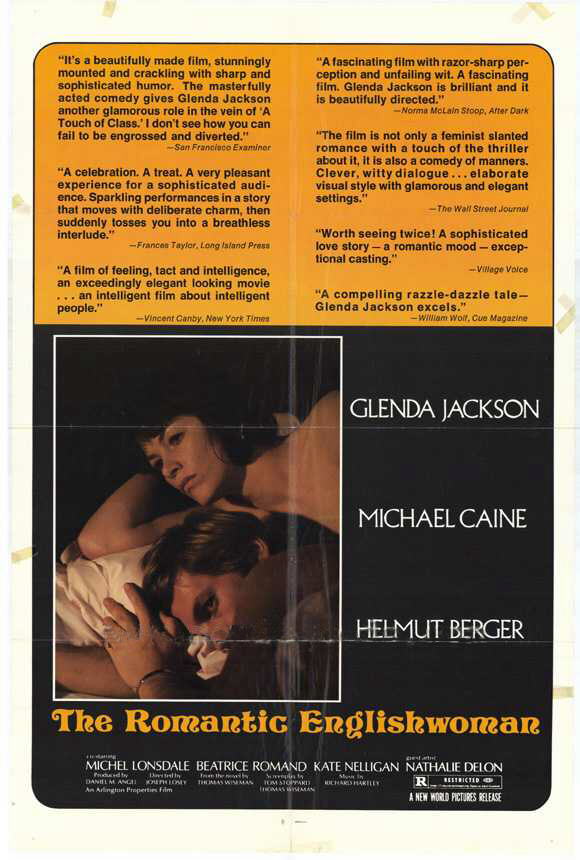
Films of Michael Caine #25: The Romantic Engishwoman

Cast: Glenda Jackson (Elizabeth), Michael Caine (Lewis), Helmut Berger (Thomas), Michael Lonsdale (Swan), Beatrice Romand (Catherine), Kate Nelligan (Isabel), Nathalie Delon (Miranda), Rene Kolldehoff (Herman), Anna Steele (Annie), Marcus Richardson (David).

Crew: Joseph Losey (director), Daniel M Angel (producer), Tom Stoppard and Thomas Wiseman (writers), Richard Hartley (music), Gerry Fisher (cinematography), Reginald Beck (editor), Richard MacDonald (production designer).

Synopsis: Bored English housewife Elizabeth goes on holiday to Baden-Baden in Germany. She meets Thomas, a handsome young gigolo who smuggles drugs. Elizabeth’s husband Lewis is a writer. He imagines her having an affair. Elizabeth returns home but her attempts to reconcile with Lewis are always interrupted. Thomas sees a man called Swan looking for him and flees Germany. The gigolo writes to Lewis and mentions meeting Elizabeth. Lewis invites the German to dinner, to Elizabeth’s annoyance. Lewis lets Thomas stay with them, employing the gigolo as a secretary. The writer bases a character in his new screenplay on Thomas. Lewis finds Elizabeth and Thomas having sex in the conservatory. The lovers flee to France, where Thomas resumes being a gigolo. He calls Lewis and tells him where Elizabeth is. Lewis drives to France, where he is followed by Swan. Swan finds Thomas and leads him away. Lewis takes Elizabeth back to Weybridge…

+++++++++++++++++++++++++++

Thomas Wiseman’s novel The Romantic Englishwoman was first published in 1971. The author collaborated with American-born director Joseph Losey on adapting the book. Losey had helmed noted pictures like The Go-Between (1970) and Accident (1967). Playwright Tom Stoppard then joined the project at the director request. ‘He hardly changed the structure … but he largely rewrote the dialogue,’ Losey told Sight & Sound in 1975.

For his leads the director cast Caine and double-Oscar-winner Glenda Jackson. Caine told Viva magazine he took the role to work with Losey and Jackson. He praised the latter as one of the most brilliant actresses in the world, but added: ‘You only enjoy it professionally with Glenda. She’s charming – but she doesn’t go to lunch, if you know what I mean.’ Losey proved even harder work. Caine bet £10 that he could make the director laugh at least once during filming. He lost the bet. The actor said the part of Lewis was unlike anything he had done before. ‘There was nothing of myself I could bring to that role, so I had to construct the character from the ground up. It was pure performance.’

The picture was filmed in England during Autumn 1974, with location work in Germany and France. Because the movie was being made during the wrong season, Losey shot the middle section first, then the ending and lastly the opening, to get the environments he wanted. This created some discomfort for Jackson, who had to appear naked outside at night for one scene. ‘A film set can be a very draughty place,’ she said in the film’s press book, ‘and a garden in the middle of November isn’t much fun either.’

In his autobiography Caine wrote that Jackson and her on-screen lover, Helmut Berger, seemed to hate each other on sight. Caine found himself acting as intermediary. The production was not a happy experience for him, nor was the end result: ’The film was not only very convoluted it was also downright grim...’ Losey’s first cut ran to 145 minutes, but the director removed near half an hour from this during editing.

The Romantic Englishwoman was released in British cinemas with an AA rating in 1975. Critics were underwhelmed and the response was just as poor in America, where it was rated R. The movie was released on video in 1986, reclassified as a 15, but has since been deleted. The film is available on Region 2 DVD.

Reviews: ‘The most complicatedly trivial film … a highly polished humbug.’ – Observer
‘Caine does well, very well indeed, as the sarky husband, considering that he’d fairly well limited to looking continuously irritated, exasperated and infuriated.’ – Evening Standard

Verdict: Near the beginning of this picture, a film producer describes a screenplay about a woman who goes off in search of herself. Michael Caine’s character describes it as pretentious, derivative and very boring – neatly summing up this movie. The Romantic Englishwoman is a domestic melodrama that tries your patience beyond belief. The three central characters are people you would never want to meet – let along spend two hours watching. Caine gets to shout and play drunk but injects no life into dull, tepid material. The film induces terminal ennui with its witless verbosity and drab visuals. Avoid.

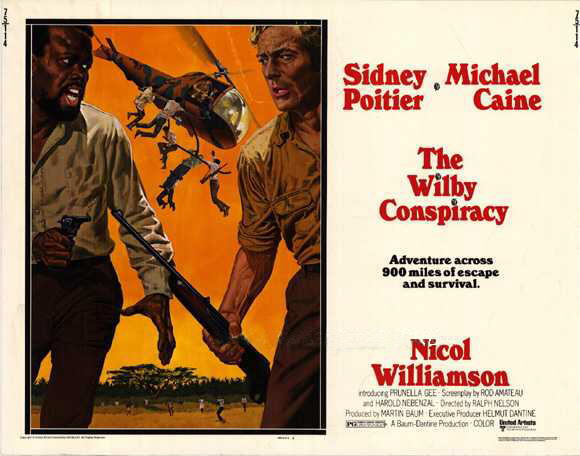
Films of Michael Caine #24: The Wilby Conspiracy

Cast: Sidney Poitier (Shack Twala), Michael Caine (Keogh), Nicol Williamson (Horn), Prunella Gee (Rina), Saeed Jaffrey (Mukarjee), Persis Khambatta (Persis), Ryk de Gooyer (Van Heerden), Rutger Hauer (Blane), Patrick Allen (District Commissioner), Joe De Graft (Wilby).

Crew: Ralph Nelson (director), Martin Baum (producer), Rod Amateau and Harold Nebenzal (writers), Stanley Myers (music), John Coquillon (cinematography), Ernest Walker (editor), Harry Pottle (production design).

Synopsis: In Capetown political prisoner Shack Twala is released after ten years in a South African jail, thanks to his lawyer Rina Van Niekirk. But within minutes the police try to arrest Shack and attack Rina when she tries to stop them. The pair escape with help from Rina’s new boyfriend, a British mining engineer called Jim Keogh. Shack and Keogh have to flee South Africa, but Shack insists on travelling via Johannesburg, 900 miles away. The fugitives are stalked by Major Horn from the Bureau of State Security. He murders a white man who helps the pair and dumps the body in their car boot. Keogh realises Shack is vice-chairman of Black Congress, a political group fighting against apartheid. The fugitives reach Johannesburg where Shack enlists the aid of Indian doctor Mukarjee to recover £750,000 of uncut diamonds. The stones will be used to further Black Congress’s cause. Keogh and Shack are reunited with Rina. She blackmails her estranged husband Blane into flying them across the border into Botswana. They land safely and are welcomed by Wilby, the chairman of Black Congress. But Horn arrives, intent on abducting Wilby and taking him back to South Africa to stand trial. Horn says Shack and Keogh were allowed to escape so they would lead him to Wilby. The uncut diamonds are just fakes. The Black congress members foil Horn’s plan and kill all his men. Keogh realises he can no longer be neutral and murders Horn…

+++++++++++++++++++++++++++

Peter Driscoll’s political thriller about racism in South Africa, The Wilby Conspiracy, was first published in 1972. Screenwriters Rob Amateau and Harold Nebenzal adapted it for the big screen, downplaying the political content and heightening the more cinematic chase element. Ralph Nelson was hired to direct the film, having twice helmed films starring Sidney Poitier. Their first collaboration, Lilies of the Field (1963), had won Poitier a best actor Oscar – the first black actor to be awarded this accolade. Poitier was chosen for the role of political activist Shack Twala, while Caine came on board as British tourist Jim Keogh.

Caine had experienced apartheid while filming Zulu on location in South Africa during 1963, and soon learnt to abhor them. Several years later he also experienced the effects of racism while shooting Hurry Sundown (1967) in the US state of Louisiana. The actor had no time for such attitudes, as his mixed race marriage to Shakira Baksh in 1973 showed. When the chance arose to star in an anti-apartheid thriller, Caine grabbed it.

The Wilby Conspiracy was unable to shoot in South Africa because of the film’s political content. Instead Kenya and Nairobi were used for seven weeks of location work during 1974, with studio sequences lensed at Pinewood back in Britain. The picture was Rutger Hauer’s first English-speaking role and gave a film debut to English actress Prunella Gee. In 1975 she told Film Review about making the movie. ‘As it was my first film, it was a bit of a strain. But Michael kept me doubled up with laughter most of the time. He is so funny. It was quite difficult to do some of the scenes for laughing.’

In Kenya Caine frequently found himself ignored while Poitier received all the adulation. But both actors almost made headlines for the wrong reason. They were filming a high speed scene in a jeep with a camera mounted to the front of the vehicle. The £35,000 camera jolted loose and flew through the empty windscreen, narrowly missing them.

The Wilby Conspiracy was released in Britain during the spring of 1975, rated AA. The picture got a mediocre reception from critics, uneasy at the mixture of politics and action. It reached America in July that year, rated PG. The Wilby Conspiracy was released on video 12 years later, reclassified as a 15. The tape has long been deleted in Britain but can still be found in the US. No DVD edition has yet been issued. {Update: The Wilby Conspiracy is now available as a Region 1 DVD.]

In his autobiography Caine said the picture was worthwhile, even without box office success: ‘This film was my first foray into that very risky realm of “message” pictures, and as such proved to be a bit ahead of its time, but I am still proud that I made it anyway.’ More than 20 years after The Wilby Conspiracy, Caine and Poitier were reunited to play the title characters in Mandela and de Klerk, a 1997 TV project about the end of apartheid in South Africa. The situation portrayed in their 1975 film had become part of history.

Reviews: ‘Somehow the story comes out too much of a pot-boiler undeserving of the fine work that Williamson, Caine and Poitier put into it.’ – Variety
‘Michael Caine has never been better, carrying off his role with a sense of humour that never interferes with the seriousness of the escapade.’ – Daily Express

Verdict: The Wilby Conspiracy is a curious mixture of chase film, buddy movie and political diatribe. It tackles the issue of racism with fervour, but loads the dice by portraying the white racists as evil sadists. There is also a crudity to the picture, with gratuitous nudity thrown in simply to titillate. But the strengths of the three leads and a sardonically humorous script ensure the film is never less than watchable. Nicol Williamson delivers a delightfully eccentric performance as the hunter Horn, while Caine and Poitier spark off each well as the fugitives whose fates are inextricably linked. The Wilby Conspiracy is an enjoyable movie, even if it employs a sledgehammer to make its point.

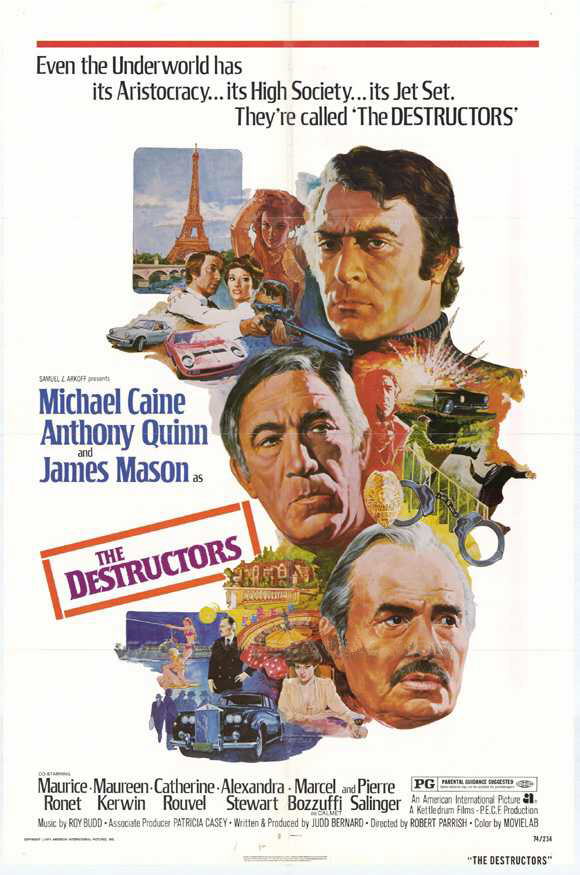
Films of Michael Caine #23: The Marseille Contract

(US title: The Destructors)
Cast: Michael Caine (John Deray), Anthony Quinn (Steve Ventura), James Mason (Jacques Brizard), Maurice Ronet (Briac), Alexandra Stewart (Rita Matthews), Maureen Kerwin (Lucienne Brizard), Catherine Rouvel (Brizard’s mistress), Marcel Bozzuffi (Calmet), Patrick Floerscheim (Kovakian), André Oumansky (Marsac), Georges Beller (Minierini).

Crew: Robert Parrish (director), Judd Bernard (producer and writer), Roy Budd (music), Douglas Slocombe (cinematography), Willy Kemplen (editor), Willy Holt (production designer).

Synopsis: In Marseilles an undercover agent for the American Drug Enforcement Agency (DEA) is murdered while trying to infiltrate the organisation of drug smuggler Jacques Brizard. The crime boss has political connections within France that protect him. The DEA boss in Paris, Steve Ventura, decides the only way to get Brizard is hire a professional assassin. French police inspector Briac arranges a meeting for Ventura with such a killer. The DEA man is surprised to find the hitman is an old friend, John Deray. Ventura gives Deray $50,000 to kill Brizard. The assassin infiltrates Brizard’s family by romancing the drug dealer’s beautiful daughter. Ventura learns Brizard is receiving a massive shipment of drugs soon. Brizard discovers Deray is an assassin and tries to have him eliminated. Deray and Ventura collaborate to bring down Brizard as he oversees the drugs shipment. Briac intervenes, planning to kill Brizard and steal the drugs. Briac and Deray die in a shootout but Brizard escapes. Ventura finds and silently murders Brizard…

+++++++++++++++++++++++++++

In the winter of 1973 producer Judd Bernard approached Caine with an offer – five weeks in a warm climate shooting a thriller with Anthony Quinn and James Mason. ‘It was just after my daughter [Natasha] was born, and to get her out of London in the winter into the south of France was wonderful,’ Caine told Time Out in 1992. ‘I never even read the script. I said: “I’ll fucking do this! I’m out of here!”’

The Marseille Contract was a $2 million movie written by Bernard and directed by American Robert Parrish, who had won an Oscar for editing Body and Soul (1947) before moving behind the camera. Caine said The Marseille Contract was a bad film ‘where I had the best bloody time in my life. We started off in Nice, went to Cannes, St Tropez and wound up in Paris.’ The picture was shot almost entirely on location, with post-production at Pinewood in England. It reunited Caine with cinematographer Douglas Slocombe and stunt driver Remy Julienne, both of whom had worked with him on The Italian Job (1969).

In his 1988 book Hollywood Doesn’t Live Here Anymore, Parrish recalled making the film. ‘It was a pleasure working with James Mason, Michael Caine, and Anthony Quinn. We all tried, but sometimes you win and sometimes you lose.’ The director also wrote about a studio representative on the film insisting that a main character share his initials. The representative demanded the actor playing that character be dressed in expensive monogrammed shirts, and possess a nine-piece set of monogrammed luggage from Louis Vuitton. The representative acquired all of these when shooting concluded.
The BBFC required cuts before passing the film with an A certificate in August 1974. Critics were less than impressed by the results. In America the picture was cryptically renamed The Destructors and rated PG, but also failed to catch fire. It was released on video in 1984 in the US and two years later in Britain, reclassified as a 15. Both tapes have long since been deleted and the film is not available on DVD.

Reviews: ‘A thriller that throws most of the current clichés – crashing cars, bouncing motorbikes, vigilante cops – into one uneasy story and comes up with not very much.’ – Sunday Telegraph
‘The plot … allows Mr Caine to make love and shoot a few people. But judging by his one expression, I’m not sure which he preferred.’ – Daily Mirror

Verdict: The Marseilles Contract is cut-rate thriller material laced with first-rate actors. A slight script never engages you while the actors meander through the action, waiting for their pay packet to arrive. Slocombe’s cinematography gives the picture a look far better than the production’s limited budget or imagination deserves. There’s a spectacular sequence arranged by Julienne with two speeding vehicles playfully duelling on a tight, twisting mountain round that is replicated in the James Bond film Goldeneye (1995). Otherwise, this film offers little of interest. Caine may play an assassin dressed like Jack Carter, but he spends much of his time on-screen grinning like a Cheshire cat. You will probably not share his enthusiasm.

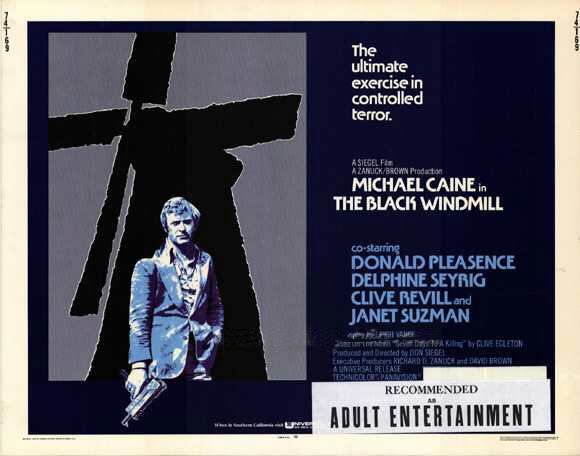
Films of Michael Caine #22: The Black Windmill

Cast: Michael Caine (Major John Tarrant), Donald Pleasence (Cedric Harper), Delphine Seyrig (Ceil Burrows), Clive Revill (Alf Chestermann), John Vernon (McKee), Joss Ackland (Chief Superintendent Wray), Janet Suzman (Alex Tarrant), Catherine Schell (Lady Julyan), Joseph O’Conor (Sir Edward Julyan), Dennis Quilley (Bateson).

Crew: Don Siegel (director and producer), Leigh Vance (writer), Roy Budd (music), Ousama Rawi (cinematography), Antony Gibbs (editor), Peter Murton (art direction).

Synopsis: Major John Tarrant is an MI6 operative trying to infiltrate a ring of saboteurs run by Ceil Burrows and a man called McKee. They kidnap Tarrant’s young son David and demand a ransom of £517,057 in uncut diamonds. That is exactly the amount previously purchased earlier by Tarrant’s boss, Harper. The only people with knowledge of the diamonds are Tarrant, Harper and the General Purposes Committee, headed by Sir Edward Julyan. Burrows and McKee plant evidence to frame Tarrant. The government refuses to pay the ransom so Tarrant steals the diamonds and takes them to a rendezvous in Paris. The major is knocked out and drugged, losing the diamonds. Tarrant is found by French police, lying unconscious beside Burrows’ corpse. He is charged with her murder. McKee helps Tarrant escape custody and tries to have him killed. Tarrant returns to London and traces his son to a black windmill in Sussex. Realising one of the committee members must be involved, Tarrant calls all of them with a message that will lure the traitor to Sussex. Sir Julyan takes the bait. Tarrant storms the windmill, kills McKee and rescues his son…

+++++++++++++++++++++++++++

The Black Windmill began life as Seven Days to a Killing, a 1973 novel by Clive Egleton. Leigh Vance adapted it into a screenplay for American director/producer Don Siegel. He came to England in 1973 to make The Black Windmill after 30 years helming high calibre action films, such as Invasion of the Body Snatchers (1956) and Dirty Harry (1971). he director a film that explored the archetype again. In the movie’s press book, Siegel stated his first and only choice for the part of Tarrant was Caine. ‘There are actors who are tougher, more handsome, more emotive, but there was only one with a centre solid enough to convey the very complex undertones of this role.’

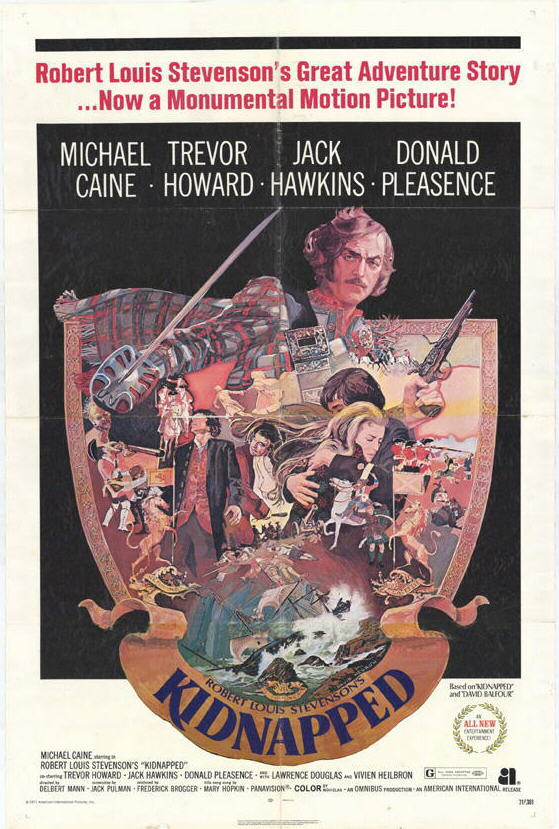
Caine took the film for the opportunity to work with Siegel. ‘I grew up with his films,’ the actor said in the press book interview. ‘The Black Windmill is a dramatic, suspense plus love story.’ The 11-week shoot began in August 1973, using the working title Drabble. Filming was predominantly location-based at sites in England and France, with some studio work at Twickenham. The picture reunited Caine and Donald Pleasance, who had worked together on Kidnapped (1971).

The Black Windmill was released in 1974, rated A in the UK and PG in the US. Critics considered it one of Siegel’s lesser works. Emma Andrews’ 1978 book The Films of Michael Caine quotes the actor on why the picture did not live up to its promise: ‘I think the gentility of England rubbed off on Don Siegel… It became too sentimental and convoluted.’ The film has never been available on VHS or DVD in Britain, but an American video was released in 1986. [Update: a REgion 2 DVD was released in 2005.]

Reviews: ‘Don Siegel’s filmmaking takes a dip in The Black Windmill … the production fizzles in its final half hour.’ - Variety
‘Slick, craftsmanlike but general undistinguished thriller … Siegel has done better.’ – Maltin’s

Verdict: The Black Windmill is a routine espionage thriller that never surprises. Siegel’s direction is efficient and workmanlike, while Caine gives a taut, controlled performance as Tarrant. But the film’s attempts to create suspense and misdirect the viewer’s suspicions never grip or convince. The Roy Budd music reeks of the 1970s and strongly evokes a later British TV espionage series, The Professionals. Bodie and Doyle would not have looked out of place in The Black Windmill and might well have enlivened the film. This is a minor work in the careers of almost everyone involved.

Sunday, November 26, 2006

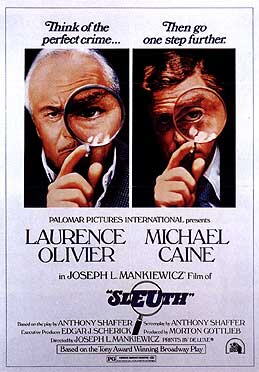
Films of Michael Caine #21: Sleuth (1972)


Cast: Laurence Olivier (Andrew Wyke), Michael Caine (Milo Tindle), Alex Cawthorne (Inspector Doppler).

Crew: Joseph L Mankiewicz (director), Morton Gottlieb (producer), Anthony Shaffer (writer), John Addison (music), Oswald Morris (cinematography), Richard Marden (editor), Ken Adam (production design).

WARNING! IF YOU HAVEN'T SEEN SLEUTH, DON'T READ ANY FURTHER!

Synopsis: Milo Tindle accepts an invitation to visit the country estate of English crime novelist Andrew Wyke. Milo is having an affair with Andrew’s wife, Marguerite, and wants to marry her. Andrew questions the younger man’s background and financial circumstances. He says Milo cannot afford to keep Marguerite, but the problem can be solved. Andrew persuades Milo to stage a burglary, stealing £250,000 of insured jewels from the house. But afterwards Andrew says this is all a ruse so he can murder Milo and claim the killing was self defence. The writer shoots several bullets from a revolver to prove he is serious before viciously humiliating Milo. Finally, he fires the revolver into the back of Milo’s head. Two days later, a policeman called Inspector Doppler arrives, investigating the disappearance of Milo. He interrogates Andrew and discovers dried blood. The writer claims it was all an elaborate double-bluff to humiliate Milo, but insists the final bullet was a blank.

The inspector arrests Andrew before peeling away his own face to reveal that Doppler is actually Milo. Andrew claims he knew that and was just playing along with the game. Milo says he doesn’t want to play a game – he wants revenge. Milo claims he murdered Andrew’s mistress and then hid four pieces of evidence in the house linking the writer to the crime. The police are due within minutes. Andrew doesn’t believe him, but when he tries to contact his mistress he learns she is dead – strangled. Andrew frantically searches to find all the clues, eventually locating and destroying the murder weapon. Milo reveals this was just another game. Andrew’s mistress is still alive. Milo taunts the author, telling him Marguerite is never come back. Andrew murders Milo but loses their final game – the police are outside, waiting to arrest him…

+++++++++++++++++++++++++++

Anthony Shaffer’s play Sleuth opened in 1970 and became a success on London’s West End, running for nearly 2400 performances. The show was also a smash hit on Broadway in New York, winning a Tony award. But Shaffer didn’t want his script turned into a film, believing any cinema version would stifle the play’s future success. He was persuaded to surrender the film rights and American director Joseph L Mankiewicz began working with Shaffer on an adaptation. Mankiewicz had won Oscars for writing and directing All About Eve (1950), and also for helming A Letter to Three Wives (1949). The two men added new material to keep Sleuth fresh for those who had already seen the play.

Sleuth only had a cast of two, so choosing the right actors was crucial. For the part of Andrew Wyke Shaffer favoured Anthony Quayle, who had originated the role on stage, and Alan Bates as Milo Tindle. Instead Mankiewicz secured the legendary Laurence Olivier as Wyke, even though the actor had once dismissed the play as ‘a piece of piss’. Olivier reportedly chose Caine to be his co-star. The two actors rehearsed for a fortnight before filming began. In an interview on the Sleuth DVD, Shaffer recalls the younger man was frightened of playing opposite the veteran. ‘Michael Caine was really scared about working with Larry Olivier,’ Shaffer says. ‘He thought Olivier would overwhelm him.’

In fact Olivier struggled for the first few days of rehearsals, having just been fired from the National Theatre. Caine talking about the turning point during a public interview at the NFT in 1998: ‘One day he came in with a little moustache and he stuck it on, and suddenly it all went right. He said: “I can never act with my bloody face! I have to have some bloody nose, or something on, and this will do.” But up until then he was floundering about, not know what he was talking about. Larry was crafty. He would do rehearsals, and he’d mumble away and then suddenly he could be this absolute giant of an actor, although he was shorter than me. Sometimes he’d come out of the bloody shadows, like a whirlwind at me, and take me completely by surprise, because he’d never do it in rehearsals. He was a very craft bugger, Larry, and you had to hang on. The greatest review I ever got was after about a week [of filming with Olivier]. He said to me, “I thought at the beginning, Michael, I had a servant. I see I have a partner.”’

Sleuth was shot during Spring 1972. All the exteriors were filmed at Athelhampton House in Dorset, with production designer Ken Adam temporarily adding a hedge maze to the grounds. The interiors were shot on elaborate sets at Pinewood Studios. ‘Ken Adam is a brilliant designer,’ Caine told the Evening Standard when a reporter visited the production in May 1972. ‘He’s given a very weird feeling to the sets. And that’s real oak, you know, in the hall, not a load of old plastic.’

In 1980 Caine told Film Comment that the 16-week shoot for Sleuth was the most exhausting film he had worked on. ‘Incredibly tiring. I’d have six-minute monologues at a time. I used to get home in the evening and say to Shakira, my wife, “I really can’t talk now. I’m sick of the sound of my voice. I don’t want to hear it again. You tell me everything, but don’t ask me any questions. Let me just sit here and listen.”’ With a cast of only two, neither actor could take a day off. Mankiewicz had to shot coverage of everything to give the editor pictures to cut to.

Sleuth was released in American cinemas with a PG rating during December 1972, just in time for consideration at annual awards ceremonies. The picture attracted raves from critics and nominations for Caine, Olivier and best picture at the Golden Globes. At the Oscars Caine and Olivier were both nominated as best actor, but were beaten by Marlon Brando’s performance in The Godfather (1972). Mankiewicz was nominated as best director for what proved to be his final film, while the score was also nominated.

Sleuth didn’t reach British cinemas until 1973, when it was rated AA. Reviews were strong, with many complimenting Caine for matching Olivier on screen in such a demanding part. The film eventually received four BAFTA nominations for Olivier, cinematography, art direction and screenplay. A late night screening of the film inspired a Manchester singer called Morrissey to write ‘This Charming Man’, providing his band The Smiths with their first hit single. The song borrowed a line of dialogue from Shaffer’s screenplay: ‘A jumped up pantry boy who never knew his place.’ ‘This Charming Man’ reached Number 25 in November 1983 and peaked at Number 8 when re-released in 1992.

Sleuth was released on video in 1987 and made its DVD debut in 2002. Shaffer died in November 2001, soon after recording his interview for the DVD. In November 2002 Caine told the Hollywood Reporter he was hoping to remake Sleuth with himself in Olivier’s role and British actor Jude Law taking over Caine’s part. Six months later Variety reported US filmmaking company Castle Rock had acquired the film rights to Shaffer’s play as a vehicle for Law. Playwright Harold Pinter had been commissioned to write a fresh adaptation, having never seen the 1972 film version. The report suggested Caine might co-star with Law in the new adaptation.

Reviews: ‘Although brilliantly plotted, flawlessly constructed, genuinely thrilling and more than usually attentive to character, Sleuth is essentially a piece for the theatre...’ – MFB
‘Mr Caine, with the help of spectacular make-up, shows a range of which one had not expected from this excellent player of layabouts and secret agents.’ – The Sunday Times

Verdict: Sleuth is a flawed diamond of a film – a priceless gem with sparkling dialogue, stunning production design, and two bravura performances from Olivier and Caine. But it still has blemishes. Mankiewicz’s film never truly escapes the theatricality of its source material. The middle section fails to convince because Inspector Doppler is all too obviously Caine in makeup, especially when the wrinkles on his forehead abruptly stop at the front edge of his bald cap. This distracts your attention and makes it difficult to discern whether or not Olivier’s character believes in Doppler. But Sleuth overcomes these problems to deliver a compelling thriller riddled with sly asides about prejudice, the class system and gamesmanship. This film is among the finest of Caine’s long career.

Saturday, November 25, 2006

Films of Michael Caine #20: Pulp (1972)


Cast: Michael Caine (Mickey King), Mickey Rooney (Preston Gilbert), Lionel Stander (Ben Dinuccio), Lizabeth Scott (Betty Cippola), Nadia Cassini (Liz), Dennis Price (The Englishman), Al Lettieri (Miller), Leopoldo Trieste (Marcovic), Amerigo Tot (Partisan), Roberto Sacchi (The Bogeyman), Giulio Donnini (Typing Pool Manager), Joe Zammit Cordina (The Beautiful Thing), Luciano Pigozzi (Clairvoyant).

Crew: Mike Hodges (director), Michael Klinger (producer), Mike Hodges (writer), George Martin (music), Ousama Rawi (cinematography), John Glen (editor), Patrick Downing (production designer).

Synopsis: Mickey King is a pulp fiction author living in the Mediterranean. He is asked to ghost-write a famous person’s autobiography by a man called Dinuccio, but not given the name of his subject. Instead King is sent on a five day coach tour and told he will be contacted. The writer thinks an American called Miller is the contact. Instead King is met by a beautiful woman who takes him to meet the subject of the book. Preston Gilbert was a Hollywood star who appeared in dozens of films as a gangster before being deported to Europe. He dictates his memoirs to King in a week. Afterwards Gilbert organises a lunch for his friends and King at a restaurant. Gilbert is murdered by a man disguised as a priest, but King survives. A clairvoyant gives the writer clues about why somebody wanted to kill the former film star. Gilbert was involved with a scandal years earlier about a teenage girl who died at a hunting lodge while being raped by hunters. The others believed Gilbert was going to mention the incident in his autobiography. King goes to a beach where the girl’s body is buried. The hitman reappears, gunning for the author. King runs him over with a truck, discovering the assassin was Miller. The writer realises he has been shot in the leg. King is taken in and cared for by a powerful political family that was involved with the scandal. He is warned to stay silent or else he’ll be charged with killing Miller…

++++++++++++++++++++++++++++++++++++++++++++

A trio of Michaels – Caine, Hodges and Klinger – had startled cinema patrons with the brutal realities of Get Carter (1971). A year after that film, the three men reunited for Pulp (1972). This was made from an original screenplay by Hodges, with the working title Memoirs of a Ghostwriter. ‘I wanted to do something light, as a bookend to Carter, to get away from the violence,’ Hodges told interviewer Steven Paul Davies for the book Get Carter and Beyond: The Cinema of Mike Hodges. ‘Mind you, my humour might be described as very surreal and rather bleak.’

The plot about a young girl found dead on a beach was based on a scandal that rocked Italian society in the 1950s. Hodges’ script was also prompted by the rise of neo-fascism in Italy in the early 1970s. The director said Pulp’s off-beat style was inspired by John Huston’s film Beat the Devil (1954). American studio United Artists agreed to help finance Pulp. Hodges went to Italy on a research trip. But when the location manager try to secure the locations chosen by Hodges, they found themselves dealing with the Mafia. The director had a house on Malta and suggested the Mediterranean island as a new home for the production. The film was shot entirely on location during the winter of 1971-1972.

At the time Caine told journalists he did not enjoy working on Malta, complaining about the barren landscape and lack of trees. When asked what no visitor to the island should miss, the actor’s reply was short and pithy: ‘The plane home.’ Twenty years later, Caine had a different recollection of the movie in his autobiography. ‘Pulp never made any real money, but I … had a wonderful experience making it so I remember it with affection.’

Pulp was released in 1972, rated AA in Britain. Critics were bemused by the movie and it failed at the box office. Reviews were stronger in America but the film never got a chance to capitalise on them, quickly disappearing from cinemas. Sixteen years later it was released on video in the US, but has since been deleted. The picture has never been released on VHS or DVD in Britain. [Update: Pulp was finally released on Region 2 DVD in 2004.]

Mike Hodges declined to be interviewed at length for this book, but did talk about Pulp’s unhappy fate: ‘It puzzles and saddens me why it’s not on video of DVD. Some films seem to just get lost in the shuffle. Pulp is one. On the other hand Black Rainbow [a much praised but rarely seen Hodges film from 1990] is about to come out on DVD – so you never know! In a recent exchange of letters with J G Ballard, he voiced his love of Pulp. I’ve noticed that writers, in particular, like it.’

Reviews: ‘Hodges has not only got his distance in Pulp, he has also found a style and voice of his own. Always an adept actor, Caine is splendid here.’ – Time
‘A reasonably entertaining piece of rococo recall … at its best as visual camp. Caine … delivers his usual attractive turn.’ – Variety

Verdict: The word quirky could have been invented to describe Pulp. It shares plot similarities with Get Carter (1971), but it’s hard to imagine two more different movies. The first twenty minutes is a flurry of running gags and visual humour, with Caine’s world-weary voiceover a witty counterpoint to the on-screen action. After that, the movie settles into a slightly more conventional tale. The tone is uneven, but Hodges keeps driving the story forward fast enough to overcome this. There’s a succession of sub-textural references to the conventions of pulp fiction and cinema that are worthy of a thesis, but it’s the performances of Caine and Rooney that bring the film alive. Pulp is a cult movie in waiting.

Friday, November 24, 2006

Films of Michael Caine #19: Zee & Co (1972)

(US title: X, Y & Zee)

Cast: Elizabeth Taylor (Zee), Michael Caine (Robert), Susannah York (Stella), Margaret Leighton (Gladys), John Standing (Gordon), Mark Larkin (Rita), Michael Cashman (Gavin).

Crew: Brian G Hutton (director), Jay Kanter and Alan Ladd Jr (producers), Edna O’Brien (writer), Stanley Myers (music), Billy Williams (cinematography), Jim Clark (editor), Peter Mullins (art direction).

Synopsis: Swinging Londoners Robert and Zee Blakeley have an open marriage and separate bedrooms. At a party Robert is intrigued by Stella, a beautiful young widow. They become lovers. Zee responds by insinuating herself into Stella’s life. When Robert and Stella go away on holiday, Zee crashes her husband’s car. He comes back to her again. Zee tries to commit suicide. Robert saves her but considers letting Zee die to escape her mind games. Stella visits Zee in hospital and admits to lesbian tendencies as a teenager. Robert is due to spend the night with Stella but Zee drags him to a party and gets him drunk. Next day Robert argues with Stella, who wants to end the affair. Robert sleeps with his secretary. Zee visits Stella’s new flat and seduces her. Robert arrives to find Zee triumphant…

Irish novelist Edna O’Brien wrote Zee and Co as an original screenplay in 1970. The strong female lead character attracted the interest of Elizabeth Taylor, at the time a major cinema star. American director Brian G Hutton was attached to the project. The role of Zee’s husband Robert was offered to Caine, after Peter O’Toole turned it down. Susannah York was chosen to play Robert’s mistress Stella. In his autobiography Caine says the chance to work with Taylor was his main reason for accepting the role, but he never regretted making the movie. O’Brien had the opposite reaction after discovering her script had been extensively rewritten to include a lesbian finale. The enraged author claimed Hutton had butchered her screenplay.

The picture was shot predominantly on sets at Shepperton Studios with limited location work around London. The 14-week production began filming in January 1971. When Taylor was on-set she arrived with at least three limousines to carry her entourage. During filming Caine told the Evening Standard about his early experiences on the picture. ‘When we began this film both Elizabeth and I were nervous of each other. It was difficult because we had to go right into fights and love scenes rolling around the bed and we never even knew each other. But after the first couple of days we admitted that we were nervous. I gave her a bit of a hug – you know, not being familiar, but just to make human contact and we were fine after that.’

The actor discussed Taylor during an interview with the Cranky Critic website in 1998. ‘She was the most extraordinary actress to work with. Elizabeth has a memory like a rat trap. She never flubbed a line. With Elizabeth, she had it in her contract that she didn’t have to be in the studio until 10 o’clock. I was always there at eight doing close-ups on my own with a continuity girl saying, “I love you darling. Take your trousers off.” I remember saying to Elizabeth, “I know for sure that you are a great star and a real professional.” She said, “How do you know?’ I said, “You are a great star because you don’t have to get here until 10 o’clock and I know you are a professional because you are never late!”’

The picture required Caine to perform love scenes, but he refused to be filmed naked. ‘I think the public is sick of it,’ the actor told Photoplay Film Monthly. ‘I’ve never been fully nude on the screen because I don’t believe I have anything that anyone would be interested in seeing. Nudity isn’t interesting unless a girl is undressing for me, personally.’

Zee and Co was released during January 1972 as an R-rated film in America, renamed X, Y & Zee. Critics praised the picture, with Taylor’s volcanic performance getting most of the kudos. The film reached British cinemas several months later, rated X. It was nominated as the best English-language foreign film at the Golden Globes in January 1973, but lost to Young Winston (1972). A year later the picture was re-edited and reclassified as a PG for the US. Zee and Co has never been released on video in Britain and is not available on DVD.

Reviews: ‘Not in years have three people more deserved the star billing they get in this Love Story for adults.’ – Variety
‘The film gradually sinks into a quagmire of repetition from which the only way out is through melodrama...’ – MFB

Verdict: Few of Caine’s films have dated as badly as Zee and Co. This hysterical, overwrought melodrama is ripe with symptoms of a Swinging 1960s hangover. Try to imagine a cross between Austin Powers and Who’s Afraid of Virginia Woolf? – then make it twice as bad. Taylor chews scenery like the world has run out of food, while parading around in clothes that make you beg to be struck colour blind. Susannah York is both drippy and winsome while Caine is left looking angry or frustrated in equal measure. You can’t care about the characters but you can laugh at their turgid, torpid love triangle. This film deserves to be enshrined as a camp classic – there’s certainly no other reason to watch it.

Thursday, November 23, 2006

Films of Michael Caine #18: Kidnapped


Cast: Michael Caine (Alan Breck), Lawrence Douglas (David Balfour), Vivien Heilbron (Catriona Stewart), Trevor Howard (Lord Advocate), Jack Hawkins (Captain Hoseason), Donald Pleasance (Ebenezer Balfour), Gordon Jackson (Charles Stewart), Freddie Jones (Cluny), Jack Watson (James Stewart), Peter Jeffrey (Riach), Roger Booth (Duke of Cumberland), Geoffrey Whitehead (Lt Duncansby).

Crew: Delbert Mann (director), Frederick Brogger (producer), Jack Pulman (writer), Roy Budd (music), Paul Beeson (cinematography), Peter Boita (editor), Vetchinsky (art direction).

Synopsis: Scotland, 1746. In the aftermath of the battle at Culloden, Jacobite rebels are fleeing the forces of King George. The Stuart claim to the British throne is in tatters. Soon afterwards teenager David Balfour arrives at the House of Shaws, home of his uncle Ebenezer. The old man tries to arrange an accidental death for David. When that fails, Ebenezer has David kidnapped by a slave trader, Captain Hoseason. The 18-year-old is to be sold as a slave in America. But Hoseason’s ship runs over a boat carrying Alan Breck. The rebel leader was trying to reach a vessel bound for France. Hoseason’s ship crashes against rocks, throwing Breck and David into the water. The pair make it to shore and start walking to Edinburgh. David and Breck see innocent women and children murdered by government forces led by Mungo Campbell. They stop at the home of James Stewart, a former Jacobite. David is smitten by James’s daughter, Catriona. Next morning Mungo Campbell and his men come for James. Mungo is murdered by an unseen assassin and James is wounded. David, Breck and Catriona flee. Later they hear James survived and is going to stand trial in Edinburgh for murdering Mungo Campbell. David goes to the Lord Advocate and tries to give evidence that James is innocent, but the Lord Advocate refuses to listen. Unless Breck is captured, James will be found guilty in his place and executed. David inherits the House of Shaws after Ebenezer dies. Catriona begs David not to give evidence, or she will lose him and her father. Breck admits he killed Mungo Campbell. The Jacobite rebel surrenders himself, saving James…

In 1971 American director Delbert Mann was hired to shoot a new version of the much loved Robert Louis Stevenson novel Kidnapped. The tale had already been adapted for the cinema three times before, so the production sought a new approach. Screenwriter Jack Pulman drew on both Kidnapped and Stevenson’s sequel Catriona (also known as David Balfour) for his plot. Mann told Film Making magazine that most literary scholars considered the books had to be read together to be fully acceptable as classic novels: ‘Each depends on the other to give the reader full enjoyment.’

The movie was shot on location in Scotland over the Summer of 1971, using the working title of David and Catriona. Fresh from filming Get Carter, London-born Caine was cast in the unlikely role of Jacobite rebel Alan Breck. Mann said using a famous actor was important for a healthy box office. ‘Stars do still have a pull on the public. Michael, for example, is one star who can get the public in on his name!’ Stirling Castle stood in for Edinburgh Castle during the shoot, while the township of Kinross took of the place of Edinburgh circa 1746. Studio work was lensed at Pinewood, near London.

In the film’s official press book, Caine said he wanted to play Breck because Kidnapped would be seen by a far wider audience than most of his previous films. ‘It has a marvellous script by Jack Pulman, which is another reason why I accepted the part. Of course, I’ve had to adapt my Scots accent to make it sound easy and natural. It won’t fool the Scots, but I trust they’ll forgive me. After all, it’s my job to make Alan Breck easily understood by audiences all over the world.’

The funding for Kidnapped run out during filming and producer Frederick Brogger struggled to keep the cameras rolling long enough to finish. Caine deferred his salary to help the film stay solvent. Nobody was fully paid for the picture, and Caine rarely discusses Kidnapped. William Hill’s biography, Arise Sir Michael Caine, quoted the actor on the troubled production: ‘I never got paid for it so I refuse to discuss it. I’m a professional, and if I don’t get paid I don’t talk about it. They made it when they didn’t have the money to make it. I got a small percentage just so they would be able to release it, to get at least some money back on it. It was an absolute and utter disaster from beginning to end.’

The picture reached British cinemas in 1972, renamed Kidnapped and rated U. Critics were underwhelmed, but found praise for Caine’s acting, if not his accent. The film was not a box office success in the UK or the US, where it was rated G. Kidnapped was released in VHS in Britain during 1986 but has been deleted for more than a decade. It is much sought after by Caine collectors. The movie has never been available on DVD. [Update: Kidnapped was fleetingly released on DVD in 2005 and quickly deleted.]

Reviews: ‘Perhaps the fact that everyone eats so much porridge renders the script so constipated.’ – The Guardian
‘Disappointing version of Stevenson tale is made endurable by Caine’s pleasing performance as Alan Breck.’ – Maltin’s

Verdict: Kidnapped is a plodding adaptation of Robert Louis Stevenson’s interlinked novels that never gets out of second gear. Some nice scenery and a few skirling bagpipes cannot make up for the lack of excitement generated by this workmanlike effort. The central characters stroll around Scotland, searching for the end of the film. Part of the problem lies with source material that has never been made into a successful movie, despite numerous attempts. Caine does his best as Highland adventurer Alan Breck, but struggles to master a Scottish accent. At least his presence gives this drab, lifeless picture some much-needed novelty value.