Every episode of CSI Miami starts with David Caruso uttering some bizarre line before The Who start screaming over the title sequence. Now some genius has cut more than seven minutes of Caruso-saying-half-a-line, putting-on-his-sunglasses, and saying-the-rest-of-the-line madness together on YouTube. Barmy.
Monday, November 20, 2006


Script for Fiends: Stalingrad #8
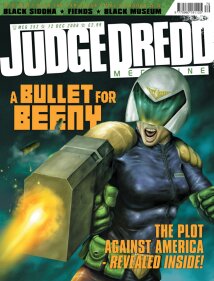
The latest issue of the Judge Dredd Megazine features the final part of FIENDS OF THE EASTERN FRONT: Stalingrad, written by me and illustrated by Colin MacNeil. Here's the script I wrote for the episode. You can have fun comparing and contrasting this with the published story, to see how Colin improved upon my suggestions. [Obviously, if you haven't seen the published episode yet, reading the script below may spoil the story for you!] Tomorrow, I'll publish the synopsis on which the Stalingrad story was based - it's amazing how much it changed in the telling...
FIENDS OF THE EASTERN FRONT: STALINGRAD #8 • Script: David Bishop • Art: Colin MacNeil • 6pp
PAGE ONE
1. A large panel, filling the left hand side of the page and depicting the Motherland statue that now stands atop the Mamayev Kurgan. February snow covers the hilltop but a few tourists are still climbing the steps up to the monumental statue. Leave room at the top for caption boxes, and at the foot of the page for the logo and credits.
CAPTION:
FEBRUARY 2, 1968. ATOP THE MAMAYEV KURGAN STANDS THE MOTHERLAND, A MEMORIAL TO ALL THOSE WHO DIED FIGHTING FOR STALINGRAD.
CAPTION:
SOME BELIEVE THE STATUE WILL COME ALIVE TO PROTECT US IF THE CITY’S EVER ATTACKED AGAIN.
TITLES: FIENDS OF THE EASTERN FRONT: STALINGRAD #8
2. The first of four landscape panels, stacked on the right hand side of the page. A lone figure stands in front of the statue, dwarfed by one of its massive feet. The figure is Mariya, wrapped up against the winter cold.
CAPTION:
IT’S TWENTY-FIVE YEARS SINCE I CAME FACE TO FACE WITH EVIL AND SURVIVED.
3. Profile view of 46-year-old Mariya’s careworn face and greying hair. She’s looking right to left across the panel. Leave room for captions.
CAPTION:
TWENTY-FIVE YEARS OF NIGHTMARES AND MEMORIES THAT REFUSE TO DIE…
4. Flashback to 1943. Profile view of 21-year-old Mariya’s young face and dark hair, inside the tent. She’s looking left to right across the panel.
CAPTION:
FEBRUARY 2, 1943.
MARIYA:
WAS CONSTANTA KILLED IN THE EXPLOSION?
5. Looking down past the microphone in the tent as Mariya demands answers from the blind Richter.
RICHTER:
NOTHING HUMAN COULD SURVIVE THAT.
PAGE TWO
1. NKVD Lieutenant Kamyen listens to the interrogation via headphones in another tent nearby, as seen in Part One.
JAG BALLOON:
BUT CONSTANTA WASN’T HUMAN.
2. Back to Richter, pleading with Mariya. Leave room for dialogue.
RICHTER:
EVEN IF HE DIED, THERE ARE MANY MORE LIKE HIM HELPING THE WEHRMACHT.
LINK:
I KNOW THEIR SECRETS. IF THIS PRISONER EXCHANGE GOES AHEAD, I’M A DEAD MAN.
3. Mariya folds her arms, unconvinced.
MARIYA:
HOW DO I KNOW YOU’RE NOT CONSTANTA? OUR ONLY DESCRIPTION OF HIM CAME FROM YOU.
4. Richter stands up, his chair tipped over, shouting at Mariya.
RICHTER:
GOTTEN HIMMEL, WHY WOULD I LIE? I’M BEGGING FOR YOUR PROTECTION!
5. Richter holds out his arms, palms upwards, towards Mariya.
RICHTER:
I’LL TAKE ANY TEST YOU CHOOSE TO PROVE I’M NOT VAMPYR, THAT I’M AS HUMAN AS YOU!
6. Mariya scowls in the foreground. Beyond Kamyen opens the tent flap.
KAMYEN:
[THE GERMANS ARE HERE FOR RICHTER.]*
CAPTION:
* TRANSLATED FROM RUSSIAN.
PAGE THREE
1. Kamyen walks toward Richter, cocking a pistol. Mariya is surprised.
MARIYA:
[WHAT ARE YOU DOING, LIEUTENANT?]
KAMYEN:
[GETTING THE ANSWERS YOU COULDN’T!]
2. Kamyen has pushed Richter to the ground and is pressing the pistol to the German soldier’s head.
KAMYEN:
WHAT HAPPENED TO THE GOLEM? TELL ME!
RICHTER:
PLEASE… I DON’T KNOW…
3. Kamyen executes Richter with a bullet through the head.
NO DIALOGUE
4. Mariya approaches Kamyen, who has his smoking pistol in plain view.
MARIYA:
[WHY EXECUTE HIM?]
KAMYEN:
[HE’S OF NO FURTHER USE – ALIVE.]
5. Mariya protests at the lieutenant’s action.
MARIYA:
[BUT HIS TESTIMONY ABOUT CONSTANTA, ABOUT VAMPYR HELPING THE ENEMY--]
KAMYEN:
[NAZI PROPAGANDA, DESIGNED TO CREATE FEAR AND CONFUSION.]
6. Kamyen crouches by Richter, ripping away the dead man’s ID disc.
KAMYEN:
[I COULDN’T LET HIM SPREAD ANY MORE LIES.]
PAGE FOUR
1. Looking down past Mariya to the kneeling Kamyen by Richter’s body.
KAMYEN:
[YOU DIDN’T BELIEVE RICHTER, DID YOU?]
2. Looking up past the pistol in Kamyen’s hand to a fearful Mariya.
MARIYA:
[N-NO, OF COURSE NOT...]
3. Kamyen looms over Mariya while pointing at Richter. Her Star of David emblem has escaped from inside her uniform and rests on her chest.
KAMYEN:
[GET HIS UNIFORM OFF – QUICKLY!]
4. Kamyen brandishes a letter while Mariya strips the corpse.
KAMYEN:
[THIS IS A LETTER FROM STALIN, AUTHORISING ANY AND ALL ACTIONS I CONSIDER NECESSARY FOR MY MISSION.]
5. Kamyen removes his cap.
KAMYEN:
[YOU WILL FORGET EVERYTHING YOU’VE HEARD ABOUT CONSTANTA, VAMPYR AND THE GOLEM.]
6. Kamyen removes his glasses.
KAMYEN:
[LIEUTENANT KAMYEN IS NO MORE. YOU’LL DENY MEETING HIM. HE NEVER EXISTED.]
PAGE FIVE
1. Mariya escorts Kamyen to the front passenger door of the German car. He’s now dressed in Richter’s uniform, but isn’t wearing the bandages.
CAPTION:
“FROM TODAY, I’M PANZERGRENADIER RICHTER.”
2. Kamyen’s in the front passenger seat, his tinted window halfway down. The driver has a vampyr cap badge. Mariya stands by car window.
KAMYEN:
[REMEMBER YOUR ORDERS, AND BE GRATEFUL FOR THAT EMBLEM YOU WEAR.]
3. Kamyen peels the skin away from his face, as if it’s a mask.
KAMYEN:
[FEW OF MY ENEMIES SURVIVE A MEETING WITH…]
4. Big picture for this twist: Kamyen was Constanta all along!
CONSTANTA:
[…CONSTANTA, LORD OF THE VAMPYR!]
5. A shocked Mariya clutches her Star of David as Constanta’s car goes.
NO DIALOGUE
PAGE SIX
1. A mirror image of this episode’s first page, with four landscape panels down the left and a big picture down the right to finish the story. The first landscape panel depicts 46-year-old Mariya in 1968, standing in the February snow, looking down at the Star of David in her hand.
CAPTION:
THE STAR OF DAVID SAVED ME. IRONIC, SINCE IT COST SO MANY THEIR LIVES DURING THE WAR.
2. Mariya looks up at the statue towering over her, the sun peering briefly through the clouds above the statue. Leave room for captions.
CAPTION:
I DISCOVERED THE REAL LIEUTENANT’S SKINNED CORPSE AFTER CONSTANTA HAD GONE.
CAPTION:
THE VAMPYR HAD WORN KAMYEN’S FACE LIKE A MASK, TO PROTECT HIMSELF FROM THE SUN.
3. Cut to 1943 as Mariya searches the rubble inside the shattered bunker.
CAPTION:
IT WAS ANOTHER WEEK BEFORE I FOUND WHERE THE GOLEM WAS CREATED.
4. Mariya holds up a tangled cradle of metal rods, the Star of David just discernible in their shape, the golem’s heart still protected inside them.
CAPTION:
ITS BODY HAD BEEN DESTROYED, BUT THE HEART WAS STILL SAFE – READY TO BRING ANOTHER GOLEM TO LIFE, IF MY PEOPLE EVER NEEDED IT.
CAPTION:
I KEPT THE HEART SAFE FOR MORE THAN TWENTY YEARS, BUT NOW IT HAS A NEW HOME.
5. A large panel, filling the right hand side of the page. A smiling Mariya walks down the steps set into the Mamayev Kurgan. Behind her the Motherland statue a white silhouette against dark winter clouds. The caption boxes should be at the foot of this panel, in line with Panel 4.
CAPTION:
SOME BELIEVE THE STATUE ATOP THE MAMAYEV KURGAN WILL COME ALIVE TO PROTECT US IF THE CITY’S EVER ATTACKED AGAIN.
CAPTION:
I DON’T NEED TO BELIEVE – I KNOW IT’S TRUE.
BOX:
THE END.
A moment of pause between tumults
Been a tumultuous few weeks. Things have been helter skelter since the middle of October and I haven't seemed to had time to focus on a single project. Frankly, I took on one too many things all happening simultaneously and struggled to keep the plates spinning. I thoroughly enjoyed BBC Radio drama lab over the past three weeks [more on that below], but spending two days a week at that stymied me from making much progress on other projects. I could do bits and pieces of work, but nothing substantial. For most things that was okay, but it's prevented me getting stuck into my next Black Flame novel. So I spent the weekend finishing off my much-delayed Phantom story in an effort to clear the decks. From now until Christmas I need to devote the bulk of my energies and times to writing the novel. Of course, that may be easier said than done.
TAPS have sent me the advance reading material for the TV script editing course I'm doing in London the weekend after next. I'll be away from home for four days, so that's another big hole in the writing schedule for the novel, but at least I've known that was coming and have done my best to work it into my schedule. No doubt there'll be other things that pop up over the coming weeks to distract me from the novel, but I'll simply have to find time for them as well. I've got another piece of assessed work for my screenwriting MA due on December 1st, a synopsis and step outline. The good news is I know exactly what I'm writing for that, so it's simply a case of doing it. The project I had been nurturing for the module has been set aside and instead I'm developing DANNY'S TOYS, an idea I pitched to get myself on the MA last year. That got a good response in class last Friday and I'm eager to do more with it, always a good sign.
I've also got a deadline on the mentoring project, but that's a case of reworking and improving the treatment I've already written. Again, it's a project I'm very happy with and about which I feel much more confident to develop further. Before starting the radio drama lab I was agonising over the story I'd started developing for the mentoring project. I'm so glad I decided to shelve that and move on to something else. It can be incredibly hard to know what to do when a project goes breasts vertical - is your writing the problem, or is the core idea simply not worth the candle? I'm glad I realised it was the latter in that case. As with DANNY'S TOYS, I feel I can stand up in a room full of strangers and confidently pitch the story I'm now developing for the mentoring project.
Now, before I plunge back into the Second World War where I'll be spending most of my time between now and Christmas, I thought I'd type up the last of my notes from the radio drama lab. It was a great learning experience and has completely re-energised my writing. The other scribes on the lab were friendly and enthusiastic, a real mixed bag of personalities and backgrounds, but all of us were eager to learn and supportive. The lab was a good place to be and some of the writing that emerged over the six days was simply stunning. We spent the final Friday listening to the scenes we'd written that had been recorded in a studio with professional actors the previous day. It was illuminating to hear what could be achieved in such a short space of time, and to analyse why some things worked well and others didn't.
Here are a few, final thoughts that emerged from the lab...
• Scenes need shape, as well as a beginning, middle and end
• Scenes have got to do more than one thing
• Every word, phrase and sentence is vital in shaping the audience's experience and their response to your story
• Does each scene have a clear, establishing image? Or are you using slow revelation, making the audience guess what's goingn on?
• If you're making the audience guess, you have to give them the answer by the end of the scene
• Make your characters distinct from each other via their voices and speech patterns
• Plays need stillness, movement, light, dark, silence, sound
• Radio drama needs contrasts, bother literal and metaphorical
• Make your central characters compelling, think about the detail of their lives
• Avoid flashbacks - it's much more interesting to see what people are doing now, rather than going backwards in a story to explain
TAPS have sent me the advance reading material for the TV script editing course I'm doing in London the weekend after next. I'll be away from home for four days, so that's another big hole in the writing schedule for the novel, but at least I've known that was coming and have done my best to work it into my schedule. No doubt there'll be other things that pop up over the coming weeks to distract me from the novel, but I'll simply have to find time for them as well. I've got another piece of assessed work for my screenwriting MA due on December 1st, a synopsis and step outline. The good news is I know exactly what I'm writing for that, so it's simply a case of doing it. The project I had been nurturing for the module has been set aside and instead I'm developing DANNY'S TOYS, an idea I pitched to get myself on the MA last year. That got a good response in class last Friday and I'm eager to do more with it, always a good sign.
I've also got a deadline on the mentoring project, but that's a case of reworking and improving the treatment I've already written. Again, it's a project I'm very happy with and about which I feel much more confident to develop further. Before starting the radio drama lab I was agonising over the story I'd started developing for the mentoring project. I'm so glad I decided to shelve that and move on to something else. It can be incredibly hard to know what to do when a project goes breasts vertical - is your writing the problem, or is the core idea simply not worth the candle? I'm glad I realised it was the latter in that case. As with DANNY'S TOYS, I feel I can stand up in a room full of strangers and confidently pitch the story I'm now developing for the mentoring project.
Now, before I plunge back into the Second World War where I'll be spending most of my time between now and Christmas, I thought I'd type up the last of my notes from the radio drama lab. It was a great learning experience and has completely re-energised my writing. The other scribes on the lab were friendly and enthusiastic, a real mixed bag of personalities and backgrounds, but all of us were eager to learn and supportive. The lab was a good place to be and some of the writing that emerged over the six days was simply stunning. We spent the final Friday listening to the scenes we'd written that had been recorded in a studio with professional actors the previous day. It was illuminating to hear what could be achieved in such a short space of time, and to analyse why some things worked well and others didn't.
Here are a few, final thoughts that emerged from the lab...
• Scenes need shape, as well as a beginning, middle and end
• Scenes have got to do more than one thing
• Every word, phrase and sentence is vital in shaping the audience's experience and their response to your story
• Does each scene have a clear, establishing image? Or are you using slow revelation, making the audience guess what's goingn on?
• If you're making the audience guess, you have to give them the answer by the end of the scene
• Make your characters distinct from each other via their voices and speech patterns
• Plays need stillness, movement, light, dark, silence, sound
• Radio drama needs contrasts, bother literal and metaphorical
• Make your central characters compelling, think about the detail of their lives
• Avoid flashbacks - it's much more interesting to see what people are doing now, rather than going backwards in a story to explain
Sunday, November 19, 2006
Fighting with your inner critic
Charlie and the Chocolate Factory scribe John August has a great post on his blog about those long, dark moments of the soul all writers face, and trying to distinguish between a failure of self confidence and finding yourself writing the wrong story. [Optimistic Reader also has a few things to say on the subject, too.] But my favourite bit from John August's posting is this nugget of wisdom he gleaned from another source...
At a workshop last week, one writer said her trick to getting through these bleak times started before she even began working on a project. She would write a half-page letter to herself about why she was excited about the project. Then she’d take this letter and seal it away. Hopefully, she’d never need to look at it again. But if she hit hopeless despair, she could rip that envelope open and be re-inspired.
Films of Michael Caine #17: Get Carter (1971)

Cast: Michael Caine (Jack Carter), Ian Hendry (Eric), Britt Ekland (Anna), John Osborne (Kinnear), Tony Beckley (Peter), George Sewell (Con), Geraldine Moffat (Glenda), Dorothy White (Edna), Petra Markham (Doreen), Alun Armstrong (Keith), Bryan Mosley (Brumby), Glynn Edwards (Albert), Bernard Hepton (Thorpe), Terence Rigby (Gerald Fletcher), John Bindon (Sid Fletcher), Godfrey Quigley (Eddie).
Crew: Mike Hodges (director), Michael Klinger (producer), Mike Hodges (writer), Roy Budd (music), Wolfgang Suschitzky (cinematography), John Trumper (editor), Assheton Gorton (production designer).
Synopsis: Professional killer Jack Carter works for two London gangsters, the Fletcher brothers. Jack is having an affair with Gerald Fletcher’s wife, Anna. Jack travels to Newcastle to investigate his brother’s death. Frank drowned after getting drunk and driving a car into a river, but Carter believes it was murder. He tries to get answers from Margaret, who sometimes slept with Frank. Jack is concerned about Frank’s teenage daughter Doreen. Looking for a bookie called Albert Swift, Carter meets an old enemy – Eric Paice. This leads Jack to Kinnear, a Newcastle crime boss. Carter also encounters a rival gangland figure, Cliff Brumby. The Fletchers send two men from London to bring Jack back but he escapes them. Kinnear’s girlfriend Glenda takes Carter to meet Brumby, who offers £5000 if Jack will kill Kinnear. Carter discovers his niece Doreen was used in a porn film made for Kinnear and arranged by Eric. The movie also featured Margaret, Glenda and Albert Swift. After seeing it, Brumby wanted to have sex with Doreen. Jack takes revenge on all those involved, leaving Eric until last. But Kinnear arranges for another assassin to get Carter. Just after he killed Paice, Jack is shot dead…
Ted Lewis’s novel Jack’s Return Home was still awaiting publication when it was optioned as a potential film by producer Michael Klinger. He got Caine interested in playing the lead. The actor saw the film as a way of portraying British criminals more realistically. ‘I was a co-producer,’ Caine told the San Bernadino County Sun in 2002. ‘One of the reasons I wanted to make that picture was my background. In English movies, gangsters were either stupid or funny. I wanted to show that they’re neither. Gangsters are not stupid, and they’re certainly not very funny.’
Mike Hodges was given the job of adapting the book into a film. It was his first cinema feature, having started in TV on documentary journalism series before helming dramas for the small screen. Hodges shared a background in documentaries with his cinematographer, Wolfgang Suschitzky. This proved useful in keeping the look and style of the film realistic. Hodges completed Get Carter in eight months, just 36 weeks elapsing from the day he received the unpublished novel until editing on the film was finished. ‘That was the white heat this film was made in,’ Hodges says on the commentary track of Get Carter’s DVD release. ‘The shoot was only 38, 40 days. That wouldn’t happen now days.’ The movie had a budget of just $750,000.
The bulk of the film was shot in the English city of Newcastle, with Hodges rewriting his script to incorporate new locations as they were found. The director had never worked with a cinema star like Caine before and admits he had trouble adjusting. But Hodges found the actor was not worried about his public image being damaged by the character of Carter: ‘Caine was prepared to be absolutely ugly and horrible. This picture was a career gamble, in my opinion.’
To satisfy American distributors MGM, Hodges cast Britt Ekland as Carter’s lover Anna. This gave the director freedom to fill the other roles with British character actors. The key role of gangland boss Cyril Kinnear went to John Osborne, writer of the landmark play Look Back in Anger. Caine and Osborne had become friends in the 1950s when both were struggling actors in London. One person who did not like the film’s star was Ian Hendry, cast as Eric Paice. ‘He was very jealous of Caine,’ Hodges recalls. Hendry had been a TV star in the early 1960s before drinking hurt his career. The night before shooting a scene where their characters meet for the first time at a race course, the director brought the two men together for a rehearsal. But Hendry was drunk and became abusive to Caine. Hodges says this disaster unwittingly succeeding in giving the filmed performances an extra edge.
Caine talked about the picture in a 1997 interview with the Guardian. ‘There was an extraordinary morality in Get Carter … one of the reasons Carter is prepared to kill everyone is that someone’s put a person with his surname into a pornographic film. And that’s an incredible moral judgement!’ Caine was proud that the film chose to show the reality of violence. ‘What you get these days, to a great extent, is a pornography of violence which is much more dangerous than a pornography of sex. I’d rather see people screwing each other than killing one another. Just one stab in the stomach – that’s all it takes to kill.’
‘Get Carter is a Jacobean tragedy,’ Hodges told Pitch Weekly in 2000. ‘It’s a heavy body count, and at its very heart is corruption. It’s the sense of violence. There’s not a lot of blood, and the violence is swift. You don’t wallow in it. It’s atmosphere.’
Roy Budd’s distinctive score added to that atmosphere. In his DVD commentary, Hodges says he was delighted by the music Budd provided to accompany the titles. ‘Imbedded in the theme was this melancholic little sound.’ The director asked Budd to take the handful of notes and use it as a refrain throughout the film. ‘It was so haunting.’
When the film was presented to the BBFC in November 1970, the censors required cuts to the scene where Carter stabs Albert to death. ‘The knife was more evident,’ Hodges told Premiere magazine in 2001. ‘I quite wisely took it out, because the less you see of the knife, the more effective the scene is.’ He had actor Glynn Edwards wear a white top to emphasise the blood, and replaced Albert’s dying breath with a ship’s mournful foghorn.
Get Carter was scorned by many reviewers when it was released across Britain in 1971, rated X. The grim mood, seedy subject matter and downbeat ending all came in for criticism, but it was the film’s depiction of violence that shocked and dismayed many. In America Get Carter was rated R and got buried as the second feature on a double bill with Dirty Dingus McGee (1970), a comedy western starring Frank Sinatra.
Get Carter’s archetypal story has provided fertile ground for other filmmakers. The movie was remade with a black cast in America as Hit Man (1972). Acclaimed US director Steven Soderbergh freely acknowledges the influence Get Carter had on his own revenge thriller The Limey (1999), featuring a former flatmate of Caine, Terence Stamp. A year later Sylvester Stallone starred in a new remake, Get Carter (2000), with Caine making a cameo appearance as the Brumby character.
Hodges’ film did not get released on VHS until 1993, when it was reclassified as an 18. But its re-emergence coincided with a new enthusiasm for British pop culture. A few months after Get Carter reached video rental stores, a new magazine called Loaded was launched. This celebrated teenagers and young men with cash in their pockets and a liking for lager. The magazine published a comic strip serialisation of the film, introducing Get Carter to a new generation. Caine became a British icon and the picture’s potent mix of brutal realism and eminently quotable dialogue marked it out as a classic British film. The movie’s critical reassessment had begun. ‘I used to think Get Carter was underrated,’ Caine told GQ in 1997. ‘But now it’s been rated, now it’s very rated.’
In June 1999 Get Carter was reissued in British cinemas to help publicise a video re-release. Three months later the BFI’s poll of the Top 100 British movies of the twentieth century placed Get Carter as the highest of seven Caine films on the list, voted 16th best overall. A year later a DVD version was issued, with a commentary track by Hodges and Suschitzky, augmented by comments from Caine. The actor rarely provides commentaries for DVDs, a sign of how highly he rates this picture.
Caine discussed Get Carter during an interview with Venice magazine in 2002, saying he based the performance on a professional killer he knew. Years after the film was released, the killer gave Caine his own verdict on it: ‘He said “I didn’t think that Get Carter was good, Michael. No family life. Why do you people in the cinema always ignore this. I’ve got a wife, a mortgage, one of my kids is in hospital. All you guys go around fucking all the woman, flashing all their money. I’m not gonna make any money, fucking convicted killer. In Get Carter you just showed the fancy side.”’
Reviews: ‘At any time this would be a revolting, bestial, horribly violent piece of cinema. It is all the worse for being given a quasi-realistic setting and because Caine (who should really know better than to stoop to this sort of thing) is a horribly effective smiling killer.’ – Evening News
‘So calculatedly cool and soulless and nastily erotic that it seems to belong to a new era of virtuoso viciousness.’ – New Yorker
Verdict: Get Carter is a stunning piece of cinema. More than thirty years after its release, the movie retains the power to shock and surprise, both from the bleakness of its content and how fresh it still looks. The swinging 1960s are well and truly over in this picture, the once industrious North reduced to a festering slag heap of corruption, pornography and violence. Caine gives a masterful performance as Carter, his movements precise and deadly. The moment when he watches his niece (who may be his own daughter) being abused in a porn film is Caine as his best, the horror and tears resolving into murderous implacability. Compared to the clutch of corblimey Cockney crime capers that blighted British cinema in the 1990s, Get Carter just keeps getting better with age.
Saturday, November 18, 2006
Veronica Mars: still alive and kicking
 Rejoice! Entertainment Weekly reports the much-loved US drama series Veronica Mars is still alive: 'The CW just dropped us a note letting us know it's picked up Veronica Mars -- ordering an additional seven episodes to finish out the show's third season. Sure, that's not the standard nine fan-boys and -girls were probably hoping for, but at least TV's favorite teen sleuth will be working her magic through the spring. And seeing that the series is up 7 percent in the 18-34 demographic, is there any reason she shouldn't be?' So Veronica Mars will have 20 episodes instead of 22 this season, but I'm just happy it'll still be around come spring...
Films of Michael Caine #16: The Last Valley
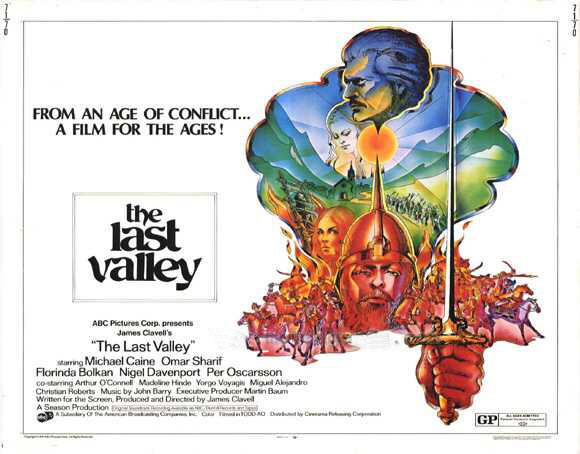
Cast: Michael Caine (The Captain), Omar Sharif (Vogel), Florinda Bolkan (Erica), Nigel Davenport (Gruber), Per Oscarsson (Father Sebastian), Arthur O’Connell (Hoffman), Madeline Hinde (Inge), Yorgo Voyagis (Pirelli), Miguel Alejandro (Julio), Christian Roberts (Andreas), Brian Blessed (Korski), Ian Hogg (Graf), Michael Gothard (Hansen), George Innes (Vornez).
Crew: James Clavell (director, producer and writer), John Barry (music), John Wilcox (cinematography), John Bloom (editor), Peter Mullins (art direction).
Synopsis: In the early 17th Century Europe is riven by the Thirty Years War between Catholics and Protestants. A wandering teacher, Vogel, stumbles into a prosperous village untouched by the conflict. But a gang of marauding mercenaries also find the hamlet in its secluded valley. Vogel persuades their leader, the Captain, not to pillage the village. Instead the soldiers take up residence for the winter, protecting the valley and its inhabitants from other intruders. The Captain kills any dissenters among his own men to maintain order. Vogel acts as mediator between the villagers and the mercenaries, ensuring his own survival. A soldier called Hansen tries to rape one of the villagers, Inge, but she is rescued by Vogel. Hansen rides out of the valley and brings back two dozen men, determined to seize control of the hidden oasis. But the intruders are ruthlessly despatched by the Captain, with help from his men and the villagers. When spring comes the mercenaries ride out to war again and most die in battle. The Captain makes it back to the valley before dying. Vogel leaves the valley, returning to the world of war and plague beyond the hills…
J B Pick’s novel The Last Valley was first published in 1959. Ten years later James Clavell began adapting the historical epic for the big screen, as producer, director and screenwriter. Clavell was best known for writing blockbuster novels like King Rat, but he had also directed several films, including To Sir, with Love (1966). Caine got top billing for his role ahead of Omar Sharif, and a reported fee of $750,000. Caine studied German dialect records in preparation for playing the Captain.
The bulk of the $6 million movie was made at an Austrian location called Trins in Tirol, near Innsbruck. Filming took place over 14 weeks in 1969, with studio work at Shepperton near London. A battle sequence outside a castle was shot beside a lake near Windsor. The cast included George Innes, who had appeared with Caine in The Italian Job (1969). Interviewed exclusively for this book, Innes said The Last Valley was a massive endeavour: ‘They built an entire village, using local people. It was quite amazing. It was a huge movie, but the problem was they had to cut it down. Clavell said, “They’re going to make me cut this, they just won’t show a film of this length.” That’s what really did it in. The Last Valley is a movie of great scope but it lost a lot in the cutting.’
It lost a little more when presented to the BBFC in November 1970, with cuts required before the film was granted an AA certificate. Reviews for the picture were decidedly mixed. Some critics praised its intelligence and Caine’s performance, while others found the feature too talky and Caine’s accent disconcerting. Despite that, Caine was voted best actor of 1970 by Films and Filming magazine. The film failed at the British box office and did no better in America, rated GP (a forerunner of PG). It was released on VHS in 1986, reclassified as a 15 in Britain. The movie was issued on budget-price DVD in the UK during 2001, and is available on both formats in America.
Caine considers The Last Valley his most unjustly neglected film, as he told GQ magazine in 1997: ‘It went completely nowhere. It’s my elder daughter’s favourite film – not only of mine, but of all time. I thought that was a wonderful film, with an unbelievable score by John Barry.’
Reviews: ‘Elegantly shot, confidently acted, with a superb central performance, this historical spectacular is also modern and intimate.’ – MFB
‘A disappointing 17th Century period melodrama … too literal in historical detail to suggest artfully the allegories intended and, paradoxically, too allegorical to make clear the actual realities of the Thirty Years War.’ – Variety
Verdict: The Last Valley is a film with a lot on its mind. Conflicts of religion, morality and philosophy are all debated in a small scale setting, hinting at the greater war raging beyond the valley. The attention to historical detail and characterisation is compelling, but the film less so. The many subtexts threaten to overwhelm the text, with Clavell’s movie making its points too strongly for the good of the story. You don’t get the chance to make your own discoveries about what is driving the characters - instead they announce their motivations to all and sundry. Despite this, The Last Valley looks sumptuous and features a lush score by John Barry. Caine gives a fine, restrained performance as the Captain, his clipped Germanic accent utterly convincing from start to finish. If only Clavell’s direction had been just as accomplished…
Friday, November 17, 2006
Does that make you Crazy? This might.
The Guardian today kindly points to a blog that collects covers, live versions and mash-up of the Gnarls Barkley hit Crazy. You can hear Elton John singing Your Song over the top of Crazy, or Sign O’ The Times by Prince colliding with Crazy, or this amazing mash-up that features Crazy, Supertramp, the Who and no doubt several other ingredients. [That's enough Crazy-ness - Ed.]
Lord of the Rings vs Sin City
What happens if you take the sountrack from the Sin City trailer and overlay it on footage from Lord of the Rings? Enter White City...
Films of Michael Caine #15: Too Late the Hero
(Alternative titles: Robert Aldrich’s Too Late the Hero; Suicide Run)

Cast: Michael Caine (Tosh), Cliff Robertson (Lt Lawson), Ian Bannen (Thornton), Harry Andrews (Colonel Thompson), Ronald Fraser (Campbell), Denholm Elliott (Captain Hornsby), Lance Percival (Corporal McLean), Percy Herbert (Johnstone), Patrick Jordan (Sergeant Major), Henry Fonda (Captain Nolan), Ken Takakura (Major Yamaguchi).
Crew: Robert Aldrich (director and producer), Robert Aldrich and Lukas Heller (writers), Gerald Fried (music), Joseph Biroc (cinematography), Michael Luciano (editor), James Dowell Vance (art direction).
Synopsis: Japanese-speaking US navy linguist Lieutenant Lawson is sent to join a British operation on an island in the New Hebrides. An American Navy convoy will soon be passing the Japanese-controlled north coast of the island. The mission is to disable the enemy transmitter and have Lawson send a false message to the enemy in Japanese from a British transmitter. The operation is led by Captain Hornsby, who bungling costs the lives of several men on the way. When the British radio transmitter is damaged beyond repair, Hornsby decides to send the false message using the Japanese radio. Lawson refuses to help him, so Hornsby destroys the enemy transmitter. Only half the patrol gets away from the enemy camp, including Lawson and a British medic, Tosh. The survivors discover the Japanese have planes hidden on the island. Unless someone makes it back to base and alerts the Americans, the navy convoy will be decimated. The Japanese commander uses loudspeakers to talk to the patrol. He offers them a chance of survival – but only if all those still alive surrender. Three do but Lawson and Tosh keep going. They have to cross an open plain to get back to base but Japanese soldiers are waiting to gun them down. The pair makes a run for it, but only one of them makes it safely across…
Producer/director Robert Aldrich scored a box office hit with The Dirty Dozen in 1967. He used the money from that to establish his own studio, securing the independence he had long craved. Among the first films Aldrich made for his own studio was Too Late the Hero (1970). The picture was based on a story written by him and Robert Sherman, adapted into a screenplay by Aldrich and Lukas Heller. Caine was cast as surly private Tosh Hearne with American actor Cliff Robertson as the reluctant Lieutenant Sam Lawson.
Location shooting began near Subic Bay in the Philippines during January 1969. Too Late the Hero was the biggest film ever made in the country at that time. The cast and crew spent months filming in a rain forest. Aldrich decided he needed professional athletes rather than stunt men for the climatic sequence, where Hearne and Lawson had to run half a mile across an open plain. The director hired two members of the Detroit Lions American football team and flew them to the Philippines for a fortnight to act as stand-ins for Caine and Robertson.
Caine recalled working with Aldrich during an interview with Venice magazine in 2002. ‘Bob was great. He was a man’s, man’s, man’s, man’s man. He was tough, built like a brick chicken-house, an ex-football player. He made very macho movies and we spent 18 weeks in the jungle in the Philippines with him. It was an amazing movie to make, but we were glad to get out of there, I can tell you. There were these little snakes all over the jungle that looked just like twigs on a tree. And they were deadly. One day before we went in the jungle, this band of little native guys came out, none over five feet tall. These guys could actually smell the twig snakes and would survey the area before we went in! The only thing that worried me is if one of them had a cold.’
Robertson won a best actor Oscar for his role in Charly (1968) while Too Late the Hero was filming in the Philippines, but Aldrich refused to let him attend the awards ceremony. Instead Gregory Peck presented Robertson with the trophy in a special event at the airport when the cast and crew returned to America. Studio work was shot at Aldrich Studios in Los Angeles and the production wrapped by the end of June 1969. As part of his promotional duties for the film, Caine featured in a photo shoot for Playboy magazine. Dressed in character, he posed with half a dozen topless models for the October 1969 issue. Co-star Denholm Elliott appeared, looking somewhat bemused, in one of the pictures.
Originally scheduled for release in December 1969, Too Late the Hero reached US cinemas five months later, rated GP. Critics gave the picture a mediocre response and it failed to repeat the success of The Dirty Dozen (1967). In the UK it was rated X by the BBFC. The film was released on video in 1987 and made its DVD debut in 2001.
Reviews: ‘Too Late the Hero generates a great deal of excitement … but it is strong meat and pretty fly blown at that.’ – The Times
‘The latter half of the film builds up an effective sense of paranoia – reinforced by the irascible acting of Michael Caine and Cliff Robertson…’ – MFB
Verdict: Too Late the Hero is one of the many war-is-hell films that got pumped out in the late 1960s and early 1970s like so many cynical celluloid bullets. Aldrich recycles plot elements from his own output, such as a suicide mission featuring a dozen scoundrels – just as in The Dirty Dozen (1967). Too Late the Hero is a decidedly humourless effort, but the quality of acting helps overcome the stolid script. Caine is reliable as ever, well matched by Robertson. The film’s highlight comes at the climax with the duo running for their lives across the open plain, even if Aldrich telegraphs his finale in the movie’s first 20 minutes. It still remains gripping viewing, waiting to see who survives.

Cast: Michael Caine (Tosh), Cliff Robertson (Lt Lawson), Ian Bannen (Thornton), Harry Andrews (Colonel Thompson), Ronald Fraser (Campbell), Denholm Elliott (Captain Hornsby), Lance Percival (Corporal McLean), Percy Herbert (Johnstone), Patrick Jordan (Sergeant Major), Henry Fonda (Captain Nolan), Ken Takakura (Major Yamaguchi).
Crew: Robert Aldrich (director and producer), Robert Aldrich and Lukas Heller (writers), Gerald Fried (music), Joseph Biroc (cinematography), Michael Luciano (editor), James Dowell Vance (art direction).
Synopsis: Japanese-speaking US navy linguist Lieutenant Lawson is sent to join a British operation on an island in the New Hebrides. An American Navy convoy will soon be passing the Japanese-controlled north coast of the island. The mission is to disable the enemy transmitter and have Lawson send a false message to the enemy in Japanese from a British transmitter. The operation is led by Captain Hornsby, who bungling costs the lives of several men on the way. When the British radio transmitter is damaged beyond repair, Hornsby decides to send the false message using the Japanese radio. Lawson refuses to help him, so Hornsby destroys the enemy transmitter. Only half the patrol gets away from the enemy camp, including Lawson and a British medic, Tosh. The survivors discover the Japanese have planes hidden on the island. Unless someone makes it back to base and alerts the Americans, the navy convoy will be decimated. The Japanese commander uses loudspeakers to talk to the patrol. He offers them a chance of survival – but only if all those still alive surrender. Three do but Lawson and Tosh keep going. They have to cross an open plain to get back to base but Japanese soldiers are waiting to gun them down. The pair makes a run for it, but only one of them makes it safely across…
Producer/director Robert Aldrich scored a box office hit with The Dirty Dozen in 1967. He used the money from that to establish his own studio, securing the independence he had long craved. Among the first films Aldrich made for his own studio was Too Late the Hero (1970). The picture was based on a story written by him and Robert Sherman, adapted into a screenplay by Aldrich and Lukas Heller. Caine was cast as surly private Tosh Hearne with American actor Cliff Robertson as the reluctant Lieutenant Sam Lawson.
Location shooting began near Subic Bay in the Philippines during January 1969. Too Late the Hero was the biggest film ever made in the country at that time. The cast and crew spent months filming in a rain forest. Aldrich decided he needed professional athletes rather than stunt men for the climatic sequence, where Hearne and Lawson had to run half a mile across an open plain. The director hired two members of the Detroit Lions American football team and flew them to the Philippines for a fortnight to act as stand-ins for Caine and Robertson.
Caine recalled working with Aldrich during an interview with Venice magazine in 2002. ‘Bob was great. He was a man’s, man’s, man’s, man’s man. He was tough, built like a brick chicken-house, an ex-football player. He made very macho movies and we spent 18 weeks in the jungle in the Philippines with him. It was an amazing movie to make, but we were glad to get out of there, I can tell you. There were these little snakes all over the jungle that looked just like twigs on a tree. And they were deadly. One day before we went in the jungle, this band of little native guys came out, none over five feet tall. These guys could actually smell the twig snakes and would survey the area before we went in! The only thing that worried me is if one of them had a cold.’
Robertson won a best actor Oscar for his role in Charly (1968) while Too Late the Hero was filming in the Philippines, but Aldrich refused to let him attend the awards ceremony. Instead Gregory Peck presented Robertson with the trophy in a special event at the airport when the cast and crew returned to America. Studio work was shot at Aldrich Studios in Los Angeles and the production wrapped by the end of June 1969. As part of his promotional duties for the film, Caine featured in a photo shoot for Playboy magazine. Dressed in character, he posed with half a dozen topless models for the October 1969 issue. Co-star Denholm Elliott appeared, looking somewhat bemused, in one of the pictures.
Originally scheduled for release in December 1969, Too Late the Hero reached US cinemas five months later, rated GP. Critics gave the picture a mediocre response and it failed to repeat the success of The Dirty Dozen (1967). In the UK it was rated X by the BBFC. The film was released on video in 1987 and made its DVD debut in 2001.
Reviews: ‘Too Late the Hero generates a great deal of excitement … but it is strong meat and pretty fly blown at that.’ – The Times
‘The latter half of the film builds up an effective sense of paranoia – reinforced by the irascible acting of Michael Caine and Cliff Robertson…’ – MFB
Verdict: Too Late the Hero is one of the many war-is-hell films that got pumped out in the late 1960s and early 1970s like so many cynical celluloid bullets. Aldrich recycles plot elements from his own output, such as a suicide mission featuring a dozen scoundrels – just as in The Dirty Dozen (1967). Too Late the Hero is a decidedly humourless effort, but the quality of acting helps overcome the stolid script. Caine is reliable as ever, well matched by Robertson. The film’s highlight comes at the climax with the duo running for their lives across the open plain, even if Aldrich telegraphs his finale in the movie’s first 20 minutes. It still remains gripping viewing, waiting to see who survives.
Thursday, November 16, 2006
Being my own worst enemy
There are times when I frustrate the hell out of myself. I spent most of yesterday not doing a job I should have done last weekend. I've got several pressing deadlines on key projects, but I'd already agreed to write a script for Team Fantomen in Sweden. I had hoped to fulfil that committment last Saturday and Sunday, but singularly failed to do so. My editor had asked for new elements to be added to my original plot, all of which were improvement, adding depth and texture to what would have been an exceedingly linear and simplistic tale.
Unfortunately, the creative chunk of my brain decided it needed time to process these changes and find the best way of implementing them. By the end of Sunday I'd managed to write the opening sequence and no more. Yesterday was my golden opportunity to finish the script, before heading to the studio today for the recording block portion of the BBC Radio drama lab I'm participating in. But I was still reworking the plot by lunchtime and only got halfway through the script by 10pm. So I've still that got to finish, which means I'll be back writing the Phantom on Sunday - again.
All the courses I'm doing, all the training and education and craft skills I'm gaining at the moment, are definitely improving my writing. But getting better as a writer means taking more time to write even simple stories. In the past I could rely on my natural storytelling instincts and hack stuff out. Now I find myself taking longer on jobs, because I want them to be the best I can make them. It's a significant change and one I'm only beginning to appreciate. Unfortunately, habit tells me I can write vast screeds of text to order. But that isn't the case so much anymore.
Anyways, I need to finish the Phantom script this week because then I can get paid for it before Christmas next month. Once the Phantom's out the way for the moment, I'll be devoting most of my waking moments between now and Christmas to my next Black Flame novel. Need to get the decks cleared, so I can focus on the book. But first, it's away to Pencaitland and into the studio with my scene, Sweet and Sour Sixteen.
Unfortunately, the creative chunk of my brain decided it needed time to process these changes and find the best way of implementing them. By the end of Sunday I'd managed to write the opening sequence and no more. Yesterday was my golden opportunity to finish the script, before heading to the studio today for the recording block portion of the BBC Radio drama lab I'm participating in. But I was still reworking the plot by lunchtime and only got halfway through the script by 10pm. So I've still that got to finish, which means I'll be back writing the Phantom on Sunday - again.
All the courses I'm doing, all the training and education and craft skills I'm gaining at the moment, are definitely improving my writing. But getting better as a writer means taking more time to write even simple stories. In the past I could rely on my natural storytelling instincts and hack stuff out. Now I find myself taking longer on jobs, because I want them to be the best I can make them. It's a significant change and one I'm only beginning to appreciate. Unfortunately, habit tells me I can write vast screeds of text to order. But that isn't the case so much anymore.
Anyways, I need to finish the Phantom script this week because then I can get paid for it before Christmas next month. Once the Phantom's out the way for the moment, I'll be devoting most of my waking moments between now and Christmas to my next Black Flame novel. Need to get the decks cleared, so I can focus on the book. But first, it's away to Pencaitland and into the studio with my scene, Sweet and Sour Sixteen.
Films of Michael Caine #14: Battle of Britain
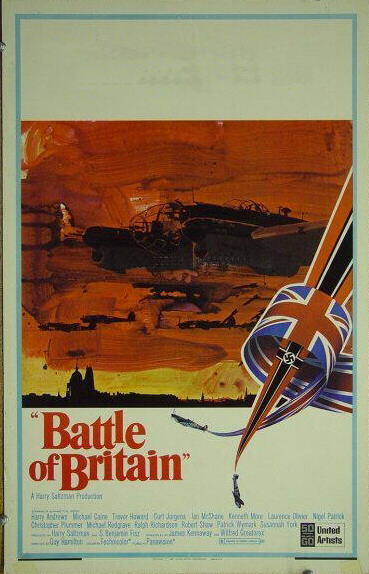
Cast: Laurence Olivier (Air Chief Marshal Sir Hugh Dowding), Robert Shaw (Squadron Leader Skipper), Christopher Plummer (Squadron Leader Colin Harvey), Susannah York (Section Officer Maggie Harvey), Michael Caine (Squadron Leader Canfield), Ian McShane (Sergeant Pilot Andy), Kenneth More (Group Captain Baker), Trevor Howard (Air Vice Marshal Keith Park), Patrick Wymark (Air Vice Marshal Trafford Leigh-Mallory), Ralph Richardson (British minister in Switzerland), Curt Jürgens (Baron von Richter), Harry Andrews (Senior Civil Servant).
Crew: Guy Hamilton (director), Harry Saltzman and Benjamin Fisz (producers), James Kennaway and Wilfred Greatorex (writers), Ron Goodwin (music), Freddie Young (cinematography), Bert Bates (editor), Maurice Carter (supervising art direction).
Synopsis: In June 1940 advancing German forces drive the retreating British troops out of France and back across the English Channel. But rather than attempting an immediate invasion, the Germans pause – giving British forces time to regroup. The Royal Air Force (RAF) prepares for the next phase, the Battle of Britain. German planes outnumber those of the RAF by four to one. The Luftwaffe strikes on August 10, attacking vital radar stations and blowing up RAF airfields. The bombing runs continue for weeks, with British planes winning the dogfights in the air but losing a war of attrition. In September Reichmarschall Goering arrives in France to take charge of the campaign. After Berlin is bombed, he directs the Luftwaffe to attack London. This gives an advantage to the RAF and the Luftwaffe suffers heavy losses. The planned invasion is postponed – the Battle of Britain is over…
Battle of Britain sought to recreate one of the most famous aerial conflicts in history, using material from a 1961 book, The Narrow Margin by Derek Wood and Derek Dempster. To ensure authenticity, ten technical directors who had fought in the battle were on set – including several former Luftwaffe pilots. Dozens of planes that survived the Second World War were gathered to recreate the aerial skirmishes. Producer Harry Saltzman boasted he had assembled the eleventh largest air force in the world for his film.
More than a dozen of Britain’s most respected actors were cast in the principal roles, led by Laurence Olivier. Caine had been under contract to Saltzman but the producer had recently released him from the deal as a birthday present. Caine agreed to help fill out the cast for Battle of Britain, spending two weeks with the production in the role of Squadron Leader Canfield. The film was shot on location in Spain, England and France, with studio work at Pinewood near London. Helming the picture was Guy Hamilton, who had just directed Caine on Funeral in Berlin (1966).
Battle of Britain was released in the UK (rated U) during September 1969, with a US release following a month later (rated G). The film was dismissed by the critics and ignored by audiences, reportedly losing $10 million. It was first released on VHS in 1985 rated PG and re-released in 2000. Unfortunately, the tape is only available as a full screen edition, hampering the visual impact of the many aerial sequences. A widescreen DVD edition is due for release during 2003. [Update: A two-disc special edition DVD was released in 2004.]
Reviews: ‘Once they are airborne and covered with goggles and oxygen masks, it is impossible to distinguish between any of the actors.’ – Time magazine
‘On the ground an impressive assemblage of stars appear and disappear. But that is all they are given a chance to do … human interest is kept to an absolute minimum.’ – The Times
Verdict: Battle of Britain means well but drains all drama and suspense from what should be a gripping story. Striving for authenticity, it becomes a crashing bore. The script tries to create poignant character moments but evokes bathos, not pathos. The film’s big selling point is also its great weakness. The aerial conflicts are spectacular at first but take up far too much screen time. Few things date a film like special effects and Battle of Britain has some that would provoke laughter from a modern audience. Caine’s role is strictly a bit part, despite his prominent credit. File this film under noble failure.
Wednesday, November 15, 2006
Films of Michael Caine #13: The Italian Job (1969)
 Cast: Michael Caine (Charlie Croker), Noël Coward (Mr Bridger), Benny Hill (Professor Simon Peach), Raf Vallone (Altabani), Tony Beckley (Freddie), Rossano Brassi (Beckerman), Maggie Blye (Lorna), Irene Handl (Miss Peach), John Le Mesurier (Governor), Fred Emney (Birkinshaw), John Clive (Garage Manager).
Crew: Peter Collinson (director), Michael Deeley (producer), Troy Kennedy Martin (writer), Quincy Jones (music), Douglas Slocombe (cinematography), John Trumper (editor), Disley Jones (production designer).
Synopsis: A criminal mastermind called Beckerman is murdered by the Mafia as he tries to leave Italy. In London Charlie Croker departs prison after two years inside, expecting to see Beckerman. Instead he is met by the dead man’s widow, who hands over the plans for her late husband’s greatest scheme. Beckerman devised a way to steal $4 million from a security van travelling from Turin airport to the Fiat car factory in the city. The Italian metropolis has a sophisticated computer-controlled traffic system. Jam the computer and the resultant chaos creates an opportunity to steal the contents of the security van. Beckerman has mapped the only way out of the city during such a traffic jam. Within two hours the thieves could be over the Alps and in Switzerland. Charlie realises he needs help to enact such a plan and enlists the aid of Mr Bridger, a British crime boss who runs his business from inside prison. The robbery goes like clockwork, despite attracting the interest of the Mafia, spiriting $4 million of gold out of Turin in three Minis. But disaster strikes as the coach containing the thieves and their loot travels up the winding road into the Alps. The bus skids out of control and is left balanced over a precipice…
In 1967 Troy Kennedy Martin was a successful British television writer trying to get into movies. That breakthrough came with the concept of a robbery set amidst a traffic jam, which had originally conceived by his brother Ian. ‘My brother came up with it, but his idea was set in London around Regent Street,’ Troy Kennedy Martin told Esquire magazine in 2001. ‘We decided a financial agreement and I took it on. I decided to move the location to Turin, because it has a computer operated traffic light system. From the very beginning, I had set my sights on Michael Caine as the hero and wrote a draft treatment accordingly.’
Having got Caine interested, the writer pitched his completed treatment to Robert Evans, head of production at American studio Paramount. Evans wanted Robert Redford to play Charlie Croker but was persuaded to stick with Caine. Michael Deeley was appointed by Paramount as producer for The Italian Job. Deeley was keen to hire Bullitt director Peter Yates for the film, having seen the car chase in that picture. But Paramount opted for the less experienced Peter Collinson. Troy Kennedy Martin began writing his first draft screenplay.
The Italian Job was a $3 million movie, made during the second half of 1968. The production spent three months filming in Italy. Shooting in Turin was made considerably easier by help from Gianna Agnelli, who owned Fiat – the city’s major employer. He ensured the film received maximum co-operation from local authorities. Conversely, the production got little help from British car company BMC, which made the Mini. Even though the film was a 100-minute advertisement for the vehicle, BMC gave the picture almost no support. The company offered six Minis at trade price. The production had to buy more than two dozen further Minis at retail prices.
All the stunt driving was performed by a French team. ‘L’Equipe Remy Julienne were the best known and the best choice in Europe,’ Deeley says on the film’s DVD commentary. ‘They were able to do amazing work.’ In the 1990s the long chase at the end of The Italian Job was named one of the greatest car chases in cinema history by Total Film magazine. But Deeley says this sequence only came alive with the addition of Quincy Jones’ score in post-production. ‘It was vital, particularly the last 15, 20 minutes of the movie. It just didn’t hold together until Quincy put the music on. Like a tailoring job, it tied the whole thing in.’
Studio work was split between Twickenham and Isleworth, with further location shooting in England and Ireland, the latter for scenes featuring Caine’s co-star, Noël Coward. The legendary British performer was persuaded out of semi-retirement to play crime boss Mr Bridger. Most of his scenes were shot at Kilmainham, a disused prison just outside Dublin. Caine was full of praise for Coward when interviewed by Films and Filming before The Italian Job’s release in 1969. ‘He’s so warm … I think it’s his best screen performance.’ Caine was also impressed by the director: ‘Peter Collinson will go out and shoot things that other people won’t. He’s an extremely determined young man and took this film into both hands and really went out and did it.’
The film gave Caine a chance to lure his brother in front of the camera. Stanley Caine had already made brief appearances in Billion Dollar Brain (1967) and Play Dirty (1969). ‘I was trying to get him into acting and he didn’t really take any interest in it,’ Michael Caine told the Australian edition of Empire in 2002. ‘It wasn’t for him, which was very disappointing for me as I was so enthusiastic about it.’
One of the biggest problems facing the filmmakers was how to end The Italian Job. Troy Kennedy Martin wrote half a dozen different endings, but Deeley wasn’t happy with any of them. ‘They all ended up as dialogues in Switzerland,’ the producer says in his commentary. ‘I didn’t feel, after all the excitement with the cars and the chase and the whole business, we should end up with dialogue. We were really stuck because all the endings were boring – they bored me.’ Deeley flew to Hollywood to meet with Robert Evans about the problem. On the flight the producer developed an idea for the ultimate cliffhanger, creating the finale for the film. ‘I thought it was a potential lead-in to a sequel if this picture was successful.’ Evans quickly agreed and Deeley flew back with Paramount’s approval. The new ending was unpopular with the screenwriter, director and Caine. Collinson refused to shoot it, leaving the job to his second unit team.
The Italian Job reached British cinemas in 1969, rated U. Critics gave it a mediocre reception, with some dismissing it as just another crime caper with a good car chase. Reaction was just as muted in America, when the movie was rated G. In 2001 Caine told Empire magazine his biggest disappointment was the US publicity campaign. He believed the film was doomed when he saw Paramount’s poster of a machine-gun wielding gangster with a semi-naked woman. ‘So I got on the next plane and came back.’ Despite its failure to ignite the American box office, The Italian Job won the Golden Globe for best English language foreign film.
Like Get Carter (1971), The Italian Job underwent a long-term rehabilitation in the eyes of the public and critics. Countless repeats on television and a video release in 1988 (reclassified as a PG) introduced the film to a new audience. The brash style, swinging 1960s flavour and spectacular car chase helped create a cult following. Troy Kennedy Martin’s satire of British antipathy to Europe was downplayed in the comedy caper, but the red, white and blue livery of the Minis underlined the subtext. By the mid-1990s, Cool Britannia hype was making Caine a British icon with The Italian Job a key part of his appeal. The film has been spoofed numerous times in advertising and music videos.
The Italian Job’s reappraisal was completed in September 1999 when the picture was re-released to British cinemas for its 30th anniversary. The film grossed just over $250,000 but this was just a stalking horse for a subsequent VHS re-release. A BFI poll to find the Top 100 British movies of the twentieth century ranked The Italian Job as the fourth highest place of seven Caine pictures on the list, voted it 36th overall.
Matthew Field’s book The Making of The Italian Job was published in 2001, as a precursor to the movie’s DVD debut. The volume contains almost everything you could want to know about the film. The movie made its DVD debut in 2002. The disc includes a deleted scene, documentaries about the movie and the commentary track.
A new version of The Italian Job was filmed at the end of 2002 and is due for cinema release in 2003. According to advance reports, the bulk of the action takes place during a traffic jam in Los Angeles. American actor Mark Wahlberg plays Charlie Croker with Donald Sutherland as the older crime boss. There was talk of Caine having a cameo in the movie, but he expressed public doubts about this after his experience on the 2000 remake of Get Carter. A fan club devoted to the 1969 film expressed anger at the remake. Deeley told the Sunday Telegraph that shifting the setting to Los Angeles was ignoring the original’s anti-European subtext: ‘It seems like a complete waste of money to me.’
In 2003 Caine’s most famous piece of dialogue from The Italian Job was voted the greatest one-liner in cinema history in a poll run by a mobile phone company. ‘You were only supposed to blow the bloody doors off!’ won out over quotes from Gone With the Wind, Withnail and I, Taxi Driver and Apocalypse Now.
Reviews: ‘A thinly scripted, routine thriller of perfect crime and inevitable retribution, lifted off the ground … by some superb stunt driving.’ – MFB, 1969
‘A perfect blend of cheery xenophobia, chirpy Cockney antics and dry wit.’ – Total Film, 1999
Verdict: The Italian Job is like a postcard from the 1960s – swinging London, vibrant primary colours, great British inventions like the Mini – a snapshot of what you imagine life must have been like on King’s Road. Everyone’s on the make, anything is possible and all it takes is a dozen London wideboys to sting Europe for millions. This movie is a fantasy from start to finish, but it’s a warm, cosy fantasy full of memorable dialogue and automobile antics. The pace never drags, thanks to deft direction, dazzling design and a succession of clever cameos by British comedy actors. The characters may be one-dimensional, but you still want them to find a way out of the cliffhanger ending. Caine is perfectly cast as Charlie Croker, the ultimate lad icon. This movie is lightweight, xenophobic and dated in many respects, but it is still fun – just enjoy it…
DVD killed the Video Star, and other stories
Hollywood has called a time of death for VHS. The home-entertainment format has perished after 30 years, claimed by a fatal case of DVD infestation. The task of pulling the plug on VHS in the US fell to retailers, who decided they no longer want to give it shelf space in their stores.
The format hit its peak with Disney's film The Lion King, selling 30 million cassettes. But the writing has been on the wall since DVD overtook VHS in popularity three years ago. Now, like characters in Logan's Run, VHS has turned thirty and gone to Carousel. Press the eject and give me the tape, Gracie.
+++++++++++++++++++++++++++
In other news, work has begun on staging all 365 plays American scribe Suzan-Lori Parks wrote over 365 days between November 2002 and November 2003. The plays vary in length from a paragraph to several, and were written in disparate places over the course of a year. Apparently the last one is a dialogue free work of meta-theatre in which lights shine on a manuscript containing all 365 days.
Of course, deciding to write a new play every day for a year doesn't mean you can always guarantee inspiration will arrive in time. Titles for some of the plays include Going Through the Motions, Empty and - my personal favourite - This Is Shit. Interviewed by the Guardian newspaper, Parks says some days were tougher than others. 'I'd question my motives, but I'd still do it anyway. Writing is a spiritual practice. It's only by sticking with it that you get to the good stuff.'
Amen to that.
+++++++++++++++++++++++++++
MGM and New Line are talking about making not one, but two films out of JRR tolkein's book The Hobbit. MGM holds the distribution rights while New Line has the rights to produce film adaptations. According to Variety, MGM wants Peter Jackson to make a movie of The Hobbit, with a second film drawing on footntoes and source material linking The Hobbit to Lord of the Rings.
But Jackson is busy suing New Line at present, so don't hold your breath for either film to go into production any time soon. MGM is also prepping a new Thomas Crown feature starring Pierce Brosnan as the suave thief, while Daniel Craig is lined up for the 22nd Bond movie. Best of all, Casino Royale opens on Friday - back to basics and no cringe-inducing invisible cars. Bring it on!
The format hit its peak with Disney's film The Lion King, selling 30 million cassettes. But the writing has been on the wall since DVD overtook VHS in popularity three years ago. Now, like characters in Logan's Run, VHS has turned thirty and gone to Carousel. Press the eject and give me the tape, Gracie.
+++++++++++++++++++++++++++
In other news, work has begun on staging all 365 plays American scribe Suzan-Lori Parks wrote over 365 days between November 2002 and November 2003. The plays vary in length from a paragraph to several, and were written in disparate places over the course of a year. Apparently the last one is a dialogue free work of meta-theatre in which lights shine on a manuscript containing all 365 days.
Of course, deciding to write a new play every day for a year doesn't mean you can always guarantee inspiration will arrive in time. Titles for some of the plays include Going Through the Motions, Empty and - my personal favourite - This Is Shit. Interviewed by the Guardian newspaper, Parks says some days were tougher than others. 'I'd question my motives, but I'd still do it anyway. Writing is a spiritual practice. It's only by sticking with it that you get to the good stuff.'
Amen to that.
+++++++++++++++++++++++++++
MGM and New Line are talking about making not one, but two films out of JRR tolkein's book The Hobbit. MGM holds the distribution rights while New Line has the rights to produce film adaptations. According to Variety, MGM wants Peter Jackson to make a movie of The Hobbit, with a second film drawing on footntoes and source material linking The Hobbit to Lord of the Rings.
But Jackson is busy suing New Line at present, so don't hold your breath for either film to go into production any time soon. MGM is also prepping a new Thomas Crown feature starring Pierce Brosnan as the suave thief, while Daniel Craig is lined up for the 22nd Bond movie. Best of all, Casino Royale opens on Friday - back to basics and no cringe-inducing invisible cars. Bring it on!
Tuesday, November 14, 2006
A student's animation thesis project
No doubt most people have already seen this, but if you haven't, here's Kiwi.
Number 7 is great - try it now!
Yesterday I burbled about Maggie's list of 11 things you can do to get your writing going from a bad patch. Well, the one that resonated with me most was number 7, reproduced below. After weeks of banging my head against a creative brick wall that suggestion got me going again. Within a few hours I'd written several thousand words, plotting a way forward for my mentoring project. My mentor read it, came back with some brilliant suggestions on how to improve it but also praised how much my new idea was working. Two weeks ago I was down and depressed; today I've got my mojo working and all's well with the word. So, here's that number 7 in full - use it well!
7) This one is evil but fantastic: open a new file and write the thing again, without looking at your current draft, no matter how many times you've rewritten it. Oh, so evil! Because you'll hate it and you'll be so mad and then, oh my goodness, you write something SO GREAT! Because you've been working on that story for so long now, you're so ready to write that thing! You're a pro at writing that thing, but you're not letting yourself write it, only rewrite it.
It's like you've been practicing a piece of Bach. Only you recorded your very first time through, and you've been tweaking that recording all this time. Play it again! Write it again! Let your characters talk. They're sick of having the same conversation over and over. What would they do if they had the chance to live that scene over again?
The joy of everyday objects that work
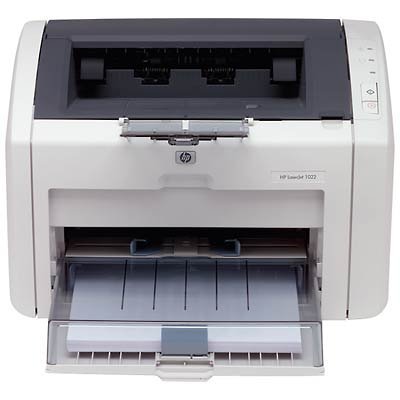 I've been having printer problems for months. The Canon I bought to accompany gave up the ghost waaay too quickly, and my old Epson Stylus has been dying on its arse for years. Finally, yesterday, I snapped. Having spent a smll fortune on cartridges for both bloody printers, neither of them was willing to work for more than five minutes. Back when I was still editing and designing the Judge Dredd Megazine, I needed a colour printer to do my job effectively - but that was five years ago. I'd say that 99% of my work is text these days, so a good, efficient B&W printer is all I need. Time to upgrade to a nice, shiny, new laserjet.
Yesterday I ordered the HP 1022 from Amazon.co.uk, with express delivery specified for a few extra squids. It arrived this morning before nine and took all of 23 minutes to set up. I've just printed my first few pages and they shot like a rabbit from a trap. Blimey, it's fast! And the print quality? Stunning. That's it, I am never going back to inkjet printing again. Let joy be unconfined, let there rejoicing in the streets and necking in the parlour. I have a printer that works and I feel fine. Amen.
Entitled [blame that Jim Swallow]
Over at his blog Jim Swallow has been contemplating the meanings hidden within titles of stories he's written. Let's see what - if any - sense I can make of my own titles, starting with the novels. The Savage Amusement was inspired by a comment my Irish grandmother once made, about work being the savage amusement. The words sounded so unlikely coming from her, that stuck in my memory. The book features Judge Dredd fighting a villain called Savage who caused chaos for his own amusement - a case of events being shaped to fit the title I wanted to use.
Cursed Earth Asylum: that was about events at an asylum. In the Cursed Earth. Natch. [Brings to mind one of my all-time favourite quotes from an Aaron Sorkin show, in this case Sports Night: 'What's a perfect game?' 'I know there's a lot of jargon but some of this is self-evident.']
Silencer: sounded cool. I think there was a conspiracy theme to the book, so it was about people being... well... silenced.
Who Killed Kennedy: A Doctor Who novel involving the assassination of JFK.
Amorality Tale: A pun of the notion of morality tales from the Middle Ages. This was a Doctor Who novel that deliberately took an amoral view of its characters. Vicious murderers acting like heroes, if it suited their needs, while good people died.
The Domino Effect: Another Doctor Who novel. It's all about cause and effect, what would happen if someone systematically suppressed the invention of the computer.
Empire of Death: Yet another Doctor Who novel. I wanted to call this Metempsychosis, as it sounded like a much cooler title and alludes to Pythagorus's theories about transmutation of the soul. The editor suggested Empire of Death. The editor won.
Bad Moon Rising: A novel that takes places over 13 hours, with each chapter representing an hour of real time. Yes, 24 had just become a hit in Britain, no prizes for spotting the obvious influence there. The story took place over one night, with a full moon overhead, hence the title borrowed from the hit single by Three Dog Night.
Kingdom of the Blind: A plotline kinda borrowed from Day of the Triffids where almost everyone in the Big Meg gets blinded. Dredd's got bionic eyes, so he is unaffected, making him king in a kingdom of the blind. That sounds better than the book was.
The Strangelove Gambit: My first Nikolai Dante novel. I wanted to call it The Faberge Experiment, but trademark infrignement concerns nixed that. My Dante novels tend to be spy-fi romps, so I was borrowing the naming conventions of authors like Robert Ludlum - you know, The Bourne Supremacy and all that.
Imperial Black: A title leftover from a rejected proposal by another author got slapped on to my second Dante novel. I managed to work it into the story okay.
Honour Be Damned!: Another Dante novel, another leftover title I inherited. It's one of Dante's catchphrases, but didn't really suit the story I wrote.
Suffer the Children: A Nightmare on Elm Street novel, inspired by a Biblical quotation. The book was akin to having Freddy torture characters from The Breakfast Club - nice.
Operation Vampyr: My first Fiends of the Eastern Front novel. It's about Operation Barbarossa in WWII and features vampires. This was suggested by the editorial team and much better than my dry, original title of Operation Barbarossa. Which stank.
The Blood Red Army: Originally The Bloody Red Army, but apparently some US book chains won't stock titles featuring the word Bloody.
Twilight of the Dead: Originally Twilight of the Undead, which made more sense. The last book of my Fiends of the Eastern Front trilogy, about vanquishing the vampire menace. Twilight of the Dead would work better on a zombie novel.
Coming soon: A Murder in Marienburg - my first Warhammer novel. It's a murder mystery. Set in Marienburg. You do the math.
Cursed Earth Asylum: that was about events at an asylum. In the Cursed Earth. Natch. [Brings to mind one of my all-time favourite quotes from an Aaron Sorkin show, in this case Sports Night: 'What's a perfect game?' 'I know there's a lot of jargon but some of this is self-evident.']
Silencer: sounded cool. I think there was a conspiracy theme to the book, so it was about people being... well... silenced.
Who Killed Kennedy: A Doctor Who novel involving the assassination of JFK.
Amorality Tale: A pun of the notion of morality tales from the Middle Ages. This was a Doctor Who novel that deliberately took an amoral view of its characters. Vicious murderers acting like heroes, if it suited their needs, while good people died.
The Domino Effect: Another Doctor Who novel. It's all about cause and effect, what would happen if someone systematically suppressed the invention of the computer.
Empire of Death: Yet another Doctor Who novel. I wanted to call this Metempsychosis, as it sounded like a much cooler title and alludes to Pythagorus's theories about transmutation of the soul. The editor suggested Empire of Death. The editor won.
Bad Moon Rising: A novel that takes places over 13 hours, with each chapter representing an hour of real time. Yes, 24 had just become a hit in Britain, no prizes for spotting the obvious influence there. The story took place over one night, with a full moon overhead, hence the title borrowed from the hit single by Three Dog Night.
Kingdom of the Blind: A plotline kinda borrowed from Day of the Triffids where almost everyone in the Big Meg gets blinded. Dredd's got bionic eyes, so he is unaffected, making him king in a kingdom of the blind. That sounds better than the book was.
The Strangelove Gambit: My first Nikolai Dante novel. I wanted to call it The Faberge Experiment, but trademark infrignement concerns nixed that. My Dante novels tend to be spy-fi romps, so I was borrowing the naming conventions of authors like Robert Ludlum - you know, The Bourne Supremacy and all that.
Imperial Black: A title leftover from a rejected proposal by another author got slapped on to my second Dante novel. I managed to work it into the story okay.
Honour Be Damned!: Another Dante novel, another leftover title I inherited. It's one of Dante's catchphrases, but didn't really suit the story I wrote.
Suffer the Children: A Nightmare on Elm Street novel, inspired by a Biblical quotation. The book was akin to having Freddy torture characters from The Breakfast Club - nice.
Operation Vampyr: My first Fiends of the Eastern Front novel. It's about Operation Barbarossa in WWII and features vampires. This was suggested by the editorial team and much better than my dry, original title of Operation Barbarossa. Which stank.
The Blood Red Army: Originally The Bloody Red Army, but apparently some US book chains won't stock titles featuring the word Bloody.
Twilight of the Dead: Originally Twilight of the Undead, which made more sense. The last book of my Fiends of the Eastern Front trilogy, about vanquishing the vampire menace. Twilight of the Dead would work better on a zombie novel.
Coming soon: A Murder in Marienburg - my first Warhammer novel. It's a murder mystery. Set in Marienburg. You do the math.
Friday Night Lights gets a full season
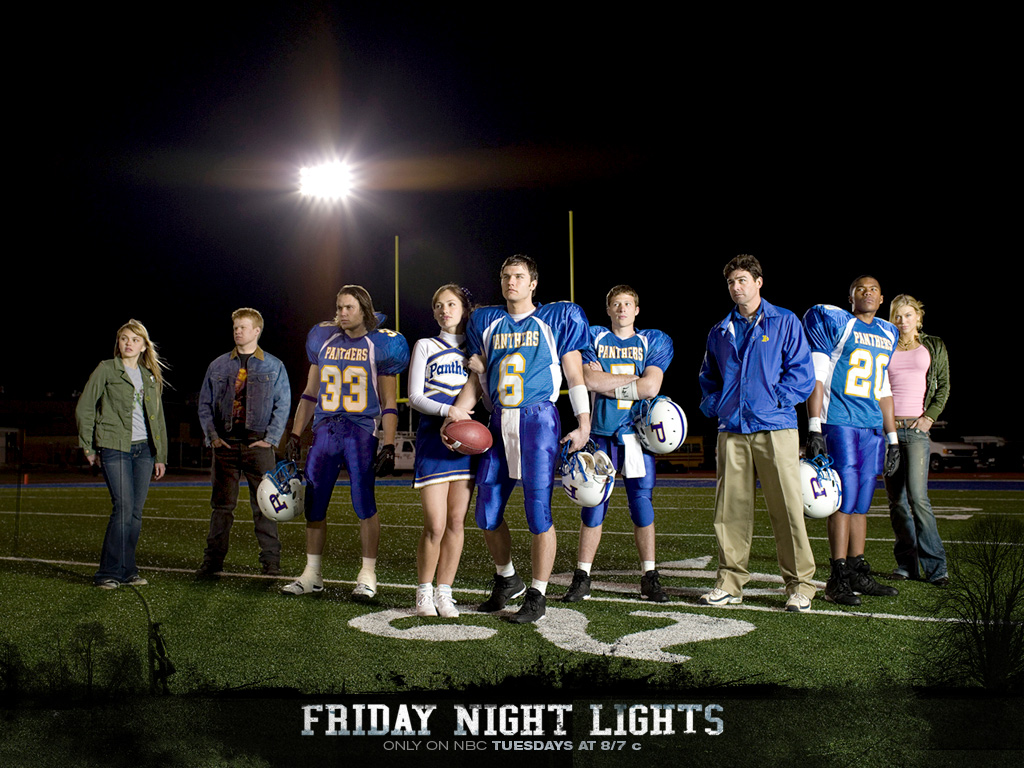 Good news from acros the Atlantic: Variety reports that new TV drama series Friday Night Lights has been picked up for a full season. The show about life in a small Texas town where everything revolves around the successes [and failures] of a local sports team has wowed critics but struggled for ratings.
 The fact FNL is ostensibly about American football means it will struggle even more to find an audience outside the US. That's a shame, as it's one of the best things I've seen on TV this year - powerful and moving, with great, subtle writing. Bizarrely, I understand ITV has bought the UK broadcast rights to FNL. Grud alone knows when and where they'll schedule it. But it's well worth watching, if you get the chance.
FNL screens on NBC in America, a channel trying to climb out of a hole at the moment [much like ITV in Britain]. That may have saved the series, as NBC Entertainment president Kevin Reilly told Variety: 'We gave it probably the toughest hour on the schedule and yet, while it's been doing modest ratings, it's been holding its own. If you hang on to good work, eventually the word gets around.' [FNL's been up against the US version of Strictly Come Dancing, which is just as much a ratings juggernaut as its UK progenitor.]
Monday, November 13, 2006
Red-Hot and Filthy Library Smut
You love it, you know you do. You can't resist the lure of Hot Library Smut, can you? Can you?
Well, I know I couldn't. Link courtesy of Anna Louise's Journal.
Well, I know I couldn't. Link courtesy of Anna Louise's Journal.
Subscribe to:
Posts (Atom)