Thursday, October 26, 2006
Reality Check - have you got what it takes?
Right, off to Glasgow for a day of working writer-director Adrian Mead, as part of the Scottish Book Trust's wonderful mentoring scheme. Confidentiality agreements mean I can't talk much about what we're working on, but it's an exciting opportunity and I'm trying to make the best of it. In the meantime, I hereby direct you to Adrian's guest post on Danny Stack's excellent blog Script Writing and Script Reading in the UK. If you harbour any idea of becoming a working scribe, this post lays out some of the things you need to be doing to make that happen. Idle dreams aren't enough. You need to work, you need to hustle, you need to make sacrifices. Talent, craft, persistence, hard work and a little bit of luck are all essential. Onwards!


We can be Heroes [not just for one day]
 I've got a writer friend I see once or twice a year in person, but we talk on the phone every couple of weeks, sharing war stories about our current jobs and where are careers are going. We also share recommendations about new TV dramas we've liked. I'm trying to persuade them to give Ugly Betty a try - it's camp nonsense, but it's also got a lot of heart and some clever twists in the writing. In return, I promised to watch the first two episodes of Heroes, another hit of the new TV season across the Atlantic. And I'm glad I did.
For anyone who hasn't heard about it yet, Heroes is a series about a diverse collection of people from across the world endowed with special powers and fated to save the planet from some as yet unspecified threat. Essentially, it's like a comic book brought to life, but played straight - no KAPOW! captions here, praise grud. If you saw the film Unbreakable, Heroes best resembles an ensemble version of that approach. I doubt this show would ever have gotten on the air if Lost hadn't been a big hit. That show's success has legitimised and made mainstream the sort of stories and storytelling that previously screamed cult appeal only.
But Heroes has been a ratings hit in the US and looks like going the distance, especially if the programme makers can keep up the quality seen on screen in the first two episodes. It uses a structural approach overtly borrowed from the old Saturday morning serials, with each episode called a chapter and ending on a twist or cliffhanger. To the show's credit, it acknowledges there is life beyond America, incorporating characters from Japan and India in the cast.
Of course, the kind of story and the way it's being told are not especially new or novel. There was a 24-issue comic called Rising Stars that ploughed some of the same furrows, and super-powered heroes have been around for 70 years. But it's a joy to see such fare tackled with a straight face and an intelligent brain. So far they've avoided costumes and capes. Yes, the sprawling conspiracy is present and correct, but that was kind of inevitable. I'd blame Lost, but I suspect it's the earlier success of The X Files that made such stories so familiar.
Anyways, I'm enjoying what I've seen of Heroes so far. Ugly Betty is going from strength to strength, and even the misfiring Studio 60 on the Sunset Strip showed a little life and depth this week. Plus there's the compelling Friday Night Lights, though it's ratings leave something to be desired. But, as US TV seasons go, this one isn't turning out too bad thus far - for drama. Comedy and sitcoms? That's another matter...
Wednesday, October 25, 2006
Jack's back [well, he will be in January]
 Across the Atlantic Fox has released a trailer for the sixth season of TV spy thriller 24. Of course, you'll need bloody Windows Media Player to watch it and a PC will probably be more conducive to that than my Mac, but it's out there and it looks groovy.
So that's why filming a minute takes a day
Being rather a naive youth, I often used to wonder why it supposedly took filmmakers a whole day to shoot a single minute of useful footage for their movie. I mean, how long can that honestly take, right? Even if you need to have twenty goes at it, that's still only twenty times a minute, right? Wrong. Wrong, wrong, wrong, wrong, wrong. The few times I've visited film sets [Judge Dredd, Lost in Space - all the classics for me], it's been like watching paint dry while being whipped with barbed wire, such is the amount of time needed to achieve the illusions we see on screen.
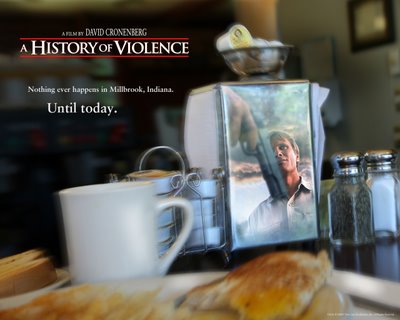 As part of the From Script to Screen module on my MA Screenwriting course, our first assignment is a 2000 word essay. For this we need to choose a film adapted from either a novel or a play. [I've picked the graphic novel A History of Violence by John Wagner and Vincent Locke, recently adapted into a feature by Canadian autuer David Cronenberg.] Next, we have to produce a shot analysis of a sequence from the film.
That means identifying all the individual shots within the sequence, timing them, write a description of the visible image, stipulating how one shot transitions to the next, discussing the camera framing and movement, and writing about the sounds that accompany the shot. Our tutor warned us this would not be a quick task, if done properly - and he was right.
I decided to study the diner stick-up sequence in A History of Violence, what screenwriting gurus would call the inciting incident and what I'd describe as the end of Act One in the movie. Shouldn't take long, right? After all, the sequence is only three minutes and seven seconds long. Wrong. Wrong, wrong, wrong, wrong, wrong. It may be only 187 seconds long, but there are 93 different shots in those 187 seconds. As a consequence, it only took me five hours to identify the shots, their length, image, transition, camera framing and movements, and the accompanying soundscape.
Guess I should be grateful I didn't pick a longer sequence. Right now, I have a new found respect for the work of anyone who has ever worked on any aspect of a film's production. Doesn't matter if what came out at the cinemas was Citizen Kane or Shanghai Surprise, grud knows hundreds of people put a massive amount of time, effort and energy into making it. For those about to film, I salute you.
 As part of the From Script to Screen module on my MA Screenwriting course, our first assignment is a 2000 word essay. For this we need to choose a film adapted from either a novel or a play. [I've picked the graphic novel A History of Violence by John Wagner and Vincent Locke, recently adapted into a feature by Canadian autuer David Cronenberg.] Next, we have to produce a shot analysis of a sequence from the film.
That means identifying all the individual shots within the sequence, timing them, write a description of the visible image, stipulating how one shot transitions to the next, discussing the camera framing and movement, and writing about the sounds that accompany the shot. Our tutor warned us this would not be a quick task, if done properly - and he was right.
I decided to study the diner stick-up sequence in A History of Violence, what screenwriting gurus would call the inciting incident and what I'd describe as the end of Act One in the movie. Shouldn't take long, right? After all, the sequence is only three minutes and seven seconds long. Wrong. Wrong, wrong, wrong, wrong, wrong. It may be only 187 seconds long, but there are 93 different shots in those 187 seconds. As a consequence, it only took me five hours to identify the shots, their length, image, transition, camera framing and movements, and the accompanying soundscape.
Guess I should be grateful I didn't pick a longer sequence. Right now, I have a new found respect for the work of anyone who has ever worked on any aspect of a film's production. Doesn't matter if what came out at the cinemas was Citizen Kane or Shanghai Surprise, grud knows hundreds of people put a massive amount of time, effort and energy into making it. For those about to film, I salute you.
Films of Michael Caine #3: Alfie
Still under the weather and with deadlines pressing, here's another filin post extracted from my book Starring Michael Caine. Since the tome was published in 2003, the remake of Alfie starring Jude Law mentioned below has been made and released, achieving limited success with critics and audiences. 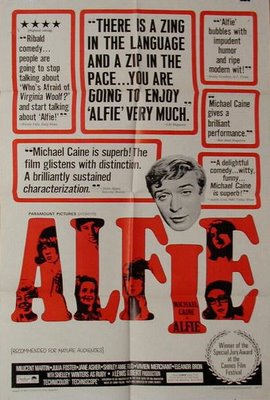
ALFIE (1966)
Cast: Michael Caine (Alfie), Shelley Winters (Ruby), Millicent Martin (Siddie), Julia Foster (Gilda), Jane Asher (Annie), Shirley Anne Field (Carla), Vivien Merchant (Lily), Eleanor Bron (The Doctor), Denholm Elliott (The Abortionist), Alfie Bass (Harry Clamacraft), Graham Stark (Humphrey), Murray Melvin (Nat).
Crew: Lewis Gilbert (director and producer), Bill Naughton (writer), Sonny Rollins (music), Otto Heller (cinematography), Thelma Connell (editor), Peter Mullins (art direction).
Synopsis: Alfie is a man of many lovers, playing the field in swinging 1960s London. His philosophy is have fun and avoid emotional attachment if you want to avoid pain. When standby lover Gilda gives birth to his son, Alfie can’t help enjoying being a father. But he refuses to commit, so Gilda marries another man. Alfie is diagnosed with tuberculosis and spends six months in a sanatorium. After leaving he sleeps with Lily, the wife of another patient. Alfie acquires two lovers – a Northern girl called Annie who cooks and cleans for him and a lively American called Ruby. But he drives Annie away, fearful of commitment. Lily gets pregnant from her fling with Alfie and he procures an illegal abortion for her. Ruby takes a younger lover and casts Alfie aside. He is left on his own, haunted by the consequences of his actions…
Alfie began life as Alfie Elkins and His Little Life, a radio play written by Bill Naughton. It subsequently became a stage play, with Caine auditioning unsuccessfully for the lead. Several years later Lewis Gilbert acquired the film rights. But finding an actor willing to play the lead proved difficult, according to Caine. ‘Everyone who was right for the role turned it down, based on the fact it would ruin them. They wouldn’t play a part where the leading man procured an abortion. I didn’t give a damn about it because I just wanted to do the part.’ Among those who turned down Alfie was Caine’s flatmate at the time, Terence Stamp. Instead he suggested Caine for the role.
On the DVD commentary for The Ipcress File, editor Peter Hunt explains how he helped influence the casting. Gilbert met Hunt during post-production of the first Harry Palmer film and they discussed who would play Alfie. ‘He said he didn’t know. He was very worried about it,’ Hunt recalls. ‘He asked “What’s this boy like that you’re working with, Michael Caine?”’ Hunt gave Gilbert a secret preview of The Ipcress File while it was still being edited. ‘I think the next day he signed up Michael to do Alfie.’
Even when the director was convinced, he still had to sell the actor to Paramount Pictures. ‘The original choice for Alfie was Tony Curtis and he was very hot at the time,’ Gilbert told Films and Filming in 1985. ‘I said it had to be a Cockney and, as it wasn’t a very big budget film, could I have Michael Caine? The reaction then was “Who is Michael Caine?”’ Gilbert eventually got his way and the part went to Caine. Also in the cast was young English actress Jane Asher, then the girlfriend of Paul McCartney. The Beatle visited the set and insisted Asher wear a less revealing shirt during a bedroom scene with Caine.
The film was shot on location around London and at Twickenham Studios for a budget of US$500,000. In the late 1980s Caine gave a televised masterclass in film acting. In the published transcript, Caine revealed he had based his performance as Alfie on a friend called Jim Slater, who was very successful with women. ‘In Alfie my character spoke to the audience through the camera, a bit like the technique of “asides” in the theatre. I used Jim as the person to whom I was talking. When I first spoke directly to the camera, I treated it like a large audience.’ Gilbert directed Caine to perform the speeches as if to a single person. ‘I played the moment as though I were talking to Jim. He would have especially appreciated remarks like “She’s in beautiful condition” when Alfie was running his hands over a woman’s bum, because Jim used to say things like that. That confidence in Jim’s appreciation is what won me the collusion of the cinema audience, even when they didn’t really approve of Alfie’s goings-on.’
Gilbert told Film Review that Alfie was an audience participation movie. ‘In many of the key scenes Alfie turns to the audience and talks quite frankly and intimately to them. They must respond. In fact the success of the film will depend largely on the viewer going along with Alfie and feeling to be part of his life.’
Alfie was presented to the British Board of Film Censors (BBFC) in January 1966, which passed the picture uncut with an X Certificate. At the time that excluded children under the age of 16. The most contentious part of the movie was the abortion, with Gilbert battling US distributor Paramount to keep it in. The director had already trimmed the sequence after five secretaries fainted at a preview screening. Eventually the studio relented, although the scene was subsequently deleted in some countries.
Alfie was a box office smash in Britain and earned Merchant a BAFTA award as most promising newcomer, along with nominations for best British film, actor (Caine), screenplay, editing and cinematography. The theme song to Alfie by Hal David and Burt Bacharach was sung for the screen by Cher but became a British Top 10 hit for Cilla Black. In France it received a special jury prize at the Cannes Film Festival and was nominated for the Golden Palm. Despite this success, Caine felt sure his accent and the film’s subject matter would prevent it doing well in America. Paramount had him loop more than a hundred lines of dialogue, softening his accent and changing words like ‘fag’ to ‘smoke’ to avoid confusion.
Alfie opened in the US during August 1966 and became a huge hit, reportedly grossing about $15 million and introducing Caine to American audiences. The movie was nominated for five Oscars – best picture, actor (Caine lost to another British actor, Paul Scofield, in A Man for all Seasons), supporting actress (Merchant), adapted screenplay and song. Caine was also nominated for a Golden Globe as best actor in a drama film and won the best actor award from America’s National Society of Film Critics.
In interviews Caine has listed Alfie among his favourite roles, because it took his name around the world. ‘That film struck a chord,’ he told Loaded in 1999, ‘because men all over the world would watch it and think they could pull all the birds, just like Alfie. People would assume I was just like the character. But I wasn’t really.’
In 1975 a less successful sequel called Alfie Darling was released. Alan Price replaced Caine in the lead role with Ken Hughes taking over as director. In 1996 pop group Divine Comedy had a Top 30 hit in Britain with the single ‘Becoming More Like Alfie’. The film Austin Powers in Goldmember (2002) initially featured a new version of the Alfie theme song but that was cut after poor reactions at test screenings. The sequence can be seen on the DVD release and includes footage from Alfie. In September 1999 the British Film Institute (BFI) took a poll of 1000 people within the industry to find the Top 100 British movies of the twentieth century. Alfie was the third highest place of seven Caine pictures on the list, being voted 33rd best film.
In 2002 Alfie was among several Caine films mooted for a remake. Actors Ewan McGregor and Brad Pitt were both tipped to play the lead. Caine described the idea as flattering. ‘We can’t have done a bad job of it the first time if they want to remake them now.’ In April 2003 Variety reported that Paramount was negotiating with Jude Law to star in the remake, directed by Charles Shyer with a script by Shyer and Elaine Pope.
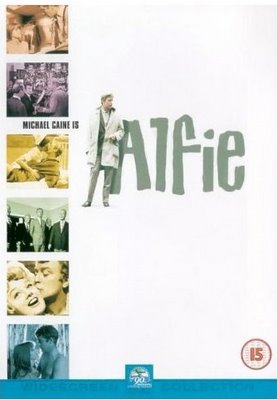 First available on video in Britain during 1985, Alfie was reclassified as a 15. It was digitally re-mastered and issued on VHS and DVD in 2002.
Reviews: ‘Alfie pulls few punches … behind its alley-cat philosophy, there’s some shrewd sense, some pointed barbs and a sharp moral.’ - Variety
‘Michael Caine … tends to be monotonous. Both he and director Gilbert seem as little conscious of the character’s psychological undertones as Alfie himself.’ - Monthly Film Bulletin
Verdict: Nearly forty years after it was made, Alfie now looks like a period piece from an era before the Pill or AIDS – at least on the surface. Despite this, Alfie remains fresh and enjoyable. The balance of power has shifted in the battle of the sexes since the mid-1960s, but this film still has much to say about the way men and women interact. Caine gives a bravura performance, all the more remarkable for being only his second leading role. He makes Alfie completely likeable, despite the way the Cockney Casanova uses everyone around him. The device of having a character talk directly to the audience is over-familiar these days from its frequent use on television sitcoms, but here it is compelling, drawing you into Alfie’s mindset. Caine’s finest moment is the quiet horror he displays when looking down at the aborted foetus that would have been his child. Gilbert directs Naughton’s funny, poignant script with a light touch, aided by Heller’s rich cinematography. Alfie is a restrained, thoughtful film and well worth seeing.

ALFIE (1966)
Cast: Michael Caine (Alfie), Shelley Winters (Ruby), Millicent Martin (Siddie), Julia Foster (Gilda), Jane Asher (Annie), Shirley Anne Field (Carla), Vivien Merchant (Lily), Eleanor Bron (The Doctor), Denholm Elliott (The Abortionist), Alfie Bass (Harry Clamacraft), Graham Stark (Humphrey), Murray Melvin (Nat).
Crew: Lewis Gilbert (director and producer), Bill Naughton (writer), Sonny Rollins (music), Otto Heller (cinematography), Thelma Connell (editor), Peter Mullins (art direction).
Synopsis: Alfie is a man of many lovers, playing the field in swinging 1960s London. His philosophy is have fun and avoid emotional attachment if you want to avoid pain. When standby lover Gilda gives birth to his son, Alfie can’t help enjoying being a father. But he refuses to commit, so Gilda marries another man. Alfie is diagnosed with tuberculosis and spends six months in a sanatorium. After leaving he sleeps with Lily, the wife of another patient. Alfie acquires two lovers – a Northern girl called Annie who cooks and cleans for him and a lively American called Ruby. But he drives Annie away, fearful of commitment. Lily gets pregnant from her fling with Alfie and he procures an illegal abortion for her. Ruby takes a younger lover and casts Alfie aside. He is left on his own, haunted by the consequences of his actions…
Alfie began life as Alfie Elkins and His Little Life, a radio play written by Bill Naughton. It subsequently became a stage play, with Caine auditioning unsuccessfully for the lead. Several years later Lewis Gilbert acquired the film rights. But finding an actor willing to play the lead proved difficult, according to Caine. ‘Everyone who was right for the role turned it down, based on the fact it would ruin them. They wouldn’t play a part where the leading man procured an abortion. I didn’t give a damn about it because I just wanted to do the part.’ Among those who turned down Alfie was Caine’s flatmate at the time, Terence Stamp. Instead he suggested Caine for the role.
On the DVD commentary for The Ipcress File, editor Peter Hunt explains how he helped influence the casting. Gilbert met Hunt during post-production of the first Harry Palmer film and they discussed who would play Alfie. ‘He said he didn’t know. He was very worried about it,’ Hunt recalls. ‘He asked “What’s this boy like that you’re working with, Michael Caine?”’ Hunt gave Gilbert a secret preview of The Ipcress File while it was still being edited. ‘I think the next day he signed up Michael to do Alfie.’
Even when the director was convinced, he still had to sell the actor to Paramount Pictures. ‘The original choice for Alfie was Tony Curtis and he was very hot at the time,’ Gilbert told Films and Filming in 1985. ‘I said it had to be a Cockney and, as it wasn’t a very big budget film, could I have Michael Caine? The reaction then was “Who is Michael Caine?”’ Gilbert eventually got his way and the part went to Caine. Also in the cast was young English actress Jane Asher, then the girlfriend of Paul McCartney. The Beatle visited the set and insisted Asher wear a less revealing shirt during a bedroom scene with Caine.
The film was shot on location around London and at Twickenham Studios for a budget of US$500,000. In the late 1980s Caine gave a televised masterclass in film acting. In the published transcript, Caine revealed he had based his performance as Alfie on a friend called Jim Slater, who was very successful with women. ‘In Alfie my character spoke to the audience through the camera, a bit like the technique of “asides” in the theatre. I used Jim as the person to whom I was talking. When I first spoke directly to the camera, I treated it like a large audience.’ Gilbert directed Caine to perform the speeches as if to a single person. ‘I played the moment as though I were talking to Jim. He would have especially appreciated remarks like “She’s in beautiful condition” when Alfie was running his hands over a woman’s bum, because Jim used to say things like that. That confidence in Jim’s appreciation is what won me the collusion of the cinema audience, even when they didn’t really approve of Alfie’s goings-on.’
Gilbert told Film Review that Alfie was an audience participation movie. ‘In many of the key scenes Alfie turns to the audience and talks quite frankly and intimately to them. They must respond. In fact the success of the film will depend largely on the viewer going along with Alfie and feeling to be part of his life.’
Alfie was presented to the British Board of Film Censors (BBFC) in January 1966, which passed the picture uncut with an X Certificate. At the time that excluded children under the age of 16. The most contentious part of the movie was the abortion, with Gilbert battling US distributor Paramount to keep it in. The director had already trimmed the sequence after five secretaries fainted at a preview screening. Eventually the studio relented, although the scene was subsequently deleted in some countries.
Alfie was a box office smash in Britain and earned Merchant a BAFTA award as most promising newcomer, along with nominations for best British film, actor (Caine), screenplay, editing and cinematography. The theme song to Alfie by Hal David and Burt Bacharach was sung for the screen by Cher but became a British Top 10 hit for Cilla Black. In France it received a special jury prize at the Cannes Film Festival and was nominated for the Golden Palm. Despite this success, Caine felt sure his accent and the film’s subject matter would prevent it doing well in America. Paramount had him loop more than a hundred lines of dialogue, softening his accent and changing words like ‘fag’ to ‘smoke’ to avoid confusion.
Alfie opened in the US during August 1966 and became a huge hit, reportedly grossing about $15 million and introducing Caine to American audiences. The movie was nominated for five Oscars – best picture, actor (Caine lost to another British actor, Paul Scofield, in A Man for all Seasons), supporting actress (Merchant), adapted screenplay and song. Caine was also nominated for a Golden Globe as best actor in a drama film and won the best actor award from America’s National Society of Film Critics.
In interviews Caine has listed Alfie among his favourite roles, because it took his name around the world. ‘That film struck a chord,’ he told Loaded in 1999, ‘because men all over the world would watch it and think they could pull all the birds, just like Alfie. People would assume I was just like the character. But I wasn’t really.’
In 1975 a less successful sequel called Alfie Darling was released. Alan Price replaced Caine in the lead role with Ken Hughes taking over as director. In 1996 pop group Divine Comedy had a Top 30 hit in Britain with the single ‘Becoming More Like Alfie’. The film Austin Powers in Goldmember (2002) initially featured a new version of the Alfie theme song but that was cut after poor reactions at test screenings. The sequence can be seen on the DVD release and includes footage from Alfie. In September 1999 the British Film Institute (BFI) took a poll of 1000 people within the industry to find the Top 100 British movies of the twentieth century. Alfie was the third highest place of seven Caine pictures on the list, being voted 33rd best film.
In 2002 Alfie was among several Caine films mooted for a remake. Actors Ewan McGregor and Brad Pitt were both tipped to play the lead. Caine described the idea as flattering. ‘We can’t have done a bad job of it the first time if they want to remake them now.’ In April 2003 Variety reported that Paramount was negotiating with Jude Law to star in the remake, directed by Charles Shyer with a script by Shyer and Elaine Pope.
 First available on video in Britain during 1985, Alfie was reclassified as a 15. It was digitally re-mastered and issued on VHS and DVD in 2002.
Reviews: ‘Alfie pulls few punches … behind its alley-cat philosophy, there’s some shrewd sense, some pointed barbs and a sharp moral.’ - Variety
‘Michael Caine … tends to be monotonous. Both he and director Gilbert seem as little conscious of the character’s psychological undertones as Alfie himself.’ - Monthly Film Bulletin
Verdict: Nearly forty years after it was made, Alfie now looks like a period piece from an era before the Pill or AIDS – at least on the surface. Despite this, Alfie remains fresh and enjoyable. The balance of power has shifted in the battle of the sexes since the mid-1960s, but this film still has much to say about the way men and women interact. Caine gives a bravura performance, all the more remarkable for being only his second leading role. He makes Alfie completely likeable, despite the way the Cockney Casanova uses everyone around him. The device of having a character talk directly to the audience is over-familiar these days from its frequent use on television sitcoms, but here it is compelling, drawing you into Alfie’s mindset. Caine’s finest moment is the quiet horror he displays when looking down at the aborted foetus that would have been his child. Gilbert directs Naughton’s funny, poignant script with a light touch, aided by Heller’s rich cinematography. Alfie is a restrained, thoughtful film and well worth seeing.
Tuesday, October 24, 2006
Exclusive: Colin MacNeil sketches of Golem
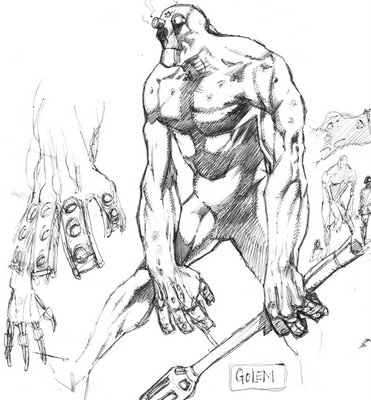
The Judge Dredd Megazine is running an eight-part serial I've written about WWII vampires called Fiends of the Eastern Front: Stalingrad, inspired by the original Fiends strip created by Gerry Finley-Day and Carlos Ezquerra. I've been lucky enough to have Colin MacNeil as artist for my story, his painted monotone pages giving the tale a depth and gravitas it would have otherwise lacked. Among his many contributions to the series was a stunning design for the Golem, as featured in current edition of the Megazine, issue 251. If I'd known how good the Golem looked, I'd have given it much more page-time. Anyways, here are two Golem sketches Colin sent me, revealed exclusively here on Vicious Imagery - enjoy!



Films of Michael Caine #2: The Ipcress File
Feeling like crap, so I'm running another uncut entry from my 2003 book Starring Michael Caine. Today's effort is a stunning spy thriller, the first of five Harry Palmer films Sir Michael would make in his illustrious career - would that all of them had been this good...
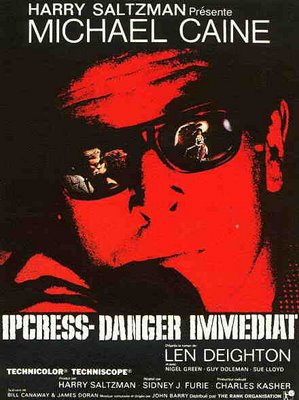 THE IPCRESS FILE (1965)
(alternate title: Len Deighton’s The Ipcress File)
Cast: Michael Caine (Harry Palmer), Nigel Green (Dalby), Guy Doleman (Ross), Sue Lloyd (Jean), Gordon Jackson (Carswell), Aubrey Richards (Radcliffe), Frank Gatliff (Bluejay), Thomas Baptiste (Barney), Oliver MacGreevy (Housemartin), Freda Bamford (Alice), Pauline Winter (Charlady), Anthony Blackshaw (Edwards).
Crew: Sidney J Furie (director), Harry Saltzman (producer), Bill Canaway and James Doran (writers), John Barry (music), Otto Heller (cinematography), Peter Hunt (editor), Ken Adam (production designer).
Synopsis: British scientists are being abducted. A scientist called Radcliffe is taken from a London train. Harry Palmer is transferred to a counter-espionage unit run by Major Dalby. The prime suspects for the kidnappings are a man called Grantby, codenamed Bluejay, and his assistant, codenamed Housemartin. The police arrest Housemartin near a warehouse, but he is mysteriously murdered while in custody. Palmer has the warehouse raided, but it has already been vacated. Harry finds a tape marked IPCRESS. Palmer is quizzed about the case by his former boss, Colonel Ross from the Ministry of Defence. Dalby and Harry arrange to buy Radcliffe back from Grantby. At the exchange Palmer kills a US agent lurking in the shadows. Another US agent begins following Harry and threatens to kill him. Radcliffe can no longer recall his own research. The meaning of the word IPCRESS is discovered – it refers to brainwashing. An agent who borrows Palmer’s car is murdered, having been mistaken for Harry. Palmer returns to his flat and finds the second US agent dead inside. The Ipcress file is stolen from Harry’s desk. Palmer is abducted by Grantby and brainwashed, but manages to escape. Harry realises either Dalby or Ross is working with Grantby. He confronts both men. Dalby is revealed as the traitor, ordering Palmer to murder Ross. But Harry kills Dalby in self defence. Ross admits using Palmer as bait to catch Dalby…
Len Deighton’s first novel, The Ipcress File, was published in 1962. The low key espionage thriller was a stark contrast to the James Bond novels written by Ian Fleming. Deighton’s story was told in the first person by an unnamed secret agent. The film rights were acquired by Charles D Kasher, who collaborated on the project with producer Harry Saltzman. Saltzman had produced the early Bond films in partnership with Cubby Broccoli, but The Ipcress File required a different approach.
Christopher Plummer was offered the role of Harry Palmer, but turned it down to star in The Sound of Music. In a 1969 interview with Films and Filming, Caine recalled how he was offered the part: ‘Saltzman saw Zulu and afterwards, I mean that same evening, he went to dinner at a restaurant … and I just happened to be there. He gave me the job just like that. Looking back, people imagine that my break came with Zulu. But quite honestly that’s just what didn’t happen, it was a year later … The Ipcress File made me a star.’
Canadian-born Sidney J Furie was hired to direct the movie. ‘The whole idea was to do the opposite of Bond,’ he explains on the film’s DVD commentary. The project almost collapsed just before shooting was to begin, when its financing was withdrawn. Saltzman told Furie to start anyway, pledging to fund the production from his own pocket. ‘He threatened Universal and Rank with a lawsuit and forced them to go ahead,’ Furie says.
The Ipcress File was shot over three months at locations around London, and at Pinewood Studios. Production designer Ken Adam transformed the rooms in a single house near Victoria Station into a series of sets, with Palmer’s flat on the top floor. Saltzman and Furie clashed repeatedly during filming. ‘The producer didn’t like all the funny [camera] angles and what I was doing. Harry wanted me fired,’ Furie says. Editor Peter Hunt was brought in by Saltzman to assess what had been shot, wanting confirmation Furie should be dismissed. On the same DVD commentary Hunt backs up this version of events. Hunt refused to confirm Saltzman’s and Furie stayed on the picture.
The director says he had no faith in the script: ‘There were many scripts but we were never happy with them. The script was being rewritten every day. We could only shot what had been written.’ Furie was so upset by the script he set fire to a copy during filming and then burst into tears. But he says Caine was able to get the best from the material. ‘The dialogue on paper was nothing. Michael would give it this inflection – he made it work.’ Furie says Caine was one of the greatest actors he ever worked with.
Problems continued during filming with studio bosses questioning the wisdom of having Palmer wear glasses or cook meals, as Caine recalled in a 2002 interview with Venice magazine: ‘Up until that point, all heroes in action films had been perfect … With the glasses, we gave him an imperfection, to make him more like an ordinary person. Also, we had him cook a meal. One of the producers said, “No, no, you can’t do that! Everyone will think he’s gay!”’ Caine pointed out that Harry was cooking for a woman to get her into bed, and the scene stayed. In the film Deighton’s hands are seen doing most of the cooking. The author’s culinary newspaper column can also be seen, pinned to Palmer’s kitchen wall.
Caine talked about Harry Palmer in a 1965 interview with the Evening News. ‘He’s a very human fellow. We’ve gone for real people, and how they get out of real trouble. The things you remember about the Bond films are the Aston Martin, and the other gimmicky effects. In ours, if someone gets shot – they die. We work on the principle that the way to make a good thriller is to make it so realistic that everyone identifies with it.’
The Ipcress File reached British cinemas in March 1965, rated A. Most critics were full of praise for the anti-Bond film and it did brisk business at the box office. The Ipcress File won BAFTAs for best British film, art direction and cinematography. Caine was nominated as best British actor and the screenplay also got a nomination. The picture reached US cinemas in August, where it impressed reviewers and audiences. Caine told Playboy in 1967 that the film’s success in the US had surprised him: ‘I suppose I underestimated the intelligence of audiences, which people in show business do all the time. We made The Ipcress File very cheaply, expecting, if we were lucky, to break even or make a little profit. I thought it would be a rather specialised movie.’
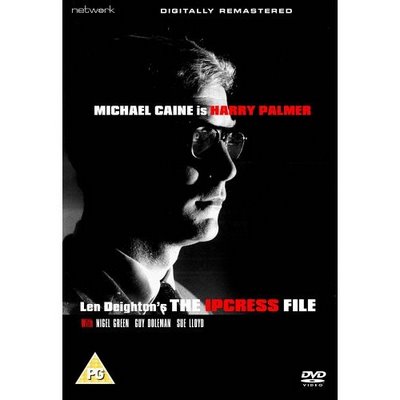 The Ipcress File was released on video in 1987, reclassified as a PG. It remains available on VHS and DVD in the UK and America. However, the US DVD is superior, with the film in widescreen and a commentary track by Furie and Hunt. The UK disc is a budget price, full-screen version that utterly fails to convey the film’s unusual and eye-catching cinematography. In September 1999 the BFI took a poll of 1000 people within the industry to find the Top 100 British movies of the twentieth century. The Ipcress File was one of seven Caine pictures on the list, being voted into 59th place. [A much improved Region 2 DVD has since been released.]
Reviews: ‘Michael Caine’s performance installs him as the first mod conman of the new British crime wave.’ – Sunday Telegraph
‘Michael Caine who plays Harry Palmer is the new style secret agent: everything that James Bond is not and all the better for it.’ – Evening Standard
Verdict: Caine believes his film star status starts with The Ipcress File and you can see why. It’s a great picture and a wonderful showcase for his burgeoning talent as a screen actor. He displays remarkable assurance in his first leading role, giving life and humanity to what could have been a very one-dimensional character. Furie’s determination to shoot every scene from an unusual angle may irk some, but it has kept this film feeling fresh nearly forty years later, unlike subsequent Harry Palmer pictures. Mention must be made of John Barry’s vocative score and the sparse sets by Ken Adam – both men giving the film a decidedly different flavour from the Bond features on which they also worked. The Ipcress File is among the best movies Caine made in the 1960s. But if you are going to watch it, find a widescreen version so you can savour the full effect.
 THE IPCRESS FILE (1965)
(alternate title: Len Deighton’s The Ipcress File)
Cast: Michael Caine (Harry Palmer), Nigel Green (Dalby), Guy Doleman (Ross), Sue Lloyd (Jean), Gordon Jackson (Carswell), Aubrey Richards (Radcliffe), Frank Gatliff (Bluejay), Thomas Baptiste (Barney), Oliver MacGreevy (Housemartin), Freda Bamford (Alice), Pauline Winter (Charlady), Anthony Blackshaw (Edwards).
Crew: Sidney J Furie (director), Harry Saltzman (producer), Bill Canaway and James Doran (writers), John Barry (music), Otto Heller (cinematography), Peter Hunt (editor), Ken Adam (production designer).
Synopsis: British scientists are being abducted. A scientist called Radcliffe is taken from a London train. Harry Palmer is transferred to a counter-espionage unit run by Major Dalby. The prime suspects for the kidnappings are a man called Grantby, codenamed Bluejay, and his assistant, codenamed Housemartin. The police arrest Housemartin near a warehouse, but he is mysteriously murdered while in custody. Palmer has the warehouse raided, but it has already been vacated. Harry finds a tape marked IPCRESS. Palmer is quizzed about the case by his former boss, Colonel Ross from the Ministry of Defence. Dalby and Harry arrange to buy Radcliffe back from Grantby. At the exchange Palmer kills a US agent lurking in the shadows. Another US agent begins following Harry and threatens to kill him. Radcliffe can no longer recall his own research. The meaning of the word IPCRESS is discovered – it refers to brainwashing. An agent who borrows Palmer’s car is murdered, having been mistaken for Harry. Palmer returns to his flat and finds the second US agent dead inside. The Ipcress file is stolen from Harry’s desk. Palmer is abducted by Grantby and brainwashed, but manages to escape. Harry realises either Dalby or Ross is working with Grantby. He confronts both men. Dalby is revealed as the traitor, ordering Palmer to murder Ross. But Harry kills Dalby in self defence. Ross admits using Palmer as bait to catch Dalby…
Len Deighton’s first novel, The Ipcress File, was published in 1962. The low key espionage thriller was a stark contrast to the James Bond novels written by Ian Fleming. Deighton’s story was told in the first person by an unnamed secret agent. The film rights were acquired by Charles D Kasher, who collaborated on the project with producer Harry Saltzman. Saltzman had produced the early Bond films in partnership with Cubby Broccoli, but The Ipcress File required a different approach.
Christopher Plummer was offered the role of Harry Palmer, but turned it down to star in The Sound of Music. In a 1969 interview with Films and Filming, Caine recalled how he was offered the part: ‘Saltzman saw Zulu and afterwards, I mean that same evening, he went to dinner at a restaurant … and I just happened to be there. He gave me the job just like that. Looking back, people imagine that my break came with Zulu. But quite honestly that’s just what didn’t happen, it was a year later … The Ipcress File made me a star.’
Canadian-born Sidney J Furie was hired to direct the movie. ‘The whole idea was to do the opposite of Bond,’ he explains on the film’s DVD commentary. The project almost collapsed just before shooting was to begin, when its financing was withdrawn. Saltzman told Furie to start anyway, pledging to fund the production from his own pocket. ‘He threatened Universal and Rank with a lawsuit and forced them to go ahead,’ Furie says.
The Ipcress File was shot over three months at locations around London, and at Pinewood Studios. Production designer Ken Adam transformed the rooms in a single house near Victoria Station into a series of sets, with Palmer’s flat on the top floor. Saltzman and Furie clashed repeatedly during filming. ‘The producer didn’t like all the funny [camera] angles and what I was doing. Harry wanted me fired,’ Furie says. Editor Peter Hunt was brought in by Saltzman to assess what had been shot, wanting confirmation Furie should be dismissed. On the same DVD commentary Hunt backs up this version of events. Hunt refused to confirm Saltzman’s and Furie stayed on the picture.
The director says he had no faith in the script: ‘There were many scripts but we were never happy with them. The script was being rewritten every day. We could only shot what had been written.’ Furie was so upset by the script he set fire to a copy during filming and then burst into tears. But he says Caine was able to get the best from the material. ‘The dialogue on paper was nothing. Michael would give it this inflection – he made it work.’ Furie says Caine was one of the greatest actors he ever worked with.
Problems continued during filming with studio bosses questioning the wisdom of having Palmer wear glasses or cook meals, as Caine recalled in a 2002 interview with Venice magazine: ‘Up until that point, all heroes in action films had been perfect … With the glasses, we gave him an imperfection, to make him more like an ordinary person. Also, we had him cook a meal. One of the producers said, “No, no, you can’t do that! Everyone will think he’s gay!”’ Caine pointed out that Harry was cooking for a woman to get her into bed, and the scene stayed. In the film Deighton’s hands are seen doing most of the cooking. The author’s culinary newspaper column can also be seen, pinned to Palmer’s kitchen wall.
Caine talked about Harry Palmer in a 1965 interview with the Evening News. ‘He’s a very human fellow. We’ve gone for real people, and how they get out of real trouble. The things you remember about the Bond films are the Aston Martin, and the other gimmicky effects. In ours, if someone gets shot – they die. We work on the principle that the way to make a good thriller is to make it so realistic that everyone identifies with it.’
The Ipcress File reached British cinemas in March 1965, rated A. Most critics were full of praise for the anti-Bond film and it did brisk business at the box office. The Ipcress File won BAFTAs for best British film, art direction and cinematography. Caine was nominated as best British actor and the screenplay also got a nomination. The picture reached US cinemas in August, where it impressed reviewers and audiences. Caine told Playboy in 1967 that the film’s success in the US had surprised him: ‘I suppose I underestimated the intelligence of audiences, which people in show business do all the time. We made The Ipcress File very cheaply, expecting, if we were lucky, to break even or make a little profit. I thought it would be a rather specialised movie.’
 The Ipcress File was released on video in 1987, reclassified as a PG. It remains available on VHS and DVD in the UK and America. However, the US DVD is superior, with the film in widescreen and a commentary track by Furie and Hunt. The UK disc is a budget price, full-screen version that utterly fails to convey the film’s unusual and eye-catching cinematography. In September 1999 the BFI took a poll of 1000 people within the industry to find the Top 100 British movies of the twentieth century. The Ipcress File was one of seven Caine pictures on the list, being voted into 59th place. [A much improved Region 2 DVD has since been released.]
Reviews: ‘Michael Caine’s performance installs him as the first mod conman of the new British crime wave.’ – Sunday Telegraph
‘Michael Caine who plays Harry Palmer is the new style secret agent: everything that James Bond is not and all the better for it.’ – Evening Standard
Verdict: Caine believes his film star status starts with The Ipcress File and you can see why. It’s a great picture and a wonderful showcase for his burgeoning talent as a screen actor. He displays remarkable assurance in his first leading role, giving life and humanity to what could have been a very one-dimensional character. Furie’s determination to shoot every scene from an unusual angle may irk some, but it has kept this film feeling fresh nearly forty years later, unlike subsequent Harry Palmer pictures. Mention must be made of John Barry’s vocative score and the sparse sets by Ken Adam – both men giving the film a decidedly different flavour from the Bond features on which they also worked. The Ipcress File is among the best movies Caine made in the 1960s. But if you are going to watch it, find a widescreen version so you can savour the full effect.
Monday, October 23, 2006
Prestige formats: autumn film upsurge
Well, it's officially autumn in the nrothern hemisphere. Ignore the changing colours of the trees outside, and the piles of leaves that have suddenly appeared everywhere. You can even ignore the rain, the cold and the occasional frost - or ice storm, as they like to call it in parts of America. Nope, the proof that autumn has arrived north of the equator can be found at the US box office. Suddenly, quality is back in fashion as studios and indies start unleashing their Oscar-bait candidates for 2006.
Martin Scorcese's The Departed is already attracting critical raves and the biggest audience yet for one of his films, a double-header that will stand the acclaimed helmer in good stead come nominations time. This weekend just gone two more films were released with at least one eye firmly directed towards snaffling a little golden statuette or two. Clint Eastwood's Flag of Our Fathers was looking a strong contender, though there's some grumbles about the lack of black soldiers visible in the WWII drama about the battle for Iwo Jima and its aftermath.
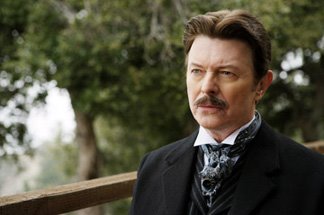 Winning the box office battle was Christopher Nolan's new effort, The Prestige, starring Hugh Jackman, Michael Caine, the inevitable Scarlett Johansson and, rather wonderfully, David Bowie. I doubt The Prestige will win that many awards but wouldn't it be a delight if Bowie got an Oscar nomination for best supporting actor? I know, I know, it's not going to happen, but Prince has got an Oscar, so I think Bowie should have one too.
While there's no shortage of contenders still to see the light of day, I confidently predict Meryl Streep will get a nomination for The Devil Wears Prada - good roles for woman are always too few and far between in Hollywood films. I've got my fingers crossed Caine might sneak a best supporting actor for one his turns this year, possible Children of Men, but that's more of a longshot. The sentamentalist in me wants Sylvester Stallone to get a nomination for Rocky Balboa but, let's face it, that's not going to happen. Such is life.
In other news, HBO has ordered twelve episodes of the new show by Deadwood creator David Milch. John From Cincinnati is described as a 'surf noir family drama' and no, I have no idea what that means either. Surf noir? The mind boggles. Can we expect people to hang ten on a set of venetian blinds? Anyways, production starts next month for a premiere in summer 2007.
Milch is also writing two made for TV movies that will wrap up the Deadwood series. All the cast have been released from contractual obligations, so it remains to be seen how many will be back for the finale. Still, watching the last few episodes of The West Wing over the weekend, it was amazing how many of the cast from the previous seven years were lured back - even creator Aaron Sorkin, who left the show under a cloud after season four made a cameo appearance. Let's hope the end of Deadwood is just as good, if not better.
Martin Scorcese's The Departed is already attracting critical raves and the biggest audience yet for one of his films, a double-header that will stand the acclaimed helmer in good stead come nominations time. This weekend just gone two more films were released with at least one eye firmly directed towards snaffling a little golden statuette or two. Clint Eastwood's Flag of Our Fathers was looking a strong contender, though there's some grumbles about the lack of black soldiers visible in the WWII drama about the battle for Iwo Jima and its aftermath.
 Winning the box office battle was Christopher Nolan's new effort, The Prestige, starring Hugh Jackman, Michael Caine, the inevitable Scarlett Johansson and, rather wonderfully, David Bowie. I doubt The Prestige will win that many awards but wouldn't it be a delight if Bowie got an Oscar nomination for best supporting actor? I know, I know, it's not going to happen, but Prince has got an Oscar, so I think Bowie should have one too.
While there's no shortage of contenders still to see the light of day, I confidently predict Meryl Streep will get a nomination for The Devil Wears Prada - good roles for woman are always too few and far between in Hollywood films. I've got my fingers crossed Caine might sneak a best supporting actor for one his turns this year, possible Children of Men, but that's more of a longshot. The sentamentalist in me wants Sylvester Stallone to get a nomination for Rocky Balboa but, let's face it, that's not going to happen. Such is life.
In other news, HBO has ordered twelve episodes of the new show by Deadwood creator David Milch. John From Cincinnati is described as a 'surf noir family drama' and no, I have no idea what that means either. Surf noir? The mind boggles. Can we expect people to hang ten on a set of venetian blinds? Anyways, production starts next month for a premiere in summer 2007.
Milch is also writing two made for TV movies that will wrap up the Deadwood series. All the cast have been released from contractual obligations, so it remains to be seen how many will be back for the finale. Still, watching the last few episodes of The West Wing over the weekend, it was amazing how many of the cast from the previous seven years were lured back - even creator Aaron Sorkin, who left the show under a cloud after season four made a cameo appearance. Let's hope the end of Deadwood is just as good, if not better.
Sunday, October 22, 2006
Up from the Ashes [to Ashes] of Life on Mars
 British tabloid the Daily Mirror is claiming the BBC has asked for a spin-off from time-slip cop drama Life on Mars. The show is returning for its second and final series early in 2007, as post-millennium cop Sam Tyler tries to find his way back from either 1973, a coma or insanity, depending upon what's actually happened to him. The Mirror says the new series will set in the 1980s and be named Ashes to Ashes, after David Bowie's big hit from 1980.
 If you believe the hype, the spin-off will have Sam appear in the 1980s, where he'll catch up with his old friends from 1973 and discover how they've changed. If he arrives in the same year as the theme tune was a hit - as he did with Life on Mars - then Ashes to Ashes would see him transported to 1980. That would mean ska bands, two tone and new romantics. But the Mirror seems to think the show will have a Miami Vice feel, which is much more 1985.
Grud forbid somebody decides to make a 1990s version, as Bowie didn't have many great or iconic hit singles in the 1990s. I mean, can you see anybody making a TV show called Jump They Say? As least, one without Nigel Harman in the lead role?
Saturday, October 21, 2006
Sarah Jane Smith Wardobe Appreciation Society
 Fans of Sarah Jane Smith from Doctor Who are constructing a site devoted to SJ's incredible 1970s outfits - the Andy Pandy dungarees from Hand of Fear, the serving wench outfit from The Time Warriors, and all the other favourites are being screen captured and uploaded, story by story. Below are a selection of images from the site, but to see the full wonder of it all, go to The Sarah Jane Smith Wardrobe Appreciation Society - magic!


Friday, October 20, 2006
Films of Michael Caine #1: Zulu
At the suggestion of a regular reader [thanks Chris], I'm posting uncut entries from my book Starring Michael Caine. Each one details the background, making of and post-release history of film featuring British actor Sir Michael Caine. In the book the films were presented in alphabetical order, but here I I'm going for chronological order. First up, the film that turned the former Maurice Micklewhite into a rising star.

ZULU (1964)
Cast: Stanley Baker (Lieutenant John Chard R E), Jack Hawkins (Otto Witt), Ulla Jacobsson (Margareta Witt), James Booth (Private Henry Hook), Michael Caine (Lieutenant Gonville Bromhead), Nigel Green (Colour-Sergeant Bourne), Ivor Emmanuel (Private Owen), Paul Daneman (Sergeant Maxfield), Glynn Edwards (Corporal William Allen), Neil McCarthy (Private Thomas), David Kernan (Private Hitch), Gary Bond (Private Cole).
Crew: Cy Endfield (director), Stanley Baker and Cy Endfield (producers), John Prebble and Cy Endfield (writers), John Barry (music), Stephan Dade (cinematography), John Jympson (editor), Ernest Archer (art direction).
Synopsis: In January 1879 more than 1000 British soldiers are killed during a battle with the Zulu forces of King Cetewayo at Isandhlwana in South Africa. The next target for the 4000 Zulu warriors is a mission station at Rorke’s Drift that also has a hospital for British soldiers. Swedish missionary Otto Witt and his daughter Margareta hurry back to the station when they hear of the coming attack. Lieutenant John Chard of the Royal Engineers is at Rorke’s Drift to build a bridge. When word of the approaching Zulu arrives, Chard takes charge from the commanding officer, Lieutenant Gonville Bromhead. They have the same rank but Chard has three months’ seniority. There are just seven officers, 36 sick and wounded soldiers and less than 100 fit infantrymen at Rorke’s Drift to face 4000 Zulu warriors. South African cavalrymen pass the mission station but refuse to stay and help. Chard is forced to send Witt and Margareta away after the reverend causes trouble and gets drunk. The Zulu send wave after wave of attackers against the station, but the Welsh infantrymen stand firm. The battle continues through the night and resumes next morning. Eventually the Zulu withdraw, chanting a salute to the brave British warriors. Eleven Victoria Cross medals for valour and extreme courage were given to the defenders of Rorke’s Drift, the most ever awarded for a single battle…
In the early 1960s journalist John Prebble wrote a series of articles about courage, using the true story of the battle at Rorke’s Drift for one of his pieces. A shortened version of that piece appeared in Lilliput magazine. Film rights to the article were acquired by Diamond Films, a production company set up by Welsh actor Stanley Baker and American director Cy Endfield. They choose it as their first project, developing the screenplay with Prebble under the working title The Battle of Rorke’s Drift. Originally budgeted at £2.6 million, finance was provided by US producer Joseph E Levine on the condition the budget was cut to £2 million.
Baker was already attached as the star and cast people he had previously enjoyed working with, several of whom had appeared in A Hill in Korea (1956). Among the young actors Baker befriended on that picture was Caine, then struggling to make an impact in a succession of bit parts. During pre-production for Zulu Baker went to see Caine on stage in a play called Next Time I’ll Sing For You. Afterwards he invited Caine to audition for the role of Cockney malingerer Private Hook in Zulu. But the part had already been given to an actor called James Booth. Caine thought his chance had gone.
‘Cy Endfield … was convinced my face was that of a British aristocrat,’ Caine told Films and Filming in 1969. ‘“It’s long … you’ve got a long face like a horse.” He was never very complimentary towards me but he sort of talked himself, and Stanley, and me, into playing the aristocratic lieutenant. This was based on my “horsey” face, longish blond hair … and, of course, economics came into it.’
In a documentary on the Zulu DVD, the widow of Stanley Baker recalls Caine’s screen test. ‘Paramount were pressing for Terence Stamp,’ Lady Ellen Baker says. ‘There were only two tests made, Terry and Michael. Michael’s wasn’t a good test, Terry’s was very, very professional. But both Stanley and Cy knew it had to be Michael. Stanley said, “He’s going to be a massive star.”’ Lady Baker says Paramount and Levine fought against the casting of Caine and tried to have the actor sacked several times during filming. But Enfield and Baker stood by their decision.
Caine had fought in the Korean War as a soldier, but wanted to know more about how officers treated each other. ‘I’d go to the Grenadier Guards’ mess [in London] every lunchtime to talk with the officers,’ he told Film Comment in 1980. ‘I’d only been a private in the army, so my view of officers had been a private’s view. I spent two weeks having meals with them, seeing how they spoke to each other.’ The actor was also preparing to adopt the accent of an upper class Englishman.
Location shooting took place over 14 weeks in Natal, South Africa during 1963, with subsequent studio work at Twickenham Studios in London. During filming in South Africa each day’s footage was sent to England for developing, then came back as rushes so it could be screened for the cast and crew. Caine was horrified by the results. ‘This person came on, quite strange to me, completely awful looking,’ the actor said in a public interview at the NFT in 1998. ‘Suddenly this terrible voice came out, and there was this terrible acting going on, and I threw up on the floor. I threw up and rushed out, and I’ve never been back to rushes.’ The sole exception was The Man Who Would Be King (1975) when director John Huston insisted everyone attended the screening of rushes.
Zulu got its premiere (rated U) in Britain on January 22 1964 - the 85th anniversary of the battle it depicted. Critics questioned the film’s historical accuracy and considered the style old fashioned. But it still found favour with audiences, grossing more than four times its budget at the box office. Film and Filming magazine stated Zulu was the third most successful UK general release of 1964, behind the James Bond blockbuster Goldfinger and the Beatles’ movie debut, A Hard Day’s Night. Zulu was BAFTA-nominated for best art direction. The movie reached US cinemas in June 1964, but failed to replicate its UK success. The picture was reissued to British cinemas in 1967, 1972 and 1976.
Zulu was released on video in 1989, reclassified as a PG in the UK. In a BFI to find the Top 100 British movies of the twentieth century, Zulu was the second highest placed of seven Caine pictures, being voted 31st. It was issued on DVD in 2002, accompanied by a commentary track and two-part documentary about the film’s genesis and production.
Reviews: ‘The production is distinguished by its notable onscreen values … top quality lensing … and intelligent screenplay which avoids most of the obvious clichés.’ – Variety
‘Zulu is a typically fashionable war film, paying dutiful lip service to the futility of the slaughter while milking it for thrills.’ – MFB
Verdict: Zulu is a war film that still stirs the soul and compels the viewer, despite being 40 years old. The screenplay tweaks reality for dramatic effect, but the key facts of this remarkable true story are accurate. There is a lot of time spent setting the scene, but this is more than repaid by the gripping battle that fills the second hour of the picture. Enfield extracts strong performances from his cast and the whole production looks fresh and new, aided by an evocative John Barry score. Caine creates an empathetic characterisation from limited material as the aristocratic Bromhead. His presence on screen belies the fact that this was Caine’s first role of any note. He helps make Zulu a classic of its kind.
Thursday, October 19, 2006
Why not all US TV execs are ruthless people
There's an interesting piece in Hollywood trade paper Variety today, detailing the different fates of two TV dramas. CBS has decided to pull the plug on a new show before a single episode of it was screened. Waterfront was slated to begin appearing early in the new year. But CBS has decided to ditch the show, made by Warner Brothers TV, citing a lack of gaps in the network's own schedule. Four episodes and a pilot had already been shot, featuring Joe Pantoliano as the mayor of Providence in the state of Rhode Island. According to Variety, CBS executives weren't totally happ with the show's direction and decided to nix the project. Imagine how much money that decision has written off, how many hopes and dreams it crushed.
Meanwhile rival network NBC has ordered nine more scripts for its massively acclaimed drama Friday Night Lights. The show features life in a Texas town where everyone's hope and dreams depend upon the high school football team. If that sounds familiar, it was developed from a hit film of the same name that starred Billy Bob Thornton, which adapted a non-fiction book about a real team. Friday Night Lights has been getting a ton of love from critics and online commentators, but isn't finding much of an audience thus far. So, all credit to NBC for sticking with the show. Besides the extra scripts order, the network is also road-testing the show in another timeslot, to try and build the audience. I hope they succeed, because Friday Night Lights is a cracking series.
Meanwhile rival network NBC has ordered nine more scripts for its massively acclaimed drama Friday Night Lights. The show features life in a Texas town where everyone's hope and dreams depend upon the high school football team. If that sounds familiar, it was developed from a hit film of the same name that starred Billy Bob Thornton, which adapted a non-fiction book about a real team. Friday Night Lights has been getting a ton of love from critics and online commentators, but isn't finding much of an audience thus far. So, all credit to NBC for sticking with the show. Besides the extra scripts order, the network is also road-testing the show in another timeslot, to try and build the audience. I hope they succeed, because Friday Night Lights is a cracking series.
Buying a DVD I will never, ever finish
 A few years back I researched and wrote a book called Starring Michael Caine, about every film the British actor had made since his breakthrough role in Zulu. I meticulously researched all 80 movies, spending days on end in the British Film Institute library, interviewing directors and actors who had worked with Caine on particular films and trying [and failing] to get an interview with Sir Michael himself. As part of my research, I watched almost every Caine film twice: once to gain an instant, audience member response to the movie; the second time to note all the themes and detail that escaped me on a first watch.
A couple of films eluded me and one film I simply could not watch twice - at least, not without tearing my eyeballs from my skull and throwing them through the TV screen. [I opted to fast-forward instead.] The movie I couldn't stand to ever see more than once from end to end was The Magus, an adaptation of John Fowles' novels of ideas. Alas, a novel of ideas does not translate well to the big screen, barring the intervention of genius. Fowles himself wrote the screenplay and it wasn't his finest hour, by any stretch of the imagination. Personally, I think the one of the few redeeming features about The Magus as a feature was its poster, a nifty design you still see referenced today.
But it was Woody Allen who best summed up the film's lack of appeal. The comedian, writer and director was once asked what he would do differently if he could live his life over again. 'I'd do everything the same,' Allen replied, 'except watch The Magus.'
To get viewing copies of almost every Caine film made since Zulu, I had to spend a lot of time and money on the auction website eBay, scoring the globe for tapes and discs of the actor's more obscure projects. In some cases I paid money hand over fist to get what proved to be dodgy off-air recordings of films that had never been released on VHS or DVD - and The Magus was one of them. Now, three years after my book was published, many more of Caine's films have been released on shiny disc.
This week another clutch of them hit shops in the US, including Deadfall, Peeper and - you guessed it - The Magus. So I've ordered them all. I guess it's the completist in me. The Caine book didn't sell enough to earn royalties, so I doubt I'll ever be asked to write a revised and updated edition. I certainly have no intention of ever watching my DVD of The Magus when it arrives. [I doubt I'll watch Peeper either, a fatally flawed attempt at something Chinatown did with far more success. Deadfall has its moment, especially the centrepiece heist sequence, even if it was borrowed from Rififi - I might watch parts of that again.] But I want to have The Magus on DVD. It would certainly come in handy if I ever get a job as an interrogator.
In the meantime, here's my list of Michael Caine's Top 10 Most Under-rated Movies:
Gambit (1966)
Play Dirty (1968)
The Last Valley (1970)
Pulp (1972)
The Wilby Conspiracy (1975)
Dressed to Kill (1980)
A Shock to the System (1990)
Blood and Wine (1997)
Little Voice (1998)
Last Orders (2001)
Wednesday, October 18, 2006
Ugly Betty: the shape of telly to come
For those of you wondering why I keep hammering on about the appeal of new US TV show Ugly Betty, the answer appears in today's edition of the Guardian newspaper: 'British broadcasters are looking to the telenovela as their secret weapon in the battle to boost ratings, with the BBC investing millions in its own prime-time version'. Ugly Betty is based upon a hit Columbian telenovela, a form of soap opera where the story is finite but everything else is turned up to 11. The Guardian describes typical telenovelas as 'melodramatic tales of lost love, convoluted dynastic disputes and overwrought plot twists'. They can also be hilariously funny, with tongues buried firmly in cheeks and a level of camp bitchiness that would make Graham Norton blush.
It seems the BBC is working with several writers on a British version of telenovela, and has commissioned playwright Jonathan Harvey [whose name is regularly on the credits of ITV's flagship soap Coronation Street at present] to develop a telenovela project with Talkback Thames, the indie prodco behind The Bill and The Apprentice. 'We're going to have a go at doing something in the telenovela mould,' the BBC's head of fiction, Jane Tranter, told the Guardian. 'We will know how many episodes we will do from the start. It will have a beginning, middle and an end, but we'll shoot each episode just a few days before.'
The corporation flirted with the genre on its recent Bafta-winning adaptation of Charles Dickens' Bleak House, turning the novel into a pacily shot serial scheduled in the style of a soap with twice-weekly half-hour episodes. Ms Tranter said the BBC might simply take an existing telenovela and reshoot it for a British audience, as ABC did with Ugly Betty, or get writers who understand the genre to come up with new ideas. But she promised that any BBC telenovela would stay true to the spirit of the genre and not tip into irony or kitsch. 'They aren't the stuff of UK television culture so you have to understand what it is before you start breaking the rules. If we take some of the things that are very strong in it and have permission to have a bit of fun, we'll probably get something really good out of it.'
 Personally, I can't wait. One suggestion: can somebody hire Jacqueline Pearce to star in the first BBC telenovela? She's perfect casting for this kind of story, as anyone who saw her being Servalan in Blakes 7 can testify. Hell, let's just make a telenovela version of Blakes 7 - you know it makes sense.
The Fiends story that wasn't
 The latest Judge Dredd Megazine officially goes on sale today, although most subscribers got their copy on Monday. The cover features a painting by Colin MacNeil, keyed into events in the latest episode of my Fiends of the Eastern Front serial Stalingrad. There's only one more part to come and I can't wait to see what Colin has painted for the finale; his moody greytone art has added so much to my story. But his contribution certainly didn't begin and end with illustrating my scripts.
It was Colin who suggested the Soviet soldiers could turn the hammer and sickle symbol of the USSR into weapons against Constanta and his vampyr troops. It was Colin who urged me to include the infamous battle for the strategic hill known as the Mamayev Kurgan in my scripts. And Colin made many, many more contributions to the telling of the tale, all of them improving it no end. So, all praise to the mighty Colin MacNeil, a prince among artists. It's amazing what a difference having an experienced, intelligent storyteller as artist makes to a comic strip, how much more they can bring to a script at every stage.
The Fiends serial came about because I was asked to write a trilogy of novels for Black Flame, based upon the 1980 comic strip created by Gerry Finley-Day and Carlos Ezquerra. While plotting my trilogy I realised it was impossible to include every major battle of the Eastern Front conflict in the books, even though I had 210,000 words to play with. I also discovered Colin was a massive Fiends fan while interviewing him for a Megazine feature. He offered to fight any other artist for the chance of drawing any comic strip revival of Fiends.
That got me thinking, so I researched the battle for Stalingrad, to see if Constanta and his Fiends could be worked into reality. I watched the films Enemy at the Gate and Stalingrad, read Anthony Beevor's stunning Stalingrad tome and a shelf-full of other books about the long, bloody battle. Then I came up with an idea for a Fiends serial and pitched it to Matt Smith at 2000 AD. He turned it down, rightly pointing out the proposed story was far too derivative [I think I had watched a recent remake of Salem's Lot]. Worst of all, the story made little or no use of Stalingrad's unique properties as a battleground. Besides the weekly had been having a rash of old strip revivals and Matt wasn't in need of another.
Like many scribes I'm fond of recycling rejected ideas, so I pitched the story to Alan Barnes, then editor of the Judge Dredd Megazine. He also turned my proposed plotline down, but encouraged me to go back to the drawing board. Fiends in Stalngrad was a good idea, but I needed a better, more original plot - some of which is what's currently appearing in the Megazine. Come back in a month when the final episode of Fiends in Stalingrad is published and I'll reveal the plotline that got me a commission to write 48 pages for the Megazine. In the meantime, here's the synopsis that [quite rightly] got rejected by both 2000 AD and the Megazine...
1. Lieutenant Charnosov is awaiting execution for an unspecified crime. But he is spared because his father is an important communist party member. Charnosov’s NKVD accuser instead arranges for the lieutenant to lead a unit of shtrafroty (penal company). The first mission is relieving Russian soldiers occupying a four-storey building on the front line. Contact was lost with them just before dawn. Charnosov and his seven reluctant men go in, armed with only a few rifles, a box of ammunition and some hand grenades. The rest bring knives and sharpened shovels as weapons. But they find the soldiers in the building are already dead. Several have committed suicide but the others are pale and white, as if drained of blood – with puncture marks on their necks!
2. One of the shtrafroty, a superstitious coward called Slavik, says the puncture marks are those left by vampires. He has heard rumours the Germans have formed an unholy alliance with the undead to win this war. The others scoff, not believing such nonsense. They want to retreat. Charnosov refuses, even when his men – led by the mutinous Dolymin - threaten to shoot him. But when the shtraf unit tries to leave, the building has been surrounded by Germans – they are trapped. Charnosov smiles grimly – it seems we are staying here after all. The sun goes down. That’s when the undead rise, Slavik murmurs, getting a rifle butt in the face from Dolymin. The soldiers realise there is someone moving about on the floor above. Someone is coming for them.
3. A boy appears on the staircase, and is almost killed by the soldiers. What the hell is he doing here? I live here, says Jakob proudly. The Germans have heard the shots and are approaching the ground floor. Jakob leads the soldiers down to the basement, when he lives with his older sister Mariya. The Germans search the ground floor while the Russians hide in the basement. Dolymin tries to rape teenage Mariya but she fights him off long enough for Charnosov to intervene. In whispers Jakob tells them about hearing the screams of the soldiers who died the previous night. Jakob says he saw their attackers – they were shot many times but did not die. They drank the soldiers’ blood! A panicked Slavik tries to escape, alerting the Germans to their presence.
4. The shtraf unit fights it way out of the basement, killing all but one of the Germans. Mariya helps them, earning the soldiers’ respect. But the German who got away, he will bring back others – or send for the Rumanians. Charnosov organises his men to mount a defence against the Germans. But what if they send the blood suckers, Slavik whimpers. This boy and his sister have survived three months here, we can survive one night. A cry from the top level of the building gets Charnosov to look out. An unearthly mist swirls outside, approaching them. As it gets closer, half a dozen figures emerge. They smile, showing their fangs to the Russians. The vampires are here!
5. Battle begins but the Russians quickly discover what they dead comrades found – ordinary bullets cannot stop the undead. So what does kill them? Daylight does, but that’s hours away. A stake through the heart, but you need to be close enough to deliver it. Charnosov tells the men to use their bayonets and knives to sharpen some stakes. Decapitation is also supposed to work – use your shovels! The vampires attack. In the chaos one of the Russians fatally wounds two of his colleagues, before the vampires get him too. Slavik and Dolymin are trapped on an upper floor. Two other soldiers try to flee and are cut down by German snipers. Jakob makes it to the basement but Charnosov and Mariya are too slow. Charnosov empties his revolver into a vampire without effect. It advances on him and Mariya, fangs bared, ready to strike…
6. Charnosov pulls a silver cross out from inside his uniform and uses it to ward off the vampire. Dolymin stakes two more of the vampires upstairs and Slavik discovers enough courage to decapitate another. An unholy cry rends the air and the vampires dissolve into mist before vanishing. The survivors celebrate – we did it! We survived! Charnosov explains about the cross, he believes in god, something forbidden by the state. An NKVD commissar saw him praying before battle and reported this, hence the court martial. But Mariya discovers Jakob is missing. He could have escaped – or the vampires may have taken him. Charnosov says they can’t risk going out to search for Jakob, despite Mariya’s pleading. They must wait here for dawn – still six hours away.
7. Charnosov reads a letter he recovers from one of the dead soldier’s bodies. It recounts the tale of how the previous group of Russians died. They fought off the blood suckers three times before the end came. They had gained access to the sewers beneath the building and planned to use it as an escape route – but the vampires prevented that. Slavik and Dolymin keep watch while Charnosov tries to persuade Mariya to come with them through the sewers, but she is determined to wait for Jakob. He’s always come back before. Slavik and Dolymin are disturbed by a new cry from the darkness outside. They don’t notice the dead Russians getting up behind them. Despairing of Mariya, the lieutenant goes to see what this cry means. Mariya hears Jakob calling to her. Charnosov arrives just too late to save Dolymin being bitten by a Russian vampire. Meanwhile Jakob lures Mariya outside, then shows his fangs.
8. Mariya flees Jakob, the vampire boy pursuing her into the building. Charnosov, Slavik and Dolymin kill off the Russian vampires, but a weakening Dolymin knows he will become undead soon too. Charnosov presses his crucifix against the wound, burning a cross into Dolymin’s flesh – perhaps that will staunch the infection. Mariya is forced to kill her own brother. Charnosov tells the others of the escape route. But before they use it, he wants proof he can take back to HQ about the vampire threat. Charnosov and Slavik venture outside to capture a ‘tongue’ (Russian slang – prisoners captured for interrogation). They bring back a German soldier who says he and his men are just as scared of the Rumanians. God help us if they ever change sides! Charnosov wonders why the vampires are fighting in this war, what do such monsters have to gain? His cross appears and the German soldier cowers back from it – he is one of the Rumanians in disguise!
9. The Rumanian explains why the vampires are fighting in this war. We have cut a deal with the Nazis. Once the conflict is over, we shall have dominion over this area. Even if the Germans lose, vampires shall arise as a new world power in the chaotic aftermath of the war. At the Rumanian’s cry two more vampires burst in. They call to Dolymin, telling him to join them. He dives from a window and impales himself on a broken piece of wood, rather than become a vampire. Charnosov, Mariya and Slavik fight their way to the sewer access, but Slavik turns back at the last moment, choosing to fight rather than flee – I won’t be a coward, for once in my life, he vows and pulls the pin from a grenade. Mariya drags a protesting Charnosov down into the sewers just before the grenade explodes, taking one of the vampires with it. The entrance collapses after them, both believe they are safe. They begin the long journey towards the Volga, but a sinister mist follows close behind them.
10. Mariya and Charnosov stagger through a waist-high slurry of stagnant shit and poisonous water, gagging on the fumes. For five hours they support each other, pushing onwards. Finally they see a circle of light ahead – the end of the sewer! And it’s daylight outside, dawn must have broken – they’re safe at last! They have but a moment to celebrate as mist swirls around them, then solidifies into the final two vampires, one of either side of the humans. Charnosov kills one by shoving his crucifix down its throat, but loses the crucifix in the process. The other vamp fatally bites Mariya before Charnosov (seemingly) finishes it off. Mariya dies in the lieutenant’s arms and he plunges a stake through her heart, to prevent her turning undead. He staggers out of the sewer, into falling snow. The last vampire bursts from the sewer and attacks Charnosov, its undead flesh burning away as it throttles him to death, to prevent the alarm being raised. The two die together. Epilogue: Charnosov’s NKVD accuser from Episode 1 sneers over the dead lieutenant’s remains. Your god could not save you, traitor…
Tuesday, October 17, 2006
Big Fat Plug: Lancaster Comics Con Oct. 28th!
 The first annual Lancaster Comics Convention will take place in the Ashton Memorial in the grounds of Williamson Park on October 28th 2006. The event will promote both the small comics press and include guest appearances by some North England-based professional comics creators. With the very healthy small press comics scene in the UK (and beyond), both in print and online, this event will be part convention and part art exhibition and an ideal event for the small press to publicise and promote their books and merchandise.
The event will provide a showcase for local North-west creators and increase public interest in their work and, hopefully, also serve to open up new markets for creators who are based in the south of England. In addition there will be some special guests making appearances, and there will be competitions with prizes to be won.
The event will be publicised all over the North-west, in comic shops and the two large Universities in Lancaster itself, as well as other Universities in nearby Preston, Manchester and Liverpool. Find out more by going here, folks!
Ugly is beautiful, where the heart isn't
ITV has announced its pulling the plug on long-running Sunday night drama staple Where the Heart Is. 8pm on Sundays is known as the Golden Hour on Britain's leading commercial network, a place where warm and fuzzy, positive tales are told. In recent years this slot has been home to nostalgia fests like Heartbeat [1960s cops] and its spin-off, The Royal [1960s docs]. Where the Heart Is had a contemporary setting and tackled contemporary issues, but in a way that didn't challenge its audience too strongly - classic pre-watershed telly. But the end has come after nine series, sending the show out into the ether forever.
ITV is slowly stripping away many of its returning drama series, most of them born in the 1990s or the early part of this decade. Footballers' Wives, Rosemary & Thyme, Where the Heart Is have all been culled, while prison drama Bad Girls is also apparently coming to the end of its sentence. But where are the replacments? Vets in Africa show Wild at Heart was a hit back in January, so we can expect further series of that. Presumably ITV has other series up its sleeve to fill the gaps left by this drama cull.
Bringing back the likes of Prime Suspect and Cracker for a last hurrah grabs headlines, but doesn't solve longer term problems. Even spinning Inspector Morse into Lewis, as successful as that was, will only beget the channel three new episodes for 2007. That's Sunday night at 9pm sorted for most of January - but what will the channel be running the other 49 Sundays of the year? Let's hope drama doesn't go the same way as comedy on ITV.
Across the Atlantic, Ugly Betty has been picked up for a full season, along with post-apocalyse drama Jericho. The basic premise of Ugly Betty was enough to see it through two episodes, but the third episodes showed the programme has legs. Initial efforts felt like a 22-minute sitcom stretched to 42 minutes of screentime. But the writers have begun to reveal hiddens depths to the cast, exploring interlinked plotlines that have thematic resonances, like the fathers and children relationship issues tackled last week. Good stuff, carried off with panache.
Having ripped through season two of Grey's Anatomy on DVD, we're now on to season seven of The West Wing. After that, it's choice between season one of The Wire or some Spooks spy-fi action. Plus I've still got the revived Cracker sat on the DVD recorder hard drive, waiting for time and inclination to watch it. Didn't bother recording Robin Hood last Saturday. If we're in this weekend, will try to give Paul Cornell's episode a go, see if it can improve on the opening effort. But this is the show's last chance for me, so fingers crossed.
Subscribe to:
Posts (Atom)