Thursday, December 14, 2006

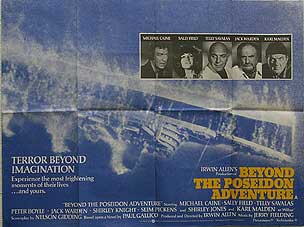
Films of Michael Caine #35: Beyond the Poseidon Adventure (1979)

Cast: Michael Caine (Captain Mike Turner), Sally Field (Celeste Whitman), Telly Savalas (Stefan Svevo), Peter Boyle (Frank Mazzetti), Jack Warden (Harold Meredith), Shirley Knight (Hannah Meredith), Shirley Jones (Gina Rowe), Karl Malden (Wilbur Hubbard), Slim Pickens (Tex), Veronica Hamel (Suzanne Constantine), Angela Cartwright (Theresa Mazzetti), Mark Harmon (Larry Simpson).

Crew: Irwin Allen (director and producer), Nelson Gidding (writer), Jerry Fielding (music), Joseph Biroc (cinematography), Bill Brame (editor), Preston Ames (production designer).

Synopsis: The luxury cruise ship Poseidon is capsized by a massive wave during a storm. Nearby Captain Mike Turner keeps his tugboat Jenny from flipping, but loses his cargo. A bank will foreclose on Turner’s boat if he returns to shore. A coast guard helicopter leads him to discover the Poseidon, upside down but still afloat – just. Turner wants salvage rights to the ship. Another vessel arrives, captained by Stefan Svevo. He claims to be a doctor. Turner and his two crew, Wilbur and Celeste, climb down into the Poseidon, accompanied by Svevo and three paramedics. As they descend, their escape route is cut off. Moving through the corridors, the group finds eight passengers still alive. Turner discovers Svevo is intent on recovering plutonium, not saving lives. Drowning and shootings claim several passengers. Turner succeeds in getting four passengers and Celeste away safely, but loses nearly all the loot he had salvaged. The Poseidon explodes, killing Svevo and his henchman…

+++++++++++++++++++++++++++

The Poseidon Adventure, based on a novel by Paul Gallico, was a smash hit movie in 1972. It grossed more than $80 million in the US, garnered three Oscar nominations and a win for best song. It also created a new genre, the disaster movie. The formula was simple – gather a dozen stars in one location, give them just enough character to make audiences care what happens next, then trap the lot in a disaster with lavish special effects and maximum thrills. Producer Irwin Allen was the master of disaster movies, but by the end of the 1970s the genre had fallen out of fashion.

Allen decided to make a sequel to the film that started the trend. Most sequels either show what happened next or simply remake the story with a fresh cast. Nelson Gidding’s script opted for the latter choice. Allen chose to direct the picture himself, despite the critical backlash to his previous effort, The Swarm (1978). Returning from that film was Caine. ‘I made it for a friend of mine,’ he told Film Comment in 1980. ‘I liked the idea of it. I had never been in a big Hollywood special effects picture before, and I thought the experience would be interesting. Trying to make something of the rather cardboard characters in those movies is quite difficult. Also, I wanted pictures in America. I was just moving there, I needed to start making a living. That was a very important consideration.’

Caine moved to Hollywood in early 1979. In February he told the Daily Mirror that Britain’s crippling tax rates for high earners were not his only reasons for shifting. ‘When I left London last month it was freezing, there were strikes everywhere. If I hadn’t already decided to go and live in California, that would have been enough to make me. Besides the sunshine and only 50 per cent maximum tax, hardly any of my films are made in Britain.’

Beyond the Poseidon Adventure was shot predominantly at Burbank Studios in California. The hull of the capsized ship was constructed on a barge and then floated in the Pacific, south of Malibu. Cast members were flown out by helicopter to the barge for filming at sea. Caine overcame his claustrophobia learning how to scuba dive for the underwater sequences. But all the effort counted for little. Released across America in May 1979 as a PG. Beyond the Poseidon Adventure was savaged by critics and audiences stayed away. Several months later it reached the UK, where the BBFC required minor cuts before rating the film A.

‘I obviously didn’t read the script for either Beyond the Poseidon Adventure or The Swarm and say “This’ll get me an Academy Award, I must do it at all costs,”’ Caine told Film Comment. ‘Frankly, I thought both of these movies would be much better than they were. I had tremendous thoughts about the special effects possibilities … but the effects in Poseidon were so much smaller than in the original. Kind of chintzy, really.’

Beyond the Poseidon Adventure was first released on VHS in 1987 and leaked out on DVD in 2006. Disaster movies made a comeback in the late 1990s with the success of Independence Day (1996) and Titanic (1997), but Allen had died in 1991 and did not see his creation’s revival.

Reviews: ‘More a movie disaster than a disaster movie…’ – The Sunday Express
‘A virtual remake of the 1972 original, without that film’s mounting suspense and excitement.’ – Variety

Verdict: Cheap and cheerless, Beyond the Poseidon Adventure is an exercise in futility. The lacklustre script shamelessly recycles the original film’s plot, adding a mediocre villain. Caine is the lead but rarely gets to do more than spout exposition and grit his teeth. What little action there is grinds to a halt so the supporting cast can each have a moment in the spotlight. Convenient explosions either endanger or rescue the cast, depending upon plot requirements, while Allen’s direction is joyless and dreary, never coming close to attaining the original film’s suspense. The explosion that finally sinks the Poseidon best resembles a firecracker let off in a bathtub. This film isn’t bad enough to be entertainingly awful, merely dull and mediocre.

Wednesday, December 13, 2006

Shed not buying World after all?

Yesterday I made mention of a report in Broadcast that UK independent TV production company Shed was looking to buy another such prodco, World. World is among the few UK indie prodcos that will look at unsolicited work, a writer-friendly attitude that's to be applauded. The commendably frank English Dave took up this story on his blog and says the Broadcast report is plain wrong, according to his sources. Anybody else with any further intelligence on this tale, feel free to let me know!

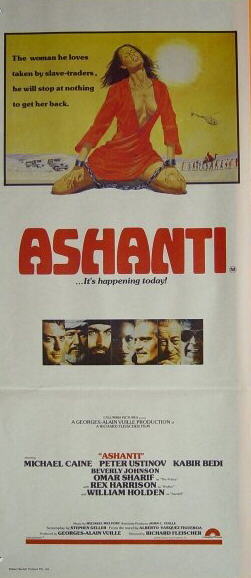
Films of Michael Caine #34: Ashanti

Cast: Michael Caine (Dr David Linderby), Peter Ustinov (Suleiman), Kabir Bedi (Malik), Beverly Johnson (Dr Anansa Linderby), Omar Sharif (Prince Hassan), Rex Harrison (Brian Walker), William Holden (James Sandell), Zia Mohyeddin (Djamel), Winston Ntshona (Ansok), Tariq Yunus (Faid), Tyrone Jackson (Dongaro), Akosua Busia (The Senofu Girl).

Crew: Richard Fleischer (director), Georges-Alain Vuille (producer), Stephen Geller (writer); Michael Melvoin (music); Aldo Tonti (cinematography); Ernest Walter (editor), Mario Chiari, Aurelio Crugnola and Kuli Sander (art direction).

Synopsis: Doctors David and Anansa Linderby are travelling around West Africa inoculating people in villages for the World Health Organisation. Anansa’s ancestors were members of the Ashanti tribe, but she was educated in America before marrying her white English husband. Anansa is abducted by slave traders led by a ruthless Arab, Suleiman. David pursues Suleiman’s caravan of slaves for three thousand miles across Africa to the Red Sea. He is aided by Malik, an Arab who has sworn vengeance after Suleiman abducted and sold Malik’s family as slaves. The duo finally confront Suleiman, but he has already sold Anansa into slavery. He agrees to say more only if Malik swears not to slay him. Suleiman says Anansa was bought by an Arab royal, Prince Hassan, who has already set sail. David murders Suleiman. The doctor and Malik get aboard the prince’s ship and rescue Anansa, but Malik is killed by the prince’s bodyguards…

+++++++++++++++++++++++++++

Ashanti was based on the 1976 novel Ebano by Alberto Vasquez-Figueroa about slave trading in Africa during the 1970s. The film’s production was troubled, with the original director, female lead and several crew members leaving after the first week. Work resumed a fortnight later, with the film shot on location in Kenya, Israel and Sicily, with the Sinai Desert doubling for the Sahara. ‘Of the films I’ve made Ashanti was by far the hardest,’ Caine told the Sunday Express in 1978. Filming took place in 130 degree heat. ‘The Egyptians can have the Sinai Desert back as far as I’m concerned. The camels were fainting from the heat and they still expected me to act.’

Two years later Caine told Film Comment magazine Ashanti was the only film he’d ever made just for the pay cheque. He was moving to Hollywood and needed cash. ‘I did Ashanti solely for the money, and I have never been so unhappy in my career. I swore I would never do it again, no matter how broke I was. That was the one and only time. Though I did what I could with the part, I hated and loathed ever second on it.’

The BBFC gave the film an AA Certificate, allowing anyone aged 14 or above to see it. Neither critics nor the public were impressed when it was released in Britain early in 1979. The Council for the Advancement of Arab-British Understanding was incensed by the movie, issuing the following statement: ‘Ashanti is one of the most virulent examples of Israel’s supporters attempting to prejudice Western opinions against the Arabs.’ In the US, Ashanti was released in April 1979 with an R rating from the Motion Picture Association of America (MPAA). Seven years later the film crept out on video in the UK, reclassified as a 15. It was re-released on VHS in 2000, but became available on DVD in 2006.

Reviews: ‘Absurd and rather unattractively brutal adventure story…’ – Halliwell’s Film & Video Guide
‘It is a toss-up as to whether Ustinov or the camels have the best lines’ - The Guardian

Verdict: In his autobiography, Caine calls Ashanti the worst, most wretched movie he ever made. He certainly seems to have had a terrible time during shooting, but there are worse pictures in his long career. This film is blander than a blancmange and twice as lifeless. Geller’s script never rises about routine, introducing characters with potential and then dismissing them minutes later. As the slave trader Ustinov gets all the best lines and hams like crazy, but Caine merely alternates between anger and frustration. A particular low point is when he spends two minutes trying to get on a camel in what is presumably meant to be a comic interlude. Fleischer’s flat, flabby direction leaves you begging for the end, but the finale is perfunctory at best. Ashanti is best watched with the fast forward button close to hand – or not watched at all.

Tuesday, December 12, 2006

It's official: Torchwood gets 2nd run, new home

In news that should surprise nobody, Doctor Who's mature viewers spin-off Torchwood is getting a second series. This was always on the cards after the first episode got 2.4 million on the digital channel BBC3 - one of the highest audiences ever for a non-terrestrial drama. Ratings have dropped considerably since then, but the first run of Torchwood is still out-performing the third series of Lost on Sky. Sky paid nearly a million pounds an episode to snatch Lost away from Channel 4, so Torchwood is a bona fide hit whichever way you slice it.

A slight surprise comes from the fact that the second series of Torchwood will make its debut on BBC2, not BBC3. It seems BBC2 controller Roly Keating won the battle to wrest the show away from his counterpart at BBC3 - no doubt that decision was less than popular at BBC3 when it was announced. Shooting for Torchwood's next series begins in the spring for an autumn 2007 launch. I've only seen a few episodes of the first run, so I can't comment with any authority about the series, but I have heard tell the quality is getting more consistent after some early peaks and troughs.

In other news from the BBC2 winter/spring launch, it's not long until the debut of Party Animals, an eight-part series about twentysomethings pursuing careers in politics. Sounds like a British blend of This Life and The West Wing, which would be a great thing if it works. The show is made by World Productions, who've also got the much-anticipated This Life reunion special on BBC2 over the festive season. I sat next to a development script editor from World during the TAPS course and she was singing the praises of Party Animals, so I'll definitely be sampling that series.

In other news, World is being sized up for acquisition by another independent British television production company, Shed. If the deal goes ahead, it could well signal a fresh wave of cannabalistic mergers and acquisitions within the sector. It's be a shame in at least one way if Shed swallows World, as World is among the few indie prodcos that will read unsolicited material. Time will tell, as usual...

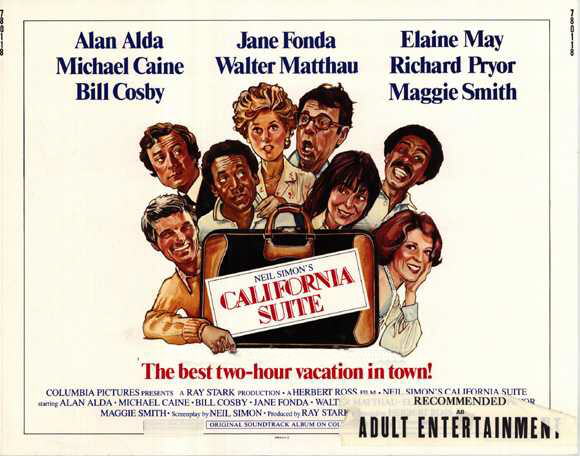
Films of Michael Caine #33: California Suite

Cast: Jane Fonda (Hannah Warren), Alan Alda (Bill Warren), Maggie Smith (Diana Barrie), Michael Caine (Sidney Cochran), Walter Matthau (Marvin Michaels), Elaine May (Millie Michaels), Herbert Edelman (Harry Michaels), Denise Galik (Bunny), Richard Pryor (Dr Chauncey Gump), Bill Cosby (Dr Willis Panama), Gloria Gifford (Lola Gump), Sheila Frazier (Bettina Panama).

Crew: Herbert Ross (director), Ray Stark (producer), Neil Simon (writer), Claude Bolling (music), David M Walsh (cinematography), Michael A Stevenson (editor), Albert Brenner (production designer).

Synopsis: Five couples arrive at the Beverly Hills Hotel in California. New York journalist Hannah Warren is meeting her ex-husband Bill. Their seventeen-year-old daughter Jenny ran away to California to stay with Bill. Hannah wants her daughter to come home but eventually relents. Diana Barrie is nominated for best actress at the Academy Awards. She arrives at the hotel with her bisexual husband, Sidney Cochran. Diana does not win the Oscar and gets drunk. In the aftermath she and Sidney have a bitter argument, but manage to renew their love for each other. Marvin Michaels travels to Los Angeles for his nephew’s bar mitzvah. Marvin’s brother Harry pays for a prostitute to spend the night with Marvin. Next morning Marvin’s wife Millie arrives and discovers the hooker. Millie forgives her husband but vows to spend all his money. Two doctors from Chicago and their wives drive across the country on what is supposed to be the holiday of a lifetime. But the vacation is one long argument that finally turns violent…

+++++++++++++++++++++++++++

Playwright Neil Simon has great success in 1968 with Plaza Suite, a collection of one-act plays all set in the same New York hotel room. The play became a successful film in 1971, starring Walter Matthau. Five years later Simon returned to the formula for California Suite, this time relocating events to the Beverly Hills Hotel. In 1978 director Herbert Ross collaborated with Simon on adapting that play into a film. Rather than simply presenting the stories one after the other, they opted to intersperse events from the four tales.

The project attracted a high calibre cast with six of actors having won or been nominated for Oscars. Caine played Sidney Cochran, his first performance as a gay man on film. ‘It was quite a difficult role but fascinating,’ he told the Daily Mirror in 1979. ‘I really don’t know what it will do to my image. The homosexuals will probably say, “I always knew he was one” and the heterosexuals will say, “I always wondered about him.”’

In a 2002 interview with Venice magazine, Caine recalled an encounter with Neil Simon on set during shooting. ‘One day he said to me, “You can really do my stuff. I’ve been watching the rushes.” I said, “Yeah, do you know what the secret to doing Neil Simon is? You can never stop moving.” You can’t do it standing still. It’s like Groucho Marx.’

California Suite received its US premiere in December 1978, rated PG. The picture got mixed reviews, with the sequence starring Caine and Maggie Smith getting the best notices. But the film still grossed nearly $30 million, aided by a strong showing at the awards ceremonies. Smith won for best actress in a musical or comedy at the Golden Globes, and the picture was nominated as best musical or comedy film. Smith was also nominated at the BAFTAs. She won an Oscar as best supporting actress – ironically for playing an actress who doesn’t win an Oscar. The film was received nominations for Simon’s screenplay and art direction. In her acceptance speech Smith thanked Caine, saying he deserved half her statuette: ‘It should be split down the middle.’

The film opened in the UK during March 1979, rated AA. Again, reviews praised Caine and Smith. In 1980 Caine considered the performance in California Suite among his best. ‘The timing was everything,’ he told Film Comment. ‘Doing that character was like walking on a razor blade. Very, very difficult and enervating.’ The film was released on video in the UK with a 15 rating in 1988. This was subsequently lowered to a 12 by the BBFC in 2001. California Suite is available on DVD in Britain and the US.

In 1994 Simon wrote London Suite, completing his trilogy of hotel-based plays. The characters played by Caine and Smith in California Suite returned in the new stage show. Caine declined an invitation to perform in the play, but offered his services if London Suite ever became a film.

Reviews: ‘The only story that is remotely successful is that concerning an Oscar nominated actress coming to terms with her husband’s bi-sexuality, touchingly conveyed by Michael Caine who’s better than he has been for many films…’ – Sunday Telegraph
‘Neil Simon and Herbert Ross have gambled in radically altering the successful format of California Suite … veering from poignant emotionalism to broad slapstick in sudden shifts.’ – Variety

Verdict: Transferring a successful stage play to the screen is a tricky business. Taking a show made up of four small plays and turning that into a movie is even harder. Despite having a great cast, an acclaimed writer and an Oscar-nominated director, California Suite doesn’t work as a cohesive movie. Cutting the four stories together simply heightens the disparities between them, rather than creating a meaningful contrast. Best of the quartet are the pairing of Caine and Smith as husband and wife, their scenes together both funny and moving. While Alan Alda and Jane Fonda get funnier dialogue in their segment, the British duo display far greater finesse. The bedroom farce with Walter Matthau is mildly amusing but the slapstick antics of Bill Cosby and Richard Pryor are just annoying. California Suite is the filmic definition of something being less than the sum of its parts.

Monday, December 11, 2006

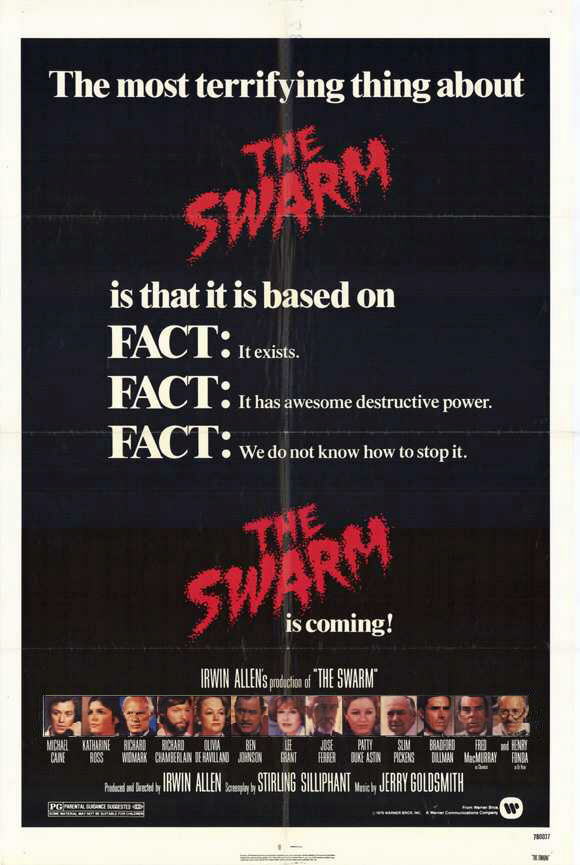
Films of Michael Caine #32: The Swarm


Cast: Michael Caine (Brad Crane), Katharine Ross (Helena), Richard Widmark (General Slater), Richard Chamberlain (Dr Hubbard), Olivia de Havilland (Maureen), Ben Johnson (Felix), Lee Grant (Anne MacGregor), Jose Ferrer (Dr Andrews), Patty Duke Astin (Rita), Slim Pickens (Jud Hawkins), Bradford Dillman (Major Baker), Fred MacMurray (Clarence) and Henry Fonda (Dr Krim).

Crew: Irwin Allen (director and producer), Stirling Silliphant (writer), Jerry Goldsmith (music), Fred J Koenekamp (cinematography), Harold F Kress (editor), Stan Jolley (production design).

Synopsis: Soldiers at a missile base in Texas are killed by an unknown foe. Entomologist Brad Crane is already on the scene when US military investigators arrive, led by General Slater. Crane claims the base was attacked by a swarm of African killer bees. His story is backed up by Dr Helena Anderson, one of the few staff to survive. The US President puts Crane in charge of efforts to stop the bees. Crane calls in experts from across the country, including America’s top immunologist, Dr Krim. The swarm attacks a nearby town of Marysville, killing 232 people. The rest of the townsfolk are evacuated by train, but this also encounters the bees. The train crashes and burns – only 17 people survive.

A massive airdrop of poison pellets fails to stop the swarm. Dr Krim dies after using killer bee stings to test a possible antidote on himself. The bees are flying towards the city of Houston, which is evacuated. The swarm attacks a nuclear power plant in its path. This explodes, killing more than 36,000. Slater gets presidential authority to replace Crane. He uses a deadly pesticide against the bees without success. The swarm attacks Houston. The military decides to set fire to the city. Crane discovers the missile base’s sonic alarm system is identical to the vibrations of the killer bees’ mating ritual – that’s why the swarm attacked the base. He uses sonic lures to lead the bees away from Houston to an oil slick. When the bees converge on the oil, it is set alight, destroying the swarm. Mankind is safe – for now…

+++++++++++++++++++++++++++

Irwin Allen produced the most successful disaster movies of the 1970s. He also directed several action sequences in The Towering Inferno (1974) and lensed uncredited scenes for The Poseidon Adventure (1972). Allen decided he wanted to direct an entire film and acquired the rights for Arthur Herzog’s killer bees novel, The Swarm, first published in 1974. Oscar-winning screenwriter Stirling Silliphant was hired to adapt the book and an all-star cast assembled, with Caine taking the lead as entomologist Brad Crane.

In 1978 Caine told Film Review he had always wanted to work with Allen. ‘I met him a couple of years ago and he said, “The next time I do a picture, I’ll do it with you.” You get lots of those sort of promises. But he’s obviously a man of his word because he next time he did a picture, he did indeed cast me.’ The actor said he used to dream about making a big Hollywood movie. He described what it was like working with screen legends like Henry Fonda, Olivia de Havilland and Richard Widmark. ‘A bit nerve-racking actually! But quite extraordinary!’

The Swarm was shot principally at Burbank Studios in California, with some location filming in Houston. The film had a reported budget of $15-21 million, but was a box office disaster when it reached US cinemas in July 1978. Rated PG, the picture grossed less than half its budget. Critics had a field day deriding the script, acting and direction, amongst other things. The picture was just an unsuccessful in Britain, where it was rated A.

‘The Swarm was one of the most difficult picture I’ve made,’ Caine told Film Comment in 1980. ‘Getting that dialogue and trying to make a reality for the character was an extraordinary exercise – like doing push-ups – and I’d recommend a picture like that to every actor. It’s funny about films like The Swarm … you’re a sort of catalyst for a whole group of people, pushing, pushing, pushing. And it’s very hard to do.’

Caine attributed the flop to its special effects. ‘Everyone keeps threatening to show it to me,’ he told the Sunday Express in 1978. ‘And I will see it one day. But I can tell you one thing – if it didn’t work, it was all the bees’ fault. I always knew they couldn’t act.’ Surprisingly, the picture received an Oscar nomination for best costume design (the award went to Death on the Nile (1978)). The Swarm was released on video in 1987, reclassified as PG. Eleven years later it was reissued with 30 minutes of extra footage incorporated. This pushed the classification up to a 12 in Britain. The film is available on DVD, but only in its extended version.

Caine recalled the film when interviewed by Empire in 1992. ‘It looked like it was gonna be good. If it were possible to know in advance how good a film will be, we’d all be in one box office smash after another and I’d be as rich as Paul McCartney.’

Reviews: ‘Killer bees periodically interrupt the arch writing, stilted direction and ludicrous acting in Irwin Allen’s disappointing and tired non-thriller.’ – Variety
‘It seems to be Caine’s sad fate to go around being intelligent in dumb movies.’ – Time

Verdict: The Swarm is so bad, it’s good. This film deserves to be included on any list of cult classic clunkers, such is the unbridled awfulness on show. In a single effort behind the camera Irwin Allen gave new meaning to the term disaster movie. Highlights in this unintentional comedy of terrors are a script packed with dialogue that beggars belief and a cast of stars who deliver their performances without a shred of irony. Caine appears to be channelling the acting talents of William Shatner, such is the gut-wrenching intensity of his characterisation in this addle-brained endeavour. The Swarm is not just a cheesy delight, it’s a quattro formaggi feast. Highly recommended, especially after excess alcohol imbibing.

Sunday, December 10, 2006

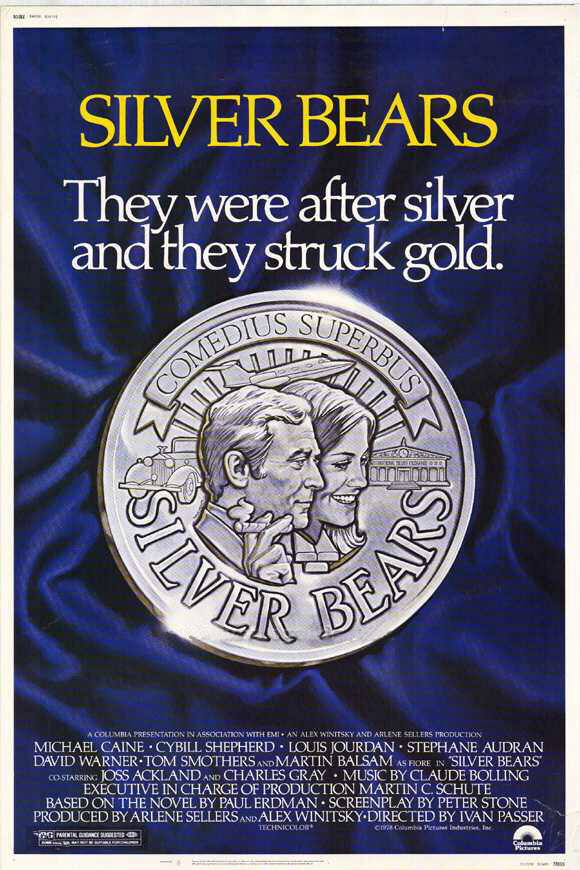
Films of Michael Caine #31: Silver Bears (1977)

Cast: Michael Caine (Doc Fletcher), Cybill Shepherd (Debbie Luckman), Louis Jourdan (Prince di Siracusa), Stephane Audran (Shireen Firdausi), David Warner (Agha Firdausi), Tom Smothers (Donald Luckman), Martin Balsam (Joe Fiore), Jay Leno (Albert Fiore), Tony Mascia (Marvin Skinner), Charles Gray (Charles Cook), Joss Ackland (Henry Foreman).

Crew: Ivan Passer (director), Arlene Sellers and Alex Winitsky (producers), Peter Stone (writer), Claude Bolling (music), Anthony Richmond (cinematography), Bernard Gribble (editor), Edward Marshall (art direction).

Synopsis: Doc Fletcher flies to Switzerland to buy a bank for Mafia boss Joe Fiore. Doc takes Fiore’s son Albert and a counterfeiter called Marvin Skinner. The $3 million deal is negotiated by Prince di Siracusa, a poor Italian aristocrat. But the bank proves to be just an office above a pizza restaurant in Lugano. Prince introduces Doc to siblings Agha and Shireen Firdausi. They show him a secret silver mine in Iran containing silver reputedly worth $1 billion. He loans them $20 million to fund exploitation. American banker Henry Foreman wants to buy a European bank. He sends one of his staff, Donald Luckman, to find a suitable candidate.

In London, the world’s richest man, Charles Cook, is worried when silver from the Firdausi mine depresses the market. He wants Luckman and Foreman to buy the Lugano bank for $60 million. Cook will then buy the silver mine from the Americans for $60 million, leaving them with a European bank acquired for nothing. Doc seduces Luckman’s ditzy wife Debbie to find out what is really going on. Fiore wants to sell the bank, but gives Doc a week to organise a management buyout. Doc tries to foreclose on the mine but discovers it does not exist. The Firdausis are smugglers, recycling silver trinkets from India into ingots. Doc engineers a complex deal that leaves him with ownership of the bank, no-one out of pocket and only one person going to jail – Luckman. Debbie moves in with Doc while her husband serves his prison sentence writing a book about his experiences…

+++++++++++++++++++++++++++

Paul Erdman’s novel, The Silver Bears, was a financial thriller set during the early 1970s collapse of silver prices. First published in 1974, the film rights were snapped up and screenwriter Peter Stone commissioned to turn the book into a comedy. Stone had achieved great success with his work on several Cary Grant films including Charade (1963). Director Ivan Passer was brought on board to helm the project. He had been a leading figure in the Czech cinema new wave during the 1960s, co-scripting all of Milos Forman’s native films. Passer left his homeland after the Soviet invasion of 1968.

In his 1992 autobiography, Caine recalled how he came to be cast as lead in Silver Bears. The actor was planning to shift from England to Los Angeles but his accountant said Caine was virtually penniless, thanks to Britain’s punitive taxes on high earners: ‘Panicking, I accepted the first offer of work that came along, to make a picture called Silver Bears.’ The picture reunited him with Joss Ackland, who worked on The Black Windmill (1974). Making his film debut in Silver Bears was young comedian Jay Leno, who later became famous as a TV host on The Tonight Show in the US.

The picture was shot in the final months of 1976, with locations in Switzerland, Morocco and England, and studio work at Twickenham. Caine was interviewed in Lugano by London’s Evening Standard newspaper. The actor had a ready explanation when told he looked lean and fit: ‘We were on location in Morocco. I had my usual cold and dysentery and lost 11 pounds.’ Despite what he later wrote in his autobiography, in the 1976 interview Caine denied rumours about going into tax exile. ‘You know, I took my decision and I’ll pay my taxes and stay in England.’

Silver Bears was released in British cinemas during 1977, rated A. Critics were unimpressed by the picture and it was not a hit at the box office. The pattern was repeated in America, where it was rated PG. The film was released on video a decade later but has since been deleted. Silver Bears has yet to make its DVD debut.

Reviews: ‘Amusing people. Opulent houses. Vintage cars. Glorious settings. Lovely women. Pity about the story.’ – Evening News
‘Director Ivan Passer has assembled a rather talented squad of performers, then marched them through a minefield, losing all hands in an attack on an uncertain objective.’ – Variety

Verdict: Silver Bears is proof that glamorous locations and a distinguished cast are not enough to overcome tepid direction and a yawn-inducing script. This film is supposed to be a comedy but laughs are few and far between. It takes nearly an hour to set up the first part of the premise before introducing a dozen new characters and subplots that merely muddy the stagnant waters of this unremarkable tale. Most of the actors seem to be sleepwalking through their paces. Caine’s performance is a strictly low energy affair. He is upstaged by the frenetic efforts of Cybill Shepherd, who yelps and screams as if being subjected to electric shocks through her underpants. This film is perhaps best used as an insomnia cure.

Saturday, December 09, 2006

No snow on the bloody logo, please

I've always been something of a premature Scrooge when it comes to the xmas spirit. Not that I mind giving or receiving presents, but the rampant commercialism of the season starts sooner and sooner every year. The nearest Tesco supermarket had Christmas stock out on sale at the end of September. At least in the US they have Halloween and Thanksgiving before festive insanity kicks in. The UK needs some other sort of delaying tactic holiday to stave off early onset xmas. When I was a comics editor in the 20th Century, I steadfastedly refused to have snow on the front cover logo every year. I hate magazines that snow on the logo, it's so crass and obvious. Besides, the onset of global warming means it'd be more accurate to feature coconuts and palm trees these days, not snow.

Thanks to Matt at Talking Fingers for tipping me off to this classic Chrismas ad shown below, ripping the urine out of a famous festive cartoon called The Snowman. Up here in Scotland, Irn Bru is a national institution. At the Biggar Theatre Workshop, we once had a glut of Diet Irn Bru and Guinnes. We thought you could mix the two and create an amazing new cocktail, named the Velvet Girder - nobody ever had the courage to try it. Anyway, this one's for Aled bloody Jones...

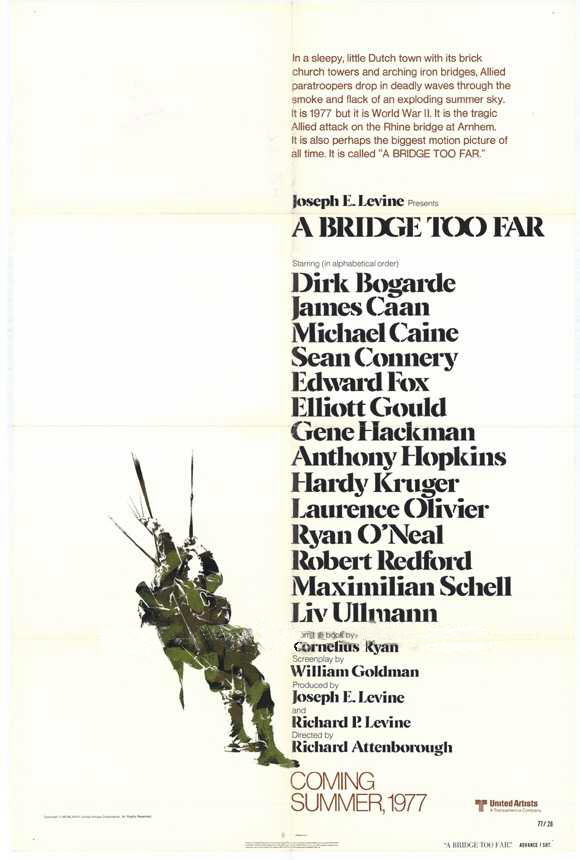
Films of Michael Caine #30: A Bridge Too Far

Cast: Dirk Bogarde (Lieutenant General Browning), James Caan (Staff Sergeant Dohun), Michael Caine (Lieutenant Colonel J O E Vandeleur), Sean Connery (Major General Urquhart), Edward Fox (Lieutenant General Horrocks), Elliott Gould (Colonel Stout), Gene Hackman (Major General Sosabowski), Anthony Hopkins (Lieutenant Colonel Frost), Hardy Kruger (Major General Ludwig), Laurence Olivier (Doctor Spaander), Ryan O’Neal (Brigadier General Gavin), Robert Redford (Major Cook), Maximilian Schell (Lieutenant General Bittrich), Liv Ullman (Kate Ter Horst).

Crew: Richard Attenborough (director), Joseph E Levine and Richard P Levine (producers), William Goldman (writer), John Addison (music), Geoffrey Unsworth (cinematography), Antony Gibbs (editor), Terence March (production designer).

Synopsis: In a bid to end the Second World War in Europe by Christmas 1944, the Allies launch Operation Market Garden. Thirty-five thousand troops are dropped behind enemy lines in Holland with orders to take and hold a series of vital bridges. Meanwhile ground forces are ordered to smash through the German forces and link up with the paratroopers, travelling sixty-three miles in just two days. The goal is to secure Arnhem Bridge, giving the Allies direct access to the heartland of Germany. But weather conditions, technical problems and tactical errors bedevil the operation. It takes the ground troops nine days instead of two to reach Arnhem and the armoured advance fails one mile short of the bridge. The Allies are forced to pull back…

+++++++++++++++++++++++++++

Operation Market Garden was one of the Second World War’s most heroic failures. It was the largest airborne operation ever mounted and cost the lives of thousands of soldiers. Cornelius Ryan turned these events into an international bestseller, A Bridge Too Far, first published in 1974. Film rights were optioned by independent producer Joseph E Levine, who came out of retirement for this project. Levine had helped make such diverse movies as Zulu (1964), The Graduate (1967), and Carnal Knowledge (1971).

A Bridge Too Far was a massive endeavour, with a cast of thousands and fourteen major actors in starring roles. It was reportedly the most expensive British production ever made at the time, with a budget estimated between $22 million and $45 million. To finance the project, Levine hired a superstar cast to pre-sell the film to distributors world-wide. The producer paid his stars a flat fee of $500,000 to $1 million a week each.

Britain actor-director Richard Attenborough was chosen to helm the picture, while Oscar-winning scribe William Goldman turned the sprawling epic into a three-hour screenplay. (There is a fascinating chapter about the production in Goldman’s seminal book, Adventures in the Screen Trade.) Filming took place over six months on location in Holland and England, with interiors at Twickenham Studios. Despite the massive scope of the project, it finished on schedule and under budget.

Caine was one of the fourteen actors hired to fill the starring roles. He played Lieutenant Colonel J O E Vandeleur, leading the armoured ground forces on their charge towards Arnhem. Caine arrived on location only two days after finishing after another WWII film, The Eagle Has Landed (1976). But while that picture purported to have some basis in fact, A Bridge Too Far was firmly reality-based. Caine sought advice from the real Vandeleur, who was a technical advisor on set. The veteran was full of praise for his film incarnation. ‘Michael Caine was first class,’ Vandeleur told the Daily Express. ‘I think it will be a marvellous film. Dickie Attenborough is a great director.’

The picture was released on June 15 1977 across America, rated PG. The MPAA had initially branded it an R but this was changed after an appeal by Levine. The film grossed more than $50 million in the US, but received mixed reviews. American critics found elements of the story unbelievable, despite the factual source material. The British release followed a week later, with the BBFC requiring cuts before granting an A rating. UK reviewers were also unsympathetic, some paying as much attention to the cost of the film as to the content. Despite this A Bridge Too Far was nominated for eight BAFTA awards in 1978 and won four – best supporting actor (Fox), music, soundtrack and cinematography. The film was first released on video in 1986 and remains available, rated 15. A DVD edition followed in 2001 with a two-disc special edition in 2003.

Reviews: ‘When celluloid death is so random and so spectacular, so mechanised and so grotesque … then it is impossible not to fill the screen, intermittently, with pictures which stun the mind and bruise the conscience.’ – Sunday Times
‘So wearily, expensively predictable that by the end the viewer will in all likelihood be too enervated to notice Attenborough’s prosaic moral epilogue.’ – MFB

Verdict: Like Battle of Britain, this film is a Second World War epic based on real events, encrusted with big name actors in small roles. But A Bridge Too Far is the more successful of the pair, keeping its focus on the war and not getting diverted by attempts at human interest. This is a accomplished feat of filmmaking by Attenborough, with stunning imagery and a stirring score. Goldman’s screenplay succeeds in making such a sprawling event easy to follow, while familiar faces helps the viewer keep track of who’s who. Caine’s role is relatively minor and mainly involves sitting atop an armoured vehicle. This film is superior to Battle of Britain, but the failure of Operation Market Garden necessitates a downbeat ending that may leave you unsatisfied.

Friday, December 08, 2006

Films of Michael Caine #29: The Eagle Has Landed

Back to college for my screenwriting MA course [featuring guest speaker Ian Rankin today!], so it's time for another delve into the archives with an entry about the films of Michael Caine...

THE EAGLE HAS LANDED (1976)

Cast: Michael Caine (Colonel Steiner), Donald Sutherland (Liam Devlin), Robert Duvall (Colonel Radl), Jenny Agutter (Molly), Donald Pleasence (Himmler), Anthony Quayle (Admiral Canaris), Jean Marsh (Joanna Grey), Sven-Bertil Taube (Captain von Neustadt), John Standing (Father Verecker), Judy Geeson (Pamela), Treat Williams (Captain Clark), Larry Hagman (Colonel Pitts).
Crew: John Sturges (director), Jack Wiener and David Niven Jr (producers), Tom Mankiewicz (writer), Lalo Schifrin (music), Anthony Richmond (cinematography), Anne V Coates (editor), Peter Murton (production design).

Synopsis: In 1943 Adolf Hitler commissions a feasibility study into kidnapping British Prime Minister Winston Churchill. Colonel Radl believes the task may be possible after learning Churchill is to visit a small Norfolk village. Radl selects an IRA dissident, Liam Devlin, to parachute into England to make preparations. For the kidnapping Radl selects a disgraced war hero, Colonel Steiner, and his squad of 16 paratroopers. The insurgents enter the village posing as Polish troops. But their true identities are discovered when one of the Germans dies saving a local child from drowning. Steiner and his men take the villagers hostage in the church. The priest’s sister escapes and alerts a nearby company of American troops. The foolhardy leader, Colonel Pitts, leads a disastrous attack against the church. Steiner escapes the church but his men volunteer to stay behind, giving him more time. They all die in the next attack. That night Steiner finds Churchill and assassinates the British leader, before being gunned down himself. But the real Churchill is at a secret meeting in Persia – the man Steiner killed was a variety artist pretending to be Churchill. Radl is executed by firing squad for the mission’s failure…

+++++++++++++++++++++++++++

The Eagle Has Landed began life as a best-selling novel by Jack Higgins, claiming its story had some basis in reality. The book was quickly optioned for the cinema with Tom Mankiewicz adapting it for the big screen. US director John Sturges was attached to the project, having previously helmed such classic films as Bad Day at Black Rock (1955), The Magnificent Seven (1960) and The Great Escape (1963).

The leading role of Colonel Kurt Steiner went to Caine, who developed several different variations of accent for his performance. ‘At first we thought that Steiner should have a German accent when he’s in Germany and an English accent when he comes to England,’ the actor told Photoplay Film Monthly in 1976. ‘But then we decided that the German characters wouldn’t have an accent when they’re talking amongst themselves, because they wouldn’t sound foreign to each other. So I used a clipped military accent for the scenes when Steiner’s giving orders to his men in German.’

One of Caine’s reasons for accepting the part was a chance to be directed by Sturges. ‘I’ve never worked with John before but I admire his work very much,’ the actor said. The film also reunited him with Donald Sutherland. ‘Donald’s an old mate. We first worked together years ago on an early episode of Dixon of Dock Green.’ Sutherland had also made a brief appearance in the third Harry Palmer film, Billion Dollar Brain (1967).

The Eagle Has Landed was shot over twelve weeks in the summer of 1976. For the first week the production went to Rovaniemi in Finland, the biggest town on the Arctic Circle. Caine had sworn off ever returning to Finland after the making of Billion Dollar Brain, but went back for Sturges. That was followed by a week in Cornwall, which doubled the Channel Islands. The bulk of filming took place in a Berkshire village, Mapledurham. Among the extras was a young Ray Winstone, who co-starred with Caine in Last Orders (2001) quarter of a century later.

The film was released across Britain with an A rating at the end of 1976, receiving harsh reviews from many critics. It reached America early in 1977, rated a PG. The film proved to be the swan-song of Sturges’ career. The Eagle Has Landed was first released on VHS in 1986, reclassified as a 15 in the UK. A budget price DVD version was issued in Britain during 2000, but this full-screen edition suffers from poor picture quality and cannot be recommended. A widescreen DVD is available in the US. [Update: various special editions and widescreen version have since appeared on DVD in both territories, with or without extra footage.]

Reviews: ‘The film manages the remarkable feat of being both far-fetched and dull at the same time. Caine, Sutherland and a host of stalwart British character actors go through their paces with unblenching professionalism.’ – Financial Times
‘Since most moviegoers probably know that German forces did not kidnap Winston Churchill during World War II The Eagle Has Landed is in the unenviable position of being a thriller without thrills.’ – Newsweek

Verdict: The Eagle Has Landed could have been lifted straight from the pages of war comics like Battle Picture Weekly or Commando. More mature minds will reject it as fanciful nonsense. The mission must fail because history tells you the Nazis did not kidnap Churchill, thus limiting any suspense. The film’s pace feels too languid for a thriller, while an attempt to develop a romantic subplot is cursory at best. But Caine succeeds in making his character sympathetic, aided by a clever variation of accent and manner. Your enjoyment will depend upon how far you are willing to suspend your disbelief.

Thursday, December 07, 2006

Groovy artists' blogs a-go-go

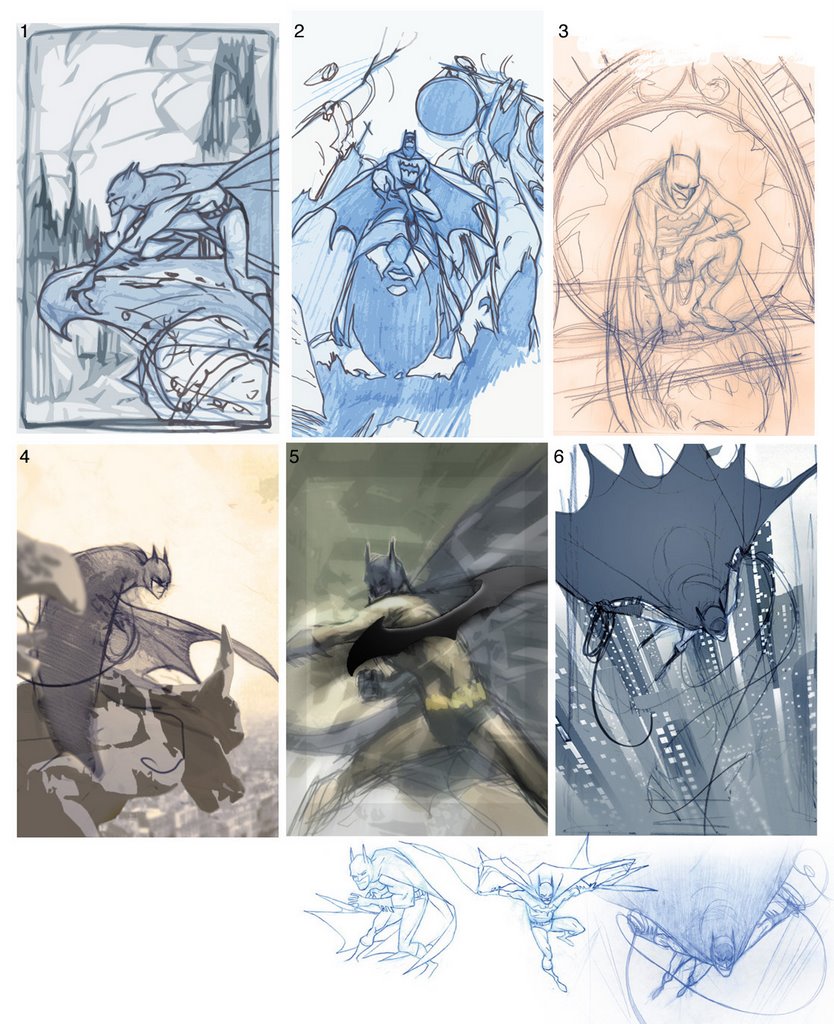
Josh Middleton has got his own blog, chock full of lovely sketches - love this guy's work!

The unfeasibly talented D'Israeli [a.k.a. Matt Brooker] has also gone blog-tastic, as evidenced by the, err, evidence below...

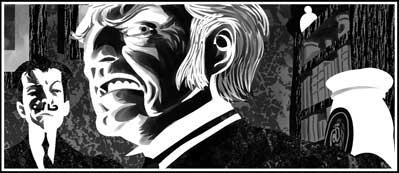
Last but certainly not least, savour the art of Mike McMahon!

Not Ready For Primetime Player - yet.

In the comments section of my blog posting about Day 2 of the TAPS TV script editing course, tonyB asks if I'd considered trying out as a writer on The Bill. Yes, I have considered it - but I don't think I'm nearly ready for that. Yet. I was a high court reporter in New Zealand for a year, covering the trials for serious offences like murder and rape. I've also been a reporter covering the police round numerous times in my career, so I've no shortage of stories I could tell. But I'm not ready yet.

For a start, The Bill wants writers with some experience, some 'seasoning' as one of my former editors once put it. there have been nearly 500 episodes of The Bill over the past 20+ years and I doubt more than a handful have been scripted by newcomers to TV drama. Judging by the script we worked on at the TAPS course, it's a particularly terse show, full of clipped dialogue, clipped writing and snappy storytelling. That suits me fine, but I'd want a few things under my belt before I considered trying out for the show. According to Mark G [in the same comments section], it's a very demanding and challenging show - something I don't doubt for a moment.

I've had a couple of opportunities to get my foot in the door of TV shows before and on both occasions I blew it. The problem wasn't so much storytelling talent - I figure I've got to have some of that, otherwise I wouldn't be able to make a decent living from telling stories via radio, novels, audio dramas, comics and the like. The problem was a lack of craft in writing for TV, and amateur hour ignorance of what not to do. If you don't know any better, you don't know any better. Last year I realised was never going to get anywhere in TV and radio drama unless I took the time to improve my craft and got to know more about the broadcast drama industry.

In a way, it's the return of Doctor Who to TV that get me a much needed punt up the posterior. I emigrated to the UK in January 1990, hoping one day I might get the chance to write an episode of Doctor Who for TV. Unfortunately, the show was about to lapse into oblivion for the next 15 years, barring a one-off TV movie in 1996. So my long-cherished goal was more of a pipe-dream. But when the show came back and was a success, that old dream resurfaced once more and gave me a nudge.

If I want to write Doctor Who for TV one day - and I still do - then I needed to get my act together and become a professional, experienced and skillful writer of broadcast drama. Hence the two radio drama labs I've been on. Hence the screenwriting MA I'm doing at Screen Academy Scotland. Hence the mentoring project with Adrian Mead guiding me towards writing an original calling card TV script, the pilot for a returnign drama series. Hence the TAPS TV script editing course I did last weekend. hence my efforts to get a foot in the door at River City. [Like everyone else who submitted material to the show this year, I'm still awaiting on feedback to my sample scenes. Fingers crossed for news before Christmas!]

All of these efforts are me actively trying to improve my craft, improve my knowledge of the industry, improve my chances of being ready for the next opportunity when it comes. By next September I intend to have three original calling card scripts - one of 10-minutes in duration, a 25-minute effort and a feature-length screenplay. Plus I'll have the pilot script for my original returning drama series. These will be my tools for getting an agent and, from there, getting some meetings. By this time next year, I want to be ready for primetime. Bring it on!

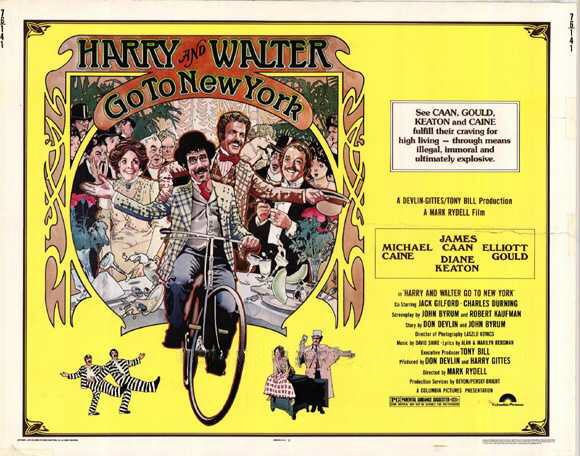
Films of Michael Caine #28: Harry and Walter Go to New York (1976)

Cast: James Caan (Harry Dighby), Elliott Gould (Walter Hill), Michael Caine (Adam Worth), Diane Keaton (Lissa Chestnut), Charles Durning (Rufus T Crisp), Lesley Ann Warren (Gloria Fontaine), Val Avery (Chatsworth), Jack Gilford (Mischa), Carol Kane (Florence), Kathryn Grody (Barbara), David Proval (Ben).

Crew: Mark Rydell (director), Don Devlin and Harry Gittes (producers), John Byrum and Robert Kaufman (writers), David Shire (music), Laszlo Kovacs (cinematography), Fredric Steinkamp, David Bretherton and Don Guidice (editors), Harry Horner (production designer).

Synopsis: Harry and Walter are bumbling entertainers on the American vaudeville circuit in 1892. The pair are arrested for petty theft and jailed in Massachusetts. Adam Worth is a millionaire celebrity who indulges in safecracking just for the thrills. The gentleman thief dines at Shang Drapers in New York, a renowned restaurant that caters to only the most refined criminals. Worth is arrested for cracking the safe of a bank in Lowell, Massachusetts. The manager, Rufus T Crisp, brags that his new bank is invulnerable. Worth is sent to prison in Massachusetts, but even there he is treated like royalty. Harry and Walter become his servants. Worth receives the blueprints for Crisp’s new bank. The safecracker is visited by reporter Lissa Chestnut and a photographer from The Advocate, a people’s paper published in New York. She invites Harry and Walter to visit her office when they are released. The bumbling pair use The Advocate’s camera to take a photo of the blueprints. In the process they set fire to the plans, infuriating Worth. Harry and Walter escape and travel to New York. They join The Advocate’s staff to get the photo of the blueprints. But Worth reappears, having been released from prison. He threatens Lissa, her co-workers and Walter until Harry hands over the photo. Both sides race to rob Crisp’s bank in Massachusetts first. Harry, Walter and friends succeed, using Worth’s own plan. Back in New York Harry and Walter are welcomed to the criminal elite, with Worth leading the plaudits …

+++++++++++++++++++++++++++

Harry and Walter Go to New York (Harry and Walter hereafter) began life as a story by Don Devlin and John Byrum. This was adapted into a screenplay by Byrum and Robert Kaufman for Mark Rydell to direct. Rydell had achieved some success as an actor, while his directing credits included work for TV and the cinema. Harry and Walter was a lavishly mounted production, predominantly shot at Burbank Studios in California. An old penitentiary in Ohio was used as the location for the prison scenes.

Caine was cast in the role of Adam Worth, gentleman safecracker and celebrity thief. He was interviewed on set by Viva magazine in 1975, explaining his criteria for choosing the project: ‘How interesting is the part? Who will I be working with? Are they going to spend enough money on the production to get quality?’ After a decade of success in cinema, Caine said he had no intention of returning to theatre acting. ‘I associate the stage with misery, struggle, hardship, and no money. But motion pictures have meant riches and delirious happiness. I keep reading about movie actors, particularly British actors, who say they need to “return to the well” – to legitimate theatre – to purify their art. But I definitely don’t need any more of that.’

In January 1976 Caine told the Evening Standard about making Harry and Walter. ‘The role I had in this film was entirely different for me. I play an American who has had an Oxford education and speaks with a posh Oxford accent. He aspires to being an English gentleman. I had to revert to my Zulu accent. James Caan and Elliott Gould are also in the film. We were just like three mates. I’ve known them a long time.’

Harry and Walter was lambasted by American reviewers and ignored by audiences when released in 1976, rated PG. It reached the UK in August that year (rated U) and bombed again, with critics particularly savage about Caan and Gould. Harry and Walter was released on video in the UK during 1986 but has long since been deleted. The film was issued on DVD for the US market in 2002.

Reviews: ‘It’s not the fault of Michael Caine that Harry and Walter Go to New York is a four-star flop. Caine and Miss Keaton do their best to salvage something from the chaos, but they are clobbered by the crude fooling of Caan and Gould.’ – Daily Mirror
‘This film fails to work as a light comedy, as a period piece, as a jigsaw puzzle … mainly, it just sits there and dies.’ – New York Post

Verdict: This film is apparently only 111 minutes long, but it feels more like a three-hour epic by the time it finally finishes. For something billed as a period comedy, Harry and Walter Go to New York is painfully unfunny. A lot of money was spent making this movie look good, but the cash would have been better invested in a decent script. Rydell’s direction drains all life from the screen, aided and abetted by a succession of one-note characterisations. Caan and Gould try to evoke the spirit of Laurel and Hardy, but only achieve some tiresome clowning and laboured slapstick. Caine gives a measured, dignified performance against their hapless hysteria. Avoid this film, unless you enjoy the sensation of wanting to gouge out your own eyeballs with a rusty hook.

Now That's What I Call An Eclectic Christmas

Spent a happy half hour creating a compilation of unlikely Christmas background music in iTunes and am now burning it to CD. Hours of fun for all the family to be had with the selection listed below.
The Christmas Song - Aimee Mann
One Hand, One Heart - Canadian Brass
Black Hole Sun - Lea DeLaria
High and Dry - El Lele De Loss Van Van
Everybody's Talkin' - Madeleine Peyroux
Imagine - A Perfect Circle
Have a Little Faith in Me - Devil's Workshop Big Band
Can't Help Falling in Love - Eels
Last Christmas - Scala & Kolacny Brothers
Beautiful Awkward Pictures - Toni Collette & the Finish
Helpless - k.d. lang
Winter Wonderland - Aimee Mann
Disarm - Smashing Pumpkins
I Will Survive - The Puppini Sisters
The Secret Marriage - Laura Leon
Fields of Gold (New Version) - Sting
No Surprises - The Section Quarter
Always On Your Side - Sherly Crow & Sting
Have Yourself a Merry Little Christmas - Aimee Mann
Life on Mars? - Seu Jorge

So, what are your unlikely festive favourites?

Wednesday, December 06, 2006

Sarah Jane Adventures - on New Year's Day


It's official - the new Doctor Who spin-off for children, The Sarah Jane Adventures, will makes its TV debut on BBC1 on New Year's Day. The picture above shows four of the main cast members (from left to right): Porchsha Lawrence Mavour (Kelsey), Elisabeth Sladen (Sarah Jane Smith), Yasmin Paige (Maria Jackson) and Thomas Knight as The Archetype/Luke. The episode on January 1st is a 60-minute pilot written by Russell T. Davies and Gareth Roberts, with a further series of 30-minute adventures to follow later in the year.

Tin dog K-9 even makes a cameo in the special, but won't be in the series as he's got his own show in development elsewhere. Put these together with Torchwood and Doctor Who's influence seems to be everywhere these days. How long before the sonic screwdriver gets its own show, one wonders? Robin Hood has been trying to hit some of the same buttons as a drama the whole family can enjoy of a Saturday night, with some success - it's been commissioned for a second series. It seems the BBC is gagging for another Doctor Who, as this extract from the drama commissioning development priorities website shows...

BBC ONE Saturday Early Evening

Audience Context: Saturday night starts here and people are gearing up for the evening ahead. It is a time when people want to watch with others, to tap into the collective feel of Saturday night as a time of relaxation and celebration. This time of day is about wanting purely to be entertained. Doctor Who and Robin Hood have proved and possibly enhanced the demand for multi-layered TV that works across the family.

Audience Need: High adrenalin family entertainment that leaves everyone on a high.

Meeting the Audience Need:
• A positive, energetic piece of entertainment to kick off Saturday night
• It’s unashamedly escapist
• Continuing the momentum we’ve built in revitalising and modernising family drama.
• A show that will build on Doctor Who’s success in revitalising and modernising family drama
• A show that is bold and surprising enough to offer entertainment to all the family
• Humour, irreverence, animation and ‘heightened reality’ settings offer fertile common ground across age groups
• Ideally it will offer the opportunity to extend the show onto a variety of media platforms

Budget: We are looking for ideas of 10-13 eps x 45 minutes. Our budget is approx £450k-£700k per hour

TAPS script editing course • Day 2 notes

Yesterday I blogged with my first day notes from the script editing course I went to in London last week. As promise, here are my second day notes. These mostly focus on The Bill, but there's plenty of good stuff included for those not specifically interested in that show...

TAPS Script Editing Course • Day 2 notes

The second half of the TAPS script editing course used an episode of The Bill written by Stuart Morris as its case study for examining the differing roles of writer and script editing on a continuing drama serial. Stuart ran the day and started by introducing himself. He got his start as a sketch writer, working with a partner. They moved on to Eastenders but eventually sundered their collaboration. From there Stuart moved to Family Affairs, writing 54 episodes of the Channel 5 soap. He says almost all his work since has stemmed from the network of writers, producers, executives and – crucially – script editors he met and worked with on Family Affairs. They’ve since spread out across the UK TV industry, creating a post-FA mafia of sorts.

Stuart Morris (SM hereafter) talked about how he sees the role of Script Editor (SE). An SE should always have an opinion and not be afraid to express it. The SE works for the producer but their job is to help the writer. The SE must express an opinion to the write, otherwise the writer will get frustrated. Honesty is the most important thing. Writers hate to be bullshitted by an SE, so always tell the writer what you think. Be as honest as you can if you want the writer to produce their best work. It’s important to have an honest relationship between writer and SE.

In continuing drama [i.e. soaps or shows with a serial, soap element like The Bill, Doctors, Casualty, Holby] the story doesn’t all come from the writer.

The Bill is the world’s biggest cop show, producing two hours a week and thus 100 hours of drama a year. It’s fast approaching its 500th episode. The show went through a soap-heavy period but has gone back to concentrating on crime stories. It tried embracing serialised crime stories that ran for weeks or even months, but these created massive production problems – change one element in one episode and it has a ripple effect that causes difficulties for months afterwards.

The Bill is now looking to have more individual episodes, and shorter runs for its serial elements. Ideally, the crime story in each episode of The Bill has to have resonance – a big buzz word within the industry at the moment, according to SM – with the regular character’s personal lives, as medical stories seek to have resonance on Casualty et al.

At The Bill the story department generates the long-term stories and character-based arcs. Every three or four months there’s a long-term meeting to plot the way forward. Seven or eight writers can be present, seven or eight SE, the production team and a rep of ITV, plus police advisors and researchers. The meeting lasts two days and is looking at episodes a year in the future e.g. a meeting this month would determine the Christmas 2007 storylines and character arcs. [According to one delegate at the course, SE people do not go to the long-term planning meetings for character arcs and plotlines.]

Three months later the storylines document comes out, detailing the serial elements for the episodes discussed at the long-term meeting. [Note: new writers don’t have to pitch story ideas to get a commission on The Bill, you get a commission on your own merits and then work with what you’re given, adding your own crime stories to the mix as required.] SE and storyliners sometimes interchange on The Bill.

Once the storyline document has been issued, a meeting is called with all the writers who have been assignment episodes in the block under consideration. The writers get their storyline document a couple of days before a meeting to discuss the document. Writers will often call their assigned SE to discuss the implications of the document in advance of the meeting. At the meeting will be the involved SE staff, writers, producer, series producer, story producer and others.

This meeting is the writer’s opportunity to ask questions and pitch ideas. The writer and SE need to identify in advance of the meeting problems with the material they’ve been given. The Bill tells writers upfront what characters are in the story, so the focus is clear. New writers will get a series bible, character backstory sheets and – lately – a chart of character quirks, to make sure each character remains distinct and well drawn. Each storyline document also contains a state of play, so everybody knows where they are. There’s also set plans, notes from police advisors and a research document about the crimes featured in each episode.

The meeting opens by stalking about the serial elements, what the story is trying to achieve. Writers and SE need to be as prepared as possible for this meeting, but not over-committed to pre-created stories of their own devising. Prepare and you’ll get the most out of this meeting – writers won’t get that chance again with everyone in the room.

Each episode of The Bill features eight guest actors and eight locations. Sometimes teams horse-trade guests for locations and vice versa.

A week after the commissioning meeting where the storyline document gets discussed, individual writers will got to the Bill production office for a meeting with the SE to beat the story out. From that the writer has a beat sheet showing the bullet points of their A, B and C story. The writer now has three weeks to do a first draft. Some writers like to do a scene-by-scene before going to first draft, but it’s not required on The Bill – SM prefers to dive straight into the first draft, using his beat sheet as a roadmap.

On The Bill the first section of the show is eight minutes long before a commercial break, so that has to really grab the audience to make them stay with the show. It’s crucial to identify whose is the A story, whose B story it is and so on. All the stories should be active, with the cops at the heart of each story. The Bill telescopes the time required for a real investigation to achieve dramatic storytelling, but strives to be factually accurate.

No scene can be more than four pages in length. Each location must be used at least twice to get the best value from the effort of location filming.

SM likes to maintain a dialogue with his SE while writing his first draft, but writers need to be aware their SE is working with multiple writers on multiple drafts of multiple episodes. Things can change at any time on The Bill, where issues of continuity are in a constant state of flux. Characters can be killed in a previous while a writer is still included them in a subsequent episodes – that’s the nature of episodic, serialised drama.

Maintaining a dialogue between SE and writers helps the writer evolve their first draft as things change in other episodes. It’s difficult to judge how much an SE should tell a writer about changes that will effect their episode. Be careful not to demoralise the writer by telling them most of what they’re slaving over will never make it on screen due to changes elsewhere, particularly a few days before the delivery deadline. A few poorly chosen words from an SE can screw up a writer’s head and work.

The SE should give the writer permission to call and ask questions at convenient times for both of them. Three drafts are usual, followed by a production draft. Writers get three weeks to deliver their first draft, two weeks for the second draft and a week for the third.

On The Bill events are only seen from the police point of view. You tend to see the effects of the crime and its aftermath, not the crime itself. It’s better to have characters fighting to hold back tears than bursting into tears – make them internalise emotions, as it gives the actors more room to act. In your stage directions, never say NEVE REACTS – that’s too bland, too vague. A better choice is NEVE LOOK DISTRAUGHT – that gives the actor something to work with, without restricting anyone. It reads better, too! Write what’s inside the character and let the actor express that.

Don’t expect all the characters to arrive fully formed in the first draft, it’s a multi-draft process. A good SE and a decent writer should be trying to see the whole process, not be fixing everything all at once – that way can lie madness.

Clarity and simplicity are keywords in TV storytelling at present, but clarity doesn’t deny depth of storytelling. Be intriguing, not baffling. Make the audience wonder, not worry. You want every draft to be a good read, in and of itself. Writers have to be specific in their intention at all times.

After lunch the workshop was joined by James Gillam-Smith (JGS), a script editor on The Bill, and senior script editor James Hall (JH).

JGS: You need a first draft to have a basis from which to work. The Bill is tending towards two-story episodes, an A story and a B story. The A story occupies 25-30 scenes. Reading the first draft, you have to ask if the stories are working. If not, why not?

JH: When reading a script, I put myself in the audience’s position: is it exciting, moving? How does it make me feel? The first read offers an instant reaction, an overall feeling. If the story works, then you move on to the details e.g. characters, structure, dialogue. Bad story will generate bad dialogue because it makes the writer’s efforts a strain. A good SE will tend to give only headline notes on the first draft, as so much is likely to change there’s no point getting into the nitty gritty yet – that wastes everyone’s time.

With the crime story on The Bill, you have to ask yourself – why should we care? Why do we care about the victims or the perpetrators? Always expect curveballs after the first draft as changes elsewhere precipitate change in later drafts. On Eastenders, writers are often required to start and finish an episode with a scene from the A story – that isn’t the case on The Bill.

SM: Every draft has a use, even if it seems useless at the time, because you learn about the characters you’re creating. No draft is wasted – often early draft elements will creep back into later versions.

JH: The Bill has changed a lot in the last two years. It had gotten very soapy and bonkers. Now it’s moved more to being about crime, coppers doing a job and how it affects their lives. At one point writers were getting ten pages of storylined serial elements, that’s now been striped back to three pages of supplied material, giving them room with which to work and be creative. Serial elements on The Bill work best when integrated into the crime story. Every episode must have a self-contained story within it.

After the first draft is delivered, there’s a meeting of in-house staff: the producer, police advisor, senior story editor, the story editor and the SE, with the SE taking all the notes. The info from that meeting is communicated by the SE to their writer, including relevant feedback and any curveballs that have arisen. There’s another meeting after the second draft, more notes taken and communicated to the writer. Again on the third, fourth and any subsequent drafts. But not everyone reads every draft.

The SE is working on multiple episodes at one time, sometimes six episodes with as many writers, keeping all those plates spinning. There’s meant to be three weeks between the final draft getting locked down and the start of shooting – in reality it tends to be only a week, sometimes considerably less. The director comes on board four weeks before shooting begins to start prepping.

It’s about three months from the commissioning meeting to the delivery of the final draft script. Two episodes are done in a block with one director and one SE. The Bill has three units on the go at once, so six episodes are being shot simultaneously. The Bill aims to shoot 12-14 pages a day.

How does The Bill find new writers? Spec scripts from agents and writers. If the production team likes a spec script, it might look further at that writer. However, it wants writers with a bit of experience, not newcomers. The show requires writers to juggle serial drama storylines, lots of constraints, the police drama elements. Writers have got to know the show and like the show, got to be able to write in The Bill’s voice. Writers should be aiming to write at least six episodes for The Bill – it’s not an itch you should planning to scratch once and then walk away.
Why "stern, yet despicable" is a bad thing

On Ken Levine's excellent blog, he's hosting a series of posts about the genesis of the sitcom Frasier, written by one of the show's creators - well worth a look.

Tuesday, December 05, 2006

New Orleans Christmas tribute on Studio 60

The December 4th episode of US TV drama Studio 60 on the Sunset Strip was great for a lot of reasons. It paid off a bunch of stuff, it set up a bunch of new stuff and it rewarded all those viewers who've stuck through the show during some iffy initial episodes. But the best moments came in the final four and a half minutes when a clutch of displaced jazz musicians from New Orleans - real musicians, not actors - played a simple, fresh and utterly heart-wrenching arrangement of the Christmas carol Oh Holy Night.

Apparently there are plans to make it available via iTunes in the US, though grud know when we'll be able to buy it over here. In the meantime, the wonder of YouTube enables you to see the scene in question. If you like it as much as me, you can donate to the Tipitina's Foundation. That's a charitable organisation offering relief for musicians displaced by Hurricane Katrina and also runningn projects like donating musical instruments to schools in the Big Easy.

If you haven't seen the episode, there is a spoiler amid the dialogue but quite frankly the music is so gorgeous that's a small price to pay in my humble opinion. You're all grown-ups, right? You can decide whether or not to watch. Anyway, here's the scene from Studio 60 - enjoy.

Fooling the Gender Genie

The Gender Genie is an algorithm that can supposedly detect the gender of an author by analysing their choice of words. You simply drop in a chunk of text [ideally more than 500 words], specify whether it comes from fiction, non-fiction or a blog entry and click a button. Hey presto, the algorithm should be able to detect your gender. Most of my fiction is full of action, blokes and danger, so I decided not to bother testing them for its masculinity. Instead, I chose the sex scene from my Nightmare on Elm Street novel, which I wrote from the female character's point of view. Could I write a good enough feminine POV to fool the algorithm?

Damn right I can! The result was 1255 female words to 754 male words, so the algorithm decided the text must have been written by a woman. Next up, the first three scenes of my BBC Radio play, Island Blue: Ronald. That features a gay man and lots of women, but would my masculine tendencies give me away? Survey says no, though it was a closer run thing with 1563 female words to 1406 male. Lastly, I tried part of my Sarah Jane Smith audio adventure Dreamland. For once, my maleness got the better of me and that was deemed to have a male author. I guess the gunfight gave the game away. Still, nice to know computers think I can write from a female perspective when required. How does your writing measure against the Gender Genie?

TAPS script editing course • Day 1 notes

The aim of the course was to explore the role of the Script Editor and what they do. The first day concentrated on original drama work, while the second day was centred on script editing for continuing drama series, using The Bill as a case study. Day 1 was led by Diane Culverhouse, while writer Stuart Morris ran Day 2. There were 15 delegates on the course, ranging from script editors at the start of their careers to development executives, agents, writers, MA lecturers and book editors.

Apparently the course could have been filled three times over with the number of people applied, but a mixture of experience and backgrounds was chosen to keep things mixed and interesting. I was grateful to have made the cut and studiously took lots of notes. Below are my best notes from the first day. Some of this stuff is pretty obvious or self evident, but it all bears repeating…

TAPS Script Editing Course • Notes from Day 1

The Script Editor (SE hereafter) can make or break a writer. The SE is a writer’s first point of contact. The SE’s role can effectively range from reader to producer, but the goal is always to produce the best possible script and/or TV series. The bigger the show, the more script editors it will have. On The Bill a SE can have up to 12 different writers working on a dozen different scripts at any one time, all of them at different stages of development.

Discovering new talent is a crucial element of the SE’s role. Where is new talent found? Theatre, radio, via agents, from the slush pile, word of mouth, opportunities like the BBC writers’ room, from MA courses and the like.

Script Editors want original voices, even though those writers will have to match their work to a specific remit and be part of a team of writers. Mimics are not wanted. Original voices are sought, but still writing about real people and real situations – with an element of surprise. Characters and dialogue are crucial, obviously. If there’s no warmth or humanity to a script, people won’t care, no matter how clever the writing might be.

Characters shouldn’t all sound the same. Dialogue is not merely functional, it should sparkle on the page. Writers have to be able to tell a story, but structure can be taught. You want to feel there’s a story there, and a freshness to the writing. You’re looking for a writer who’s got something, that spark of potential. It’s one of the most exciting parts of the job, finding that nugget of talent and nurturing it. Original voices can come through in an episode for a soap or a serial, talent shines through.

What do we mean by an original idea? The idea, the core concept – what is it about? What is it really about? Often this is at the back of the writer’s mind. Ask the writer what their idea is, what it means – over and above the narrative. You’re not asking about the plot, you’re asking what’s the angle? It will revolve around a particular character and how we, the audience, relate to their experience. It’s the pivotal thematic point of the story. It’s about the style and tone that’s intrinsic to the story.

Questions for a script editor to ask of a script:
Is the idea interesting or different?
Can we identify with it?
What does it mean?
Will it interest us and others?
Is it of interest to a particular age group [e.g. Hollyoaks or New Tricks]?
Is it a broad appeal story?
Is it clear what the idea’s about, does it have clarity?

Both writer and SE need to be clear what the theme is. Some soaps give individual episode titles that relate to the theme of that script e.g. Jealousy, Revenge. When you ask questions of the writer, you get to the theme of their story.

Characterisation: who is the story about? Whose story is it? Character-led stories are crucial, especially in spec scripts. Stories need depth, warmth and heart. Stories should tell the lead character’s journey. We want to care about characters. If we don’t, then there’s nothing in the script. We don’t have to like them, but they need a redeeming feature. We need to feel passionately about characters.

Characters can do something shocking but it has to stem from their character. Character is about attitude, their unique take on the world. Love to hate characters need a vulnerability of some sort, a redeeming feature.

Dialogue: good dialogue is hard to define. It should be naturalistic and real, but it can’t be truly naturalistic. It requires economy, energy and a pace appropriate to the telling of the story. Dialogue gives characters their identity. Does it leap off the page? Is it sparkling – or leaden? It should never be on the nose, that will destroy a character. Beware elliptical dialogue that goes round and round and round. Ending a scene on a question can create a great image for the finish. Beware the tendency to underline the theme at the end.

Exercises: the course looked at three original drama scripts. One was a ten-minute piece written for the stage, while the other two were generated by a recent TAPS continuing drama course. These two were written under certain restrictions – the number of characters, the number of sets available, the duration, the need to include an ad break halfway through the script. The premise and first drafts were supplied to SE course delegates in advance for reading and consideration.

Questions to consider when reading original drama scripts: what is the writer trying to achieve and have they achieved that in the first draft? It’s key for the SE to ask questions of the writer to bring out their intention.

Strategies for working with writers: SE has to know a script inside out. Know what you think and feel about it. That shows respect to the writer and enables you to work better together. SE should give the script a minimum of two reads to be thorough. The first read will give you an instant reaction. On the second read you’ll know what’s going to happen and what the writer was trying to achieve. You’ve got to be on top of the script.

Diplomacy is important. Suggest changes, don’t tell the writer to make them. The writer should be writing the script, not the SE. You need to build mutual respect. You need to know what they’re intending. Suggest, but don’t impose. Don’t rewrite a writer if it’s humanly possible not to do so.

Script editors should set the tone of their relationship with a writer. You want a friendly relationship but you want them to respect you. Core writers on continuing drama series can be used to do a late polish on a flawed script, if necessary. Returning drama series can be a massive intellectual exercise for writers, balancing their own story elements with the necessary serial elements.

SE should be on the side of their writer and know their writer’s work. SE should be truthful and direct. An SE shouldn’t lie. Give a writer all the positives first. Single, original drama has a far closer relationship between producer and writer. On continuing drama there’s a far larger script editing staff. The bigger a show becomes, the larger the staff, so there’s a danger the number of notes on a script will multiple exponentially. An SE has to weigh up all the notes and have an overview before talking to the writer.

Phrase everything in the shared ‘we’ e.g. are we getting the best from this scene. Ask your writer questions and invite their solutions. It should be a collaborative effort. SE needs to have a huge amount of sensitivity. Criticism should be constructive, of course. It’s about the writing, not the writer. It’s about the specific piece of work. The first page of any script should hit the ground running. The principle characters should appear in the first scene, if at all possible. This scene implicitly tells the audience whose story it is. Never got to an ad break in the middle of a scene.

If something in a script doesn’t work, first you need to explain what’s wrong with it to the writer, convince them. Then you get them to come up with solutions. Always ask a writer what do they think the story is about? Talk about the principle character’s journey. Talk about each character – their role, their function, and their relationships.

A good SE enables the writer to create the best possible script. It’s a nurturing job.

Films of Michael Caine #27: The Man Who Would Be King (1975)


Cast: Sean Connery (Daniel Dravot), Michael Caine (Peachy Carnehan), Christopher Plummer (Rudyard Kipling), Saeed Jaffrey (Billy Fish), Doghmi Larbi (Ootah), Jack May (District Commissioner), Karroom Ben Bouih (Kafu Selim), Mohammed Shamsi (Babu), Albert Moses (Ghulam), Paul Antrim (Mulvaney), Graham Acres (Officer), Shakira Caine (Roxanne).

Crew: John Huston (director), John Foreman (producer), John Huston and Gladys Hill (writers), Maurice Jarre (music), Oswald Morris (cinematography), Russell Lloyd (editor), Alexander Trauner (production designer).

Synopsis: Writer Rudyard Kipling is working his office at the Northern Star newspaper in India when he is approached by a crippled, disfigured beggar. Kipling eventually recognises the beggar as Peachy Carnehan, an ex-soldier whom he met three years before. Peachy stole Kipling’s watch and then returned it after discovering they were both Masons. Peachy and his friend Daniel Dravot had Kipling witness a contract between them foreswearing alcohol and women until they completed a mission. The pair of rogues planned to become kings of a backward country called Kafiristan, north of Afghanistan. Kipling said it was impossible. A survey team had tried to map the country and never returned. The last white man to make it back was Alexander the Great, 2200 years earlier. Kipling gave Danny a Masonic symbol for luck. Peachy and Danny went ahead with their plan, overcoming many dangers to reach Kafiristan. They met Billy Fish, a Ghurka warrior and sole survivor of the survey team. He acted as interpreter with the people of Kafiristan. Danny and Peachy trained the men of one village to be soldiers, then led them into battle successfully against their neighbours. An arrow hit Danny but did not kill him, merely lodging in the leather of his bandolier. The locals took this as evidence that Danny was the son of the god Sikander, their name for Alexander the Great.

Danny and Peachy’s army swept across the country, conquering all before it. The high priest of Kafiristan, Kafu Selim, summoned the Englishmen to the Holy City of Sikandergul. Selim did not believe Danny was a god but became convinced when he saw the Masonic symbol hung around Dravot’s neck. Alexander the Great also bore the symbol of a Mason. Danny ruled wisely but began to have delusions of grandeur. He decided to take a wife, a beautiful native woman called Roxanne, against the wishes of Selim. At the wedding ceremony Roxanne bit Danny’s face, drawing blood. Everyone saw Danny was a man, not a god. He was thrown into a ravine and Peachy was crucified. But when Peachy did not die, the priests let him go. Kipling listens to the beggar relate all of this in amazement. Peachy departs, leaving behind the decapitated head of his friend Danny – still wearing the crown of the king of Kafiristan…

+++++++++++++++++++++++++++

Rudyard Kipling’s short story The Man Who Would Be King was first published in 1888. Nearly a century later, director John Huston got the chance to fulfil his long-held ambition to film the high adventure tale. The maker of such beloved movies of The Maltese Falcon (1941), The Treasure of the Sierra Madre (1947) and The African Queen (1952) had almost succeeded in launching the project in the 1950s, with Clark Gable and Humphrey Bogart in the leads. The combination of Paul Newman and Robert Redford was also considered, before Huston settled on Caine and Sean Connery.

The two leads had been friends for more than a decade, but this was the first chance for Caine and Connery to make a feature together. ‘It was one of the most delightful films I’ve ever made in some of the most uncomfortable conditions,’ Caine told Venice magazine in 2002. ‘I’d never met John before that film. It could’ve been a dreadful experience if it had been done with two other men.’

The $8 million production was shot near Marrakesh in Morocco, with further filming on the Grande Montée at Chamonix in France and studio work at Pinewood. Caine rates Huston as the director who has most influenced him. ‘I’d been shooting a couple of days and he stopped me in the middle of a take,’ the actor told the Sunday Times in 1992. ‘I said, “What’s wrong?” He said, “You can speak faster, Michael. He’s an honest man.” And I thought that’s right, and I got the whole character then and there.’

Huston insisted everyone came to see the rushes of what had already been shot during filming – even Caine, who had refused to attend such screenings since Zulu (1964). Huston rarely gave direction to his leads, as Caine recalled for Venice: ‘I said to him one day, “You don’t really tell us much, do you?” He said, “You’re being paid a lot of money to do this, Michael. You should be able to get it right on your own.” Sean and I were obviously giving him what he wanted, so he said nothing. Good directors always do that. Bad directors can’t shut up.’

During shooting Huston changed his mind about who should play Roxanne, the Kafiristan woman that Daniel disastrously takes as his wife. The part had originally been given to actress Tessa Dahl, daughter of writer Roald Dahl and actress Patricia Neal. The director decided Roxanne had to be played by a woman with dark skin. In 2002 Caine told the San Bernadino County Sun how his Indian-born wife Shakira was chosen over dinner one night. ‘John said, “We’ve got to find an Arab princess somewhere.” And we were all eating away and we stopped eating and looked at Shakira. She didn’t want to do it. She had never acted before. But I said, “Don’t worry about that. I’ll show you how.”’

The film was released in December 1975, rated A in the UK and PG in America. Reviewers praised the picture, although influential US trade paper Variety singled out Caine’s performance for criticism. The Man Who Would Be King was nominated for four Oscars, including screenplay adaptation and one for the costumes by Hollywood legend Edith Head. The film also received BAFTA nominations for its costumes and cinematography. Thirteen years later the movie was released on video (reclassified as PG in Britain), before making its DVD debut in 2002. Entertainment Weekly magazine singled out Caine’s work in the film as one of 100 performances unjustly overlooked for an Oscar.

Reviews: ‘The film is beautifully served by the performances of Sean Connery and Michael Caine, very funny as twin incarnations of typically endearing Kipling ranker-rogues.’ – MFB
‘Whether it was the intention of John Huston or not, the tale of action and adventure is a too-broad comedy, mostly due to the poor performance of Michael Caine.’ – Variety

Verdict: The Man Who Would Be King is a delightful film that only seems to improve with age. Full of spectacle and stirring music, this is a boy’s own adventure of the highest standard. As in many Huston films, this is a story about the dreams and follies of men – woman are kept very much in the margins. Nevertheless, the script is funny and wry, while Caine and Connery give some of the warmest performances in their careers. It’s only a shame the duo haven’t had a similar vehicle since. The Man Who Would Be King is highly recommended. If you’ve never seen it before, you’re in for a rare treat.

Films of Michael Caine #26: Peeper (1975)


(Alternative title: Fat Chance)
Cast: Michael Caine (Leslie C Tucker), Natalie Wood (Ellen Prendergast), Kitty Winn (Mianne Prendergast), Michael Constantine (Anglich), Thayer David (Frank Prendergast), Timothy Agoglia Carey (Sid), Liam Dunn (Billy Pate), Don Calfa (Rosie).

Crew: Peter Hyams (director), Irwin Winkler and Robert Chartoff (producers), W D Richter (writer), Richard Clements (music), Earl Rath (cinematography), James Mitchell (editor), Albert Brenner (production designer).

Synopsis: Leslie C Tucker is a British private eye working in Los Angeles in 1948. He is hired to a find a woman called Anya by her father, Anglich. Twenty-nine years earlier Anglich left his daughter at a local orphanage. Now he has come into some money, the father wants to share the wealth with Anya. But she was adopted while still a child. Tucker tracks Anya to the wealthy Prendergast family of Beverly Hills. He deduces that one of the two daughters, Ellen and Mianne, is really Anya. Anglich sends Tucker a suitcase of cash for Anya. Soon after Anglich’s murdered body is dumped in the private eye’s office. Tucker solves a complex web of lies, blackmail and embezzlement to discover which daughter is Anya. He gives her the money, but falls in love with the other sister…

+++++++++++++++++++++++++++

Keith Laumer’s novel Deadfall (no relation to the 1968 film of the same name, also starring Caine) was first published in 1971, spoofing the hard-boiled private eye genre popularised by writers like Chandler and Spillane. The book’s film rights were acquired by producers Irwin Winkler and Robert Chartoff who hired screenwriter W D Richter to adapt it for the big screen. Director Peter Hyams was chosen to helm the project, made with the working title Fat Chance.

Caine was hired to play private detective Leslie C Tucker. He was old friends with co-star Natalie Wood, as the pair had dated briefly in the 1960s when Caine was in Hollywood making Gambit (1966). Fat Chance was Wood’s first film for five years. The former child actress had become a star in classic movies like Rebel Without a Cause (1955) and West Side Story (1961), but in the 1970s turned down roles to have a family. Caine cited the opportunity to work with her as a key factor for accepting his role.

The film was shot in Los Angeles early in 1974, with extensive location work aboard a cruise liner. The 1990 book Candidly Caine quotes Caine on the experience: ‘It was fine to make; we all went down to Mexico on a ship, and we called at all the Caribbean ports. It was like a lot of films; you have the time of your like making it, but it didn't work at all.’

Movie studio Twentieth Century Fox was so underwhelmed by Fat Chance, it kept the picture on a shelf for more than a year. But in 1975 film noir movies became hot property at the box office, thanks to the success of Chinatown and Farewell, My Lovely. Fat Chance was re-edited and released with a PG rating and a new title: Peeper. But critics found the results sadly wanting and the picture sank without trace at the box office.

Caine mentioned it in an interview with Photoplay Film Monthly in 1976. ‘I made Fat Chance some time ago in Hollywood with Natalie Wood. It was made before both Chinatown and Farewell, My Lovely. But because it’s just been shown, everyone thinks it was made as a cheap quickie following on from the success of the other two.’ The film did no better in Britain, where it was released in the Summer of 1976, rated A. Peeper was released on video in 1987 but was soon deleted. [Update: A Region 1 DVD version was issued in 2006.]

Reviews: ‘Peeper is flimsy whimsy. Peter Hyams’ limp spoof of a 1940s private-eye film … shows far more care in physical details than artistic ones.’ – Variety
‘It’s worth looking out for, if only to see Michael Caine’s knowing funny performance as a English opportunist who fetches up in California.’ – The Daily Mail

Verdict: Peeper has a neat opening, with a Humphrey Bogart double speaking the credits in a dark alleyway. Alas, that’s all the wit and invention this film possesses. The other 86 minutes are a purgatorial plethora of running around, half-hearted attempts at hard-boiled dialogue and pointlessly convoluted plotting. Peeper was made before Chinatown or Farewell, My Lovely, but both films are still ten times better than this dull, undramatic collection of clichés. Caine tries his best but brings nothing fresh or compelling to the material. Thanks to its obscurity and a rare 1970s film appearance by Natalie Wood, Peeper has a slight curiosity value – but little more.

Monday, December 04, 2006

George Lucas remakes Singin' in the Rain


Shock news from across the Altantic: George Lucas is hard at work on a remastered, reimagined version of the classic musical Singin in the Rain. Find out more about this Lusacfilm extravaganza here, but don't be freaked out if the clip begins with an ad for American Express - all part of the fun...

Home again, naturally

Well, I'm back from That Fancy London and an intense weekend on the TAPS script editing for TV course. I'll blog at length about that in the next day or two, but not today - still need some time to process all the information. If anybody has an inkling they'd like to be a script editor, I can heartily endorse the workshop - you learn a lot, you met a lot of interesting people and it'll definitely help you decide whether or not script editing is the career you want to pursue. For me, personally, it's underlined that I want to be a writer and a script editor - but not at the same time.

In fact, I've already been down this road before, to some extent. When I was editing the Judge Dredd Megazine, I took to writing in my spare time. But when I took over editing 2000 AD - commissioning and editing 1600 pages of script a year - I quickly discovered it was using all my creative juice. I didn't have the energy to write for myself anymore, I gave at the office. When I quit editing to go freelance, I soon found the urge to write was back, like a field that had been laying fallow for several years.

Now, after six years of freelance writing for a living, I'm coming to the conclusion that I wouldn't mind some time in an office dynamic again. Obviously, the best of both worlds would be a writers' room situation where writers get together and collaborate on a shared project. Participating in the mentoring project has fueled that. Three would-be TV drama writers working with industry professional Adrian Mead, all three of us working to get the best from our writing.

I've got a monster deadline looming in two weeks, so don't expect a huge amount of blogging from me here for the next fortnight. Once I get this particular project out of the way, I'm going to scale back how much work I'm taking on. Barring the arrival of an offer I can't refuse, I don't want to take on any more novels in the first half of 2007. I want and need to concentrate on the project for which I'm being mentored, on my screenwriting MA and the pursing under broadcast media writing and editing opportunities. I'll still be doing some comics work, but everything else is going to have to wait.

I've already turned down a couple of offers of work, lucrative jobs that could help sustain my bank balance. If I'm to make good on my escape bid from the world of hackwork, now's the time. As the sad death of Doctor Who author Craig Hinton this past weekend showed, none of us knows how long we have and we need to make the most of our lives. When I lived in London I would often natter with Craig at gatherings of Who authors, and we sometimes ended up at the same dinner table. He was a kind soul and will be missed by many, many people. Rest in peace Craig.