Wednesday, December 06, 2006

TAPS script editing course • Day 2 notes

Yesterday I blogged with my first day notes from the script editing course I went to in London last week. As promise, here are my second day notes. These mostly focus on The Bill, but there's plenty of good stuff included for those not specifically interested in that show...

TAPS Script Editing Course • Day 2 notes

The second half of the TAPS script editing course used an episode of The Bill written by Stuart Morris as its case study for examining the differing roles of writer and script editing on a continuing drama serial. Stuart ran the day and started by introducing himself. He got his start as a sketch writer, working with a partner. They moved on to Eastenders but eventually sundered their collaboration. From there Stuart moved to Family Affairs, writing 54 episodes of the Channel 5 soap. He says almost all his work since has stemmed from the network of writers, producers, executives and – crucially – script editors he met and worked with on Family Affairs. They’ve since spread out across the UK TV industry, creating a post-FA mafia of sorts.

Stuart Morris (SM hereafter) talked about how he sees the role of Script Editor (SE). An SE should always have an opinion and not be afraid to express it. The SE works for the producer but their job is to help the writer. The SE must express an opinion to the write, otherwise the writer will get frustrated. Honesty is the most important thing. Writers hate to be bullshitted by an SE, so always tell the writer what you think. Be as honest as you can if you want the writer to produce their best work. It’s important to have an honest relationship between writer and SE.

In continuing drama [i.e. soaps or shows with a serial, soap element like The Bill, Doctors, Casualty, Holby] the story doesn’t all come from the writer.

The Bill is the world’s biggest cop show, producing two hours a week and thus 100 hours of drama a year. It’s fast approaching its 500th episode. The show went through a soap-heavy period but has gone back to concentrating on crime stories. It tried embracing serialised crime stories that ran for weeks or even months, but these created massive production problems – change one element in one episode and it has a ripple effect that causes difficulties for months afterwards.

The Bill is now looking to have more individual episodes, and shorter runs for its serial elements. Ideally, the crime story in each episode of The Bill has to have resonance – a big buzz word within the industry at the moment, according to SM – with the regular character’s personal lives, as medical stories seek to have resonance on Casualty et al.

At The Bill the story department generates the long-term stories and character-based arcs. Every three or four months there’s a long-term meeting to plot the way forward. Seven or eight writers can be present, seven or eight SE, the production team and a rep of ITV, plus police advisors and researchers. The meeting lasts two days and is looking at episodes a year in the future e.g. a meeting this month would determine the Christmas 2007 storylines and character arcs. [According to one delegate at the course, SE people do not go to the long-term planning meetings for character arcs and plotlines.]

Three months later the storylines document comes out, detailing the serial elements for the episodes discussed at the long-term meeting. [Note: new writers don’t have to pitch story ideas to get a commission on The Bill, you get a commission on your own merits and then work with what you’re given, adding your own crime stories to the mix as required.] SE and storyliners sometimes interchange on The Bill.

Once the storyline document has been issued, a meeting is called with all the writers who have been assignment episodes in the block under consideration. The writers get their storyline document a couple of days before a meeting to discuss the document. Writers will often call their assigned SE to discuss the implications of the document in advance of the meeting. At the meeting will be the involved SE staff, writers, producer, series producer, story producer and others.

This meeting is the writer’s opportunity to ask questions and pitch ideas. The writer and SE need to identify in advance of the meeting problems with the material they’ve been given. The Bill tells writers upfront what characters are in the story, so the focus is clear. New writers will get a series bible, character backstory sheets and – lately – a chart of character quirks, to make sure each character remains distinct and well drawn. Each storyline document also contains a state of play, so everybody knows where they are. There’s also set plans, notes from police advisors and a research document about the crimes featured in each episode.

The meeting opens by stalking about the serial elements, what the story is trying to achieve. Writers and SE need to be as prepared as possible for this meeting, but not over-committed to pre-created stories of their own devising. Prepare and you’ll get the most out of this meeting – writers won’t get that chance again with everyone in the room.

Each episode of The Bill features eight guest actors and eight locations. Sometimes teams horse-trade guests for locations and vice versa.

A week after the commissioning meeting where the storyline document gets discussed, individual writers will got to the Bill production office for a meeting with the SE to beat the story out. From that the writer has a beat sheet showing the bullet points of their A, B and C story. The writer now has three weeks to do a first draft. Some writers like to do a scene-by-scene before going to first draft, but it’s not required on The Bill – SM prefers to dive straight into the first draft, using his beat sheet as a roadmap.

On The Bill the first section of the show is eight minutes long before a commercial break, so that has to really grab the audience to make them stay with the show. It’s crucial to identify whose is the A story, whose B story it is and so on. All the stories should be active, with the cops at the heart of each story. The Bill telescopes the time required for a real investigation to achieve dramatic storytelling, but strives to be factually accurate.

No scene can be more than four pages in length. Each location must be used at least twice to get the best value from the effort of location filming.

SM likes to maintain a dialogue with his SE while writing his first draft, but writers need to be aware their SE is working with multiple writers on multiple drafts of multiple episodes. Things can change at any time on The Bill, where issues of continuity are in a constant state of flux. Characters can be killed in a previous while a writer is still included them in a subsequent episodes – that’s the nature of episodic, serialised drama.

Maintaining a dialogue between SE and writers helps the writer evolve their first draft as things change in other episodes. It’s difficult to judge how much an SE should tell a writer about changes that will effect their episode. Be careful not to demoralise the writer by telling them most of what they’re slaving over will never make it on screen due to changes elsewhere, particularly a few days before the delivery deadline. A few poorly chosen words from an SE can screw up a writer’s head and work.

The SE should give the writer permission to call and ask questions at convenient times for both of them. Three drafts are usual, followed by a production draft. Writers get three weeks to deliver their first draft, two weeks for the second draft and a week for the third.

On The Bill events are only seen from the police point of view. You tend to see the effects of the crime and its aftermath, not the crime itself. It’s better to have characters fighting to hold back tears than bursting into tears – make them internalise emotions, as it gives the actors more room to act. In your stage directions, never say NEVE REACTS – that’s too bland, too vague. A better choice is NEVE LOOK DISTRAUGHT – that gives the actor something to work with, without restricting anyone. It reads better, too! Write what’s inside the character and let the actor express that.

Don’t expect all the characters to arrive fully formed in the first draft, it’s a multi-draft process. A good SE and a decent writer should be trying to see the whole process, not be fixing everything all at once – that way can lie madness.

Clarity and simplicity are keywords in TV storytelling at present, but clarity doesn’t deny depth of storytelling. Be intriguing, not baffling. Make the audience wonder, not worry. You want every draft to be a good read, in and of itself. Writers have to be specific in their intention at all times.

After lunch the workshop was joined by James Gillam-Smith (JGS), a script editor on The Bill, and senior script editor James Hall (JH).

JGS: You need a first draft to have a basis from which to work. The Bill is tending towards two-story episodes, an A story and a B story. The A story occupies 25-30 scenes. Reading the first draft, you have to ask if the stories are working. If not, why not?

JH: When reading a script, I put myself in the audience’s position: is it exciting, moving? How does it make me feel? The first read offers an instant reaction, an overall feeling. If the story works, then you move on to the details e.g. characters, structure, dialogue. Bad story will generate bad dialogue because it makes the writer’s efforts a strain. A good SE will tend to give only headline notes on the first draft, as so much is likely to change there’s no point getting into the nitty gritty yet – that wastes everyone’s time.

With the crime story on The Bill, you have to ask yourself – why should we care? Why do we care about the victims or the perpetrators? Always expect curveballs after the first draft as changes elsewhere precipitate change in later drafts. On Eastenders, writers are often required to start and finish an episode with a scene from the A story – that isn’t the case on The Bill.

SM: Every draft has a use, even if it seems useless at the time, because you learn about the characters you’re creating. No draft is wasted – often early draft elements will creep back into later versions.

JH: The Bill has changed a lot in the last two years. It had gotten very soapy and bonkers. Now it’s moved more to being about crime, coppers doing a job and how it affects their lives. At one point writers were getting ten pages of storylined serial elements, that’s now been striped back to three pages of supplied material, giving them room with which to work and be creative. Serial elements on The Bill work best when integrated into the crime story. Every episode must have a self-contained story within it.

After the first draft is delivered, there’s a meeting of in-house staff: the producer, police advisor, senior story editor, the story editor and the SE, with the SE taking all the notes. The info from that meeting is communicated by the SE to their writer, including relevant feedback and any curveballs that have arisen. There’s another meeting after the second draft, more notes taken and communicated to the writer. Again on the third, fourth and any subsequent drafts. But not everyone reads every draft.

The SE is working on multiple episodes at one time, sometimes six episodes with as many writers, keeping all those plates spinning. There’s meant to be three weeks between the final draft getting locked down and the start of shooting – in reality it tends to be only a week, sometimes considerably less. The director comes on board four weeks before shooting begins to start prepping.

It’s about three months from the commissioning meeting to the delivery of the final draft script. Two episodes are done in a block with one director and one SE. The Bill has three units on the go at once, so six episodes are being shot simultaneously. The Bill aims to shoot 12-14 pages a day.

How does The Bill find new writers? Spec scripts from agents and writers. If the production team likes a spec script, it might look further at that writer. However, it wants writers with a bit of experience, not newcomers. The show requires writers to juggle serial drama storylines, lots of constraints, the police drama elements. Writers have got to know the show and like the show, got to be able to write in The Bill’s voice. Writers should be aiming to write at least six episodes for The Bill – it’s not an itch you should planning to scratch once and then walk away.

Why "stern, yet despicable" is a bad thing

On Ken Levine's excellent blog, he's hosting a series of posts about the genesis of the sitcom Frasier, written by one of the show's creators - well worth a look.

Tuesday, December 05, 2006

New Orleans Christmas tribute on Studio 60

The December 4th episode of US TV drama Studio 60 on the Sunset Strip was great for a lot of reasons. It paid off a bunch of stuff, it set up a bunch of new stuff and it rewarded all those viewers who've stuck through the show during some iffy initial episodes. But the best moments came in the final four and a half minutes when a clutch of displaced jazz musicians from New Orleans - real musicians, not actors - played a simple, fresh and utterly heart-wrenching arrangement of the Christmas carol Oh Holy Night.

Apparently there are plans to make it available via iTunes in the US, though grud know when we'll be able to buy it over here. In the meantime, the wonder of YouTube enables you to see the scene in question. If you like it as much as me, you can donate to the Tipitina's Foundation. That's a charitable organisation offering relief for musicians displaced by Hurricane Katrina and also runningn projects like donating musical instruments to schools in the Big Easy.

If you haven't seen the episode, there is a spoiler amid the dialogue but quite frankly the music is so gorgeous that's a small price to pay in my humble opinion. You're all grown-ups, right? You can decide whether or not to watch. Anyway, here's the scene from Studio 60 - enjoy.

Fooling the Gender Genie

The Gender Genie is an algorithm that can supposedly detect the gender of an author by analysing their choice of words. You simply drop in a chunk of text [ideally more than 500 words], specify whether it comes from fiction, non-fiction or a blog entry and click a button. Hey presto, the algorithm should be able to detect your gender. Most of my fiction is full of action, blokes and danger, so I decided not to bother testing them for its masculinity. Instead, I chose the sex scene from my Nightmare on Elm Street novel, which I wrote from the female character's point of view. Could I write a good enough feminine POV to fool the algorithm?

Damn right I can! The result was 1255 female words to 754 male words, so the algorithm decided the text must have been written by a woman. Next up, the first three scenes of my BBC Radio play, Island Blue: Ronald. That features a gay man and lots of women, but would my masculine tendencies give me away? Survey says no, though it was a closer run thing with 1563 female words to 1406 male. Lastly, I tried part of my Sarah Jane Smith audio adventure Dreamland. For once, my maleness got the better of me and that was deemed to have a male author. I guess the gunfight gave the game away. Still, nice to know computers think I can write from a female perspective when required. How does your writing measure against the Gender Genie?

TAPS script editing course • Day 1 notes

The aim of the course was to explore the role of the Script Editor and what they do. The first day concentrated on original drama work, while the second day was centred on script editing for continuing drama series, using The Bill as a case study. Day 1 was led by Diane Culverhouse, while writer Stuart Morris ran Day 2. There were 15 delegates on the course, ranging from script editors at the start of their careers to development executives, agents, writers, MA lecturers and book editors.

Apparently the course could have been filled three times over with the number of people applied, but a mixture of experience and backgrounds was chosen to keep things mixed and interesting. I was grateful to have made the cut and studiously took lots of notes. Below are my best notes from the first day. Some of this stuff is pretty obvious or self evident, but it all bears repeating…

TAPS Script Editing Course • Notes from Day 1

The Script Editor (SE hereafter) can make or break a writer. The SE is a writer’s first point of contact. The SE’s role can effectively range from reader to producer, but the goal is always to produce the best possible script and/or TV series. The bigger the show, the more script editors it will have. On The Bill a SE can have up to 12 different writers working on a dozen different scripts at any one time, all of them at different stages of development.

Discovering new talent is a crucial element of the SE’s role. Where is new talent found? Theatre, radio, via agents, from the slush pile, word of mouth, opportunities like the BBC writers’ room, from MA courses and the like.

Script Editors want original voices, even though those writers will have to match their work to a specific remit and be part of a team of writers. Mimics are not wanted. Original voices are sought, but still writing about real people and real situations – with an element of surprise. Characters and dialogue are crucial, obviously. If there’s no warmth or humanity to a script, people won’t care, no matter how clever the writing might be.

Characters shouldn’t all sound the same. Dialogue is not merely functional, it should sparkle on the page. Writers have to be able to tell a story, but structure can be taught. You want to feel there’s a story there, and a freshness to the writing. You’re looking for a writer who’s got something, that spark of potential. It’s one of the most exciting parts of the job, finding that nugget of talent and nurturing it. Original voices can come through in an episode for a soap or a serial, talent shines through.

What do we mean by an original idea? The idea, the core concept – what is it about? What is it really about? Often this is at the back of the writer’s mind. Ask the writer what their idea is, what it means – over and above the narrative. You’re not asking about the plot, you’re asking what’s the angle? It will revolve around a particular character and how we, the audience, relate to their experience. It’s the pivotal thematic point of the story. It’s about the style and tone that’s intrinsic to the story.

Questions for a script editor to ask of a script:
Is the idea interesting or different?
Can we identify with it?
What does it mean?
Will it interest us and others?
Is it of interest to a particular age group [e.g. Hollyoaks or New Tricks]?
Is it a broad appeal story?
Is it clear what the idea’s about, does it have clarity?

Both writer and SE need to be clear what the theme is. Some soaps give individual episode titles that relate to the theme of that script e.g. Jealousy, Revenge. When you ask questions of the writer, you get to the theme of their story.

Characterisation: who is the story about? Whose story is it? Character-led stories are crucial, especially in spec scripts. Stories need depth, warmth and heart. Stories should tell the lead character’s journey. We want to care about characters. If we don’t, then there’s nothing in the script. We don’t have to like them, but they need a redeeming feature. We need to feel passionately about characters.

Characters can do something shocking but it has to stem from their character. Character is about attitude, their unique take on the world. Love to hate characters need a vulnerability of some sort, a redeeming feature.

Dialogue: good dialogue is hard to define. It should be naturalistic and real, but it can’t be truly naturalistic. It requires economy, energy and a pace appropriate to the telling of the story. Dialogue gives characters their identity. Does it leap off the page? Is it sparkling – or leaden? It should never be on the nose, that will destroy a character. Beware elliptical dialogue that goes round and round and round. Ending a scene on a question can create a great image for the finish. Beware the tendency to underline the theme at the end.

Exercises: the course looked at three original drama scripts. One was a ten-minute piece written for the stage, while the other two were generated by a recent TAPS continuing drama course. These two were written under certain restrictions – the number of characters, the number of sets available, the duration, the need to include an ad break halfway through the script. The premise and first drafts were supplied to SE course delegates in advance for reading and consideration.

Questions to consider when reading original drama scripts: what is the writer trying to achieve and have they achieved that in the first draft? It’s key for the SE to ask questions of the writer to bring out their intention.

Strategies for working with writers: SE has to know a script inside out. Know what you think and feel about it. That shows respect to the writer and enables you to work better together. SE should give the script a minimum of two reads to be thorough. The first read will give you an instant reaction. On the second read you’ll know what’s going to happen and what the writer was trying to achieve. You’ve got to be on top of the script.

Diplomacy is important. Suggest changes, don’t tell the writer to make them. The writer should be writing the script, not the SE. You need to build mutual respect. You need to know what they’re intending. Suggest, but don’t impose. Don’t rewrite a writer if it’s humanly possible not to do so.

Script editors should set the tone of their relationship with a writer. You want a friendly relationship but you want them to respect you. Core writers on continuing drama series can be used to do a late polish on a flawed script, if necessary. Returning drama series can be a massive intellectual exercise for writers, balancing their own story elements with the necessary serial elements.

SE should be on the side of their writer and know their writer’s work. SE should be truthful and direct. An SE shouldn’t lie. Give a writer all the positives first. Single, original drama has a far closer relationship between producer and writer. On continuing drama there’s a far larger script editing staff. The bigger a show becomes, the larger the staff, so there’s a danger the number of notes on a script will multiple exponentially. An SE has to weigh up all the notes and have an overview before talking to the writer.

Phrase everything in the shared ‘we’ e.g. are we getting the best from this scene. Ask your writer questions and invite their solutions. It should be a collaborative effort. SE needs to have a huge amount of sensitivity. Criticism should be constructive, of course. It’s about the writing, not the writer. It’s about the specific piece of work. The first page of any script should hit the ground running. The principle characters should appear in the first scene, if at all possible. This scene implicitly tells the audience whose story it is. Never got to an ad break in the middle of a scene.

If something in a script doesn’t work, first you need to explain what’s wrong with it to the writer, convince them. Then you get them to come up with solutions. Always ask a writer what do they think the story is about? Talk about the principle character’s journey. Talk about each character – their role, their function, and their relationships.

A good SE enables the writer to create the best possible script. It’s a nurturing job.

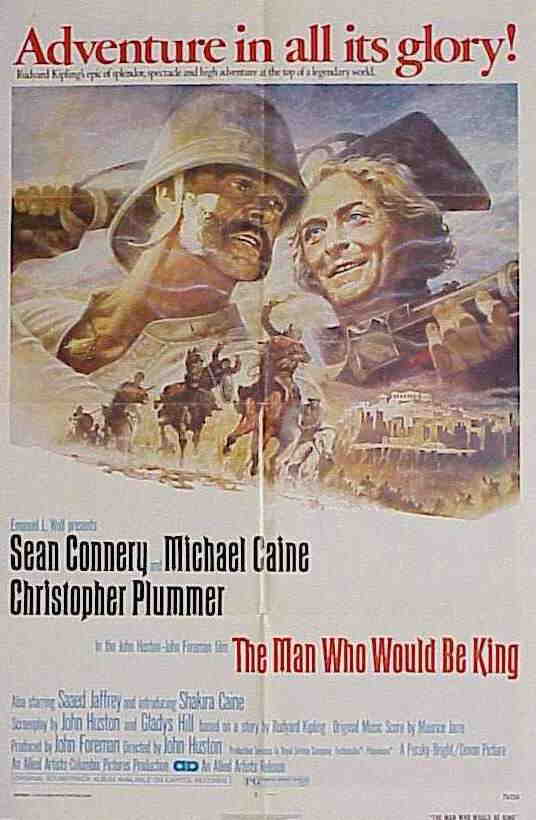
Films of Michael Caine #27: The Man Who Would Be King (1975)


Cast: Sean Connery (Daniel Dravot), Michael Caine (Peachy Carnehan), Christopher Plummer (Rudyard Kipling), Saeed Jaffrey (Billy Fish), Doghmi Larbi (Ootah), Jack May (District Commissioner), Karroom Ben Bouih (Kafu Selim), Mohammed Shamsi (Babu), Albert Moses (Ghulam), Paul Antrim (Mulvaney), Graham Acres (Officer), Shakira Caine (Roxanne).

Crew: John Huston (director), John Foreman (producer), John Huston and Gladys Hill (writers), Maurice Jarre (music), Oswald Morris (cinematography), Russell Lloyd (editor), Alexander Trauner (production designer).

Synopsis: Writer Rudyard Kipling is working his office at the Northern Star newspaper in India when he is approached by a crippled, disfigured beggar. Kipling eventually recognises the beggar as Peachy Carnehan, an ex-soldier whom he met three years before. Peachy stole Kipling’s watch and then returned it after discovering they were both Masons. Peachy and his friend Daniel Dravot had Kipling witness a contract between them foreswearing alcohol and women until they completed a mission. The pair of rogues planned to become kings of a backward country called Kafiristan, north of Afghanistan. Kipling said it was impossible. A survey team had tried to map the country and never returned. The last white man to make it back was Alexander the Great, 2200 years earlier. Kipling gave Danny a Masonic symbol for luck. Peachy and Danny went ahead with their plan, overcoming many dangers to reach Kafiristan. They met Billy Fish, a Ghurka warrior and sole survivor of the survey team. He acted as interpreter with the people of Kafiristan. Danny and Peachy trained the men of one village to be soldiers, then led them into battle successfully against their neighbours. An arrow hit Danny but did not kill him, merely lodging in the leather of his bandolier. The locals took this as evidence that Danny was the son of the god Sikander, their name for Alexander the Great.

Danny and Peachy’s army swept across the country, conquering all before it. The high priest of Kafiristan, Kafu Selim, summoned the Englishmen to the Holy City of Sikandergul. Selim did not believe Danny was a god but became convinced when he saw the Masonic symbol hung around Dravot’s neck. Alexander the Great also bore the symbol of a Mason. Danny ruled wisely but began to have delusions of grandeur. He decided to take a wife, a beautiful native woman called Roxanne, against the wishes of Selim. At the wedding ceremony Roxanne bit Danny’s face, drawing blood. Everyone saw Danny was a man, not a god. He was thrown into a ravine and Peachy was crucified. But when Peachy did not die, the priests let him go. Kipling listens to the beggar relate all of this in amazement. Peachy departs, leaving behind the decapitated head of his friend Danny – still wearing the crown of the king of Kafiristan…

+++++++++++++++++++++++++++

Rudyard Kipling’s short story The Man Who Would Be King was first published in 1888. Nearly a century later, director John Huston got the chance to fulfil his long-held ambition to film the high adventure tale. The maker of such beloved movies of The Maltese Falcon (1941), The Treasure of the Sierra Madre (1947) and The African Queen (1952) had almost succeeded in launching the project in the 1950s, with Clark Gable and Humphrey Bogart in the leads. The combination of Paul Newman and Robert Redford was also considered, before Huston settled on Caine and Sean Connery.

The two leads had been friends for more than a decade, but this was the first chance for Caine and Connery to make a feature together. ‘It was one of the most delightful films I’ve ever made in some of the most uncomfortable conditions,’ Caine told Venice magazine in 2002. ‘I’d never met John before that film. It could’ve been a dreadful experience if it had been done with two other men.’

The $8 million production was shot near Marrakesh in Morocco, with further filming on the Grande Montée at Chamonix in France and studio work at Pinewood. Caine rates Huston as the director who has most influenced him. ‘I’d been shooting a couple of days and he stopped me in the middle of a take,’ the actor told the Sunday Times in 1992. ‘I said, “What’s wrong?” He said, “You can speak faster, Michael. He’s an honest man.” And I thought that’s right, and I got the whole character then and there.’

Huston insisted everyone came to see the rushes of what had already been shot during filming – even Caine, who had refused to attend such screenings since Zulu (1964). Huston rarely gave direction to his leads, as Caine recalled for Venice: ‘I said to him one day, “You don’t really tell us much, do you?” He said, “You’re being paid a lot of money to do this, Michael. You should be able to get it right on your own.” Sean and I were obviously giving him what he wanted, so he said nothing. Good directors always do that. Bad directors can’t shut up.’

During shooting Huston changed his mind about who should play Roxanne, the Kafiristan woman that Daniel disastrously takes as his wife. The part had originally been given to actress Tessa Dahl, daughter of writer Roald Dahl and actress Patricia Neal. The director decided Roxanne had to be played by a woman with dark skin. In 2002 Caine told the San Bernadino County Sun how his Indian-born wife Shakira was chosen over dinner one night. ‘John said, “We’ve got to find an Arab princess somewhere.” And we were all eating away and we stopped eating and looked at Shakira. She didn’t want to do it. She had never acted before. But I said, “Don’t worry about that. I’ll show you how.”’

The film was released in December 1975, rated A in the UK and PG in America. Reviewers praised the picture, although influential US trade paper Variety singled out Caine’s performance for criticism. The Man Who Would Be King was nominated for four Oscars, including screenplay adaptation and one for the costumes by Hollywood legend Edith Head. The film also received BAFTA nominations for its costumes and cinematography. Thirteen years later the movie was released on video (reclassified as PG in Britain), before making its DVD debut in 2002. Entertainment Weekly magazine singled out Caine’s work in the film as one of 100 performances unjustly overlooked for an Oscar.

Reviews: ‘The film is beautifully served by the performances of Sean Connery and Michael Caine, very funny as twin incarnations of typically endearing Kipling ranker-rogues.’ – MFB
‘Whether it was the intention of John Huston or not, the tale of action and adventure is a too-broad comedy, mostly due to the poor performance of Michael Caine.’ – Variety

Verdict: The Man Who Would Be King is a delightful film that only seems to improve with age. Full of spectacle and stirring music, this is a boy’s own adventure of the highest standard. As in many Huston films, this is a story about the dreams and follies of men – woman are kept very much in the margins. Nevertheless, the script is funny and wry, while Caine and Connery give some of the warmest performances in their careers. It’s only a shame the duo haven’t had a similar vehicle since. The Man Who Would Be King is highly recommended. If you’ve never seen it before, you’re in for a rare treat.

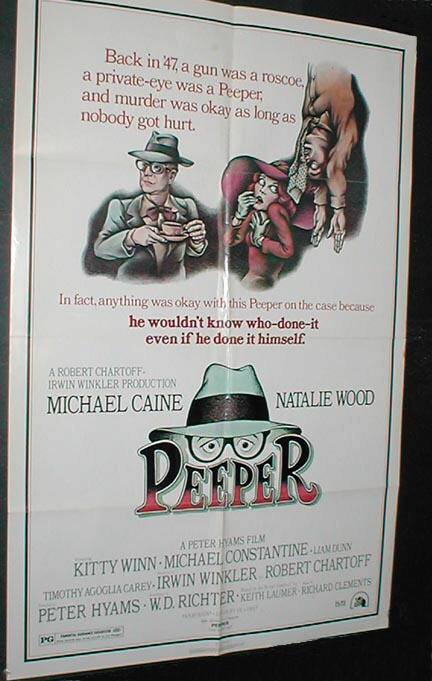
Films of Michael Caine #26: Peeper (1975)


(Alternative title: Fat Chance)
Cast: Michael Caine (Leslie C Tucker), Natalie Wood (Ellen Prendergast), Kitty Winn (Mianne Prendergast), Michael Constantine (Anglich), Thayer David (Frank Prendergast), Timothy Agoglia Carey (Sid), Liam Dunn (Billy Pate), Don Calfa (Rosie).

Crew: Peter Hyams (director), Irwin Winkler and Robert Chartoff (producers), W D Richter (writer), Richard Clements (music), Earl Rath (cinematography), James Mitchell (editor), Albert Brenner (production designer).

Synopsis: Leslie C Tucker is a British private eye working in Los Angeles in 1948. He is hired to a find a woman called Anya by her father, Anglich. Twenty-nine years earlier Anglich left his daughter at a local orphanage. Now he has come into some money, the father wants to share the wealth with Anya. But she was adopted while still a child. Tucker tracks Anya to the wealthy Prendergast family of Beverly Hills. He deduces that one of the two daughters, Ellen and Mianne, is really Anya. Anglich sends Tucker a suitcase of cash for Anya. Soon after Anglich’s murdered body is dumped in the private eye’s office. Tucker solves a complex web of lies, blackmail and embezzlement to discover which daughter is Anya. He gives her the money, but falls in love with the other sister…

+++++++++++++++++++++++++++

Keith Laumer’s novel Deadfall (no relation to the 1968 film of the same name, also starring Caine) was first published in 1971, spoofing the hard-boiled private eye genre popularised by writers like Chandler and Spillane. The book’s film rights were acquired by producers Irwin Winkler and Robert Chartoff who hired screenwriter W D Richter to adapt it for the big screen. Director Peter Hyams was chosen to helm the project, made with the working title Fat Chance.

Caine was hired to play private detective Leslie C Tucker. He was old friends with co-star Natalie Wood, as the pair had dated briefly in the 1960s when Caine was in Hollywood making Gambit (1966). Fat Chance was Wood’s first film for five years. The former child actress had become a star in classic movies like Rebel Without a Cause (1955) and West Side Story (1961), but in the 1970s turned down roles to have a family. Caine cited the opportunity to work with her as a key factor for accepting his role.

The film was shot in Los Angeles early in 1974, with extensive location work aboard a cruise liner. The 1990 book Candidly Caine quotes Caine on the experience: ‘It was fine to make; we all went down to Mexico on a ship, and we called at all the Caribbean ports. It was like a lot of films; you have the time of your like making it, but it didn't work at all.’

Movie studio Twentieth Century Fox was so underwhelmed by Fat Chance, it kept the picture on a shelf for more than a year. But in 1975 film noir movies became hot property at the box office, thanks to the success of Chinatown and Farewell, My Lovely. Fat Chance was re-edited and released with a PG rating and a new title: Peeper. But critics found the results sadly wanting and the picture sank without trace at the box office.

Caine mentioned it in an interview with Photoplay Film Monthly in 1976. ‘I made Fat Chance some time ago in Hollywood with Natalie Wood. It was made before both Chinatown and Farewell, My Lovely. But because it’s just been shown, everyone thinks it was made as a cheap quickie following on from the success of the other two.’ The film did no better in Britain, where it was released in the Summer of 1976, rated A. Peeper was released on video in 1987 but was soon deleted. [Update: A Region 1 DVD version was issued in 2006.]

Reviews: ‘Peeper is flimsy whimsy. Peter Hyams’ limp spoof of a 1940s private-eye film … shows far more care in physical details than artistic ones.’ – Variety
‘It’s worth looking out for, if only to see Michael Caine’s knowing funny performance as a English opportunist who fetches up in California.’ – The Daily Mail

Verdict: Peeper has a neat opening, with a Humphrey Bogart double speaking the credits in a dark alleyway. Alas, that’s all the wit and invention this film possesses. The other 86 minutes are a purgatorial plethora of running around, half-hearted attempts at hard-boiled dialogue and pointlessly convoluted plotting. Peeper was made before Chinatown or Farewell, My Lovely, but both films are still ten times better than this dull, undramatic collection of clichés. Caine tries his best but brings nothing fresh or compelling to the material. Thanks to its obscurity and a rare 1970s film appearance by Natalie Wood, Peeper has a slight curiosity value – but little more.

Monday, December 04, 2006

George Lucas remakes Singin' in the Rain


Shock news from across the Altantic: George Lucas is hard at work on a remastered, reimagined version of the classic musical Singin in the Rain. Find out more about this Lusacfilm extravaganza here, but don't be freaked out if the clip begins with an ad for American Express - all part of the fun...

Home again, naturally

Well, I'm back from That Fancy London and an intense weekend on the TAPS script editing for TV course. I'll blog at length about that in the next day or two, but not today - still need some time to process all the information. If anybody has an inkling they'd like to be a script editor, I can heartily endorse the workshop - you learn a lot, you met a lot of interesting people and it'll definitely help you decide whether or not script editing is the career you want to pursue. For me, personally, it's underlined that I want to be a writer and a script editor - but not at the same time.

In fact, I've already been down this road before, to some extent. When I was editing the Judge Dredd Megazine, I took to writing in my spare time. But when I took over editing 2000 AD - commissioning and editing 1600 pages of script a year - I quickly discovered it was using all my creative juice. I didn't have the energy to write for myself anymore, I gave at the office. When I quit editing to go freelance, I soon found the urge to write was back, like a field that had been laying fallow for several years.

Now, after six years of freelance writing for a living, I'm coming to the conclusion that I wouldn't mind some time in an office dynamic again. Obviously, the best of both worlds would be a writers' room situation where writers get together and collaborate on a shared project. Participating in the mentoring project has fueled that. Three would-be TV drama writers working with industry professional Adrian Mead, all three of us working to get the best from our writing.

I've got a monster deadline looming in two weeks, so don't expect a huge amount of blogging from me here for the next fortnight. Once I get this particular project out of the way, I'm going to scale back how much work I'm taking on. Barring the arrival of an offer I can't refuse, I don't want to take on any more novels in the first half of 2007. I want and need to concentrate on the project for which I'm being mentored, on my screenwriting MA and the pursing under broadcast media writing and editing opportunities. I'll still be doing some comics work, but everything else is going to have to wait.

I've already turned down a couple of offers of work, lucrative jobs that could help sustain my bank balance. If I'm to make good on my escape bid from the world of hackwork, now's the time. As the sad death of Doctor Who author Craig Hinton this past weekend showed, none of us knows how long we have and we need to make the most of our lives. When I lived in London I would often natter with Craig at gatherings of Who authors, and we sometimes ended up at the same dinner table. He was a kind soul and will be missed by many, many people. Rest in peace Craig.

Thursday, November 30, 2006

Meet the Inappropriate Dad

Right, I'm off to London for the next four days on my TAPS script editing course, so try not to break the furniture while I'm gone - and no teenage parties in here. In case anybody needs entertainment, I've posted four more entries for Michael Caine films - you can read one a day, if you like. Just scroll down to see them.

Immediately below is the script for a radio scene I wrote while on the BBC Scotland writer's lab. I had no idea what I was going to write for five days and then inspiration struck as two words collided in my imagination: Inappropriate Dad. The result was Sweet and Sour Sixteen, which appears below. It features some fruity language, but hopefully also has some laughs, twists and turns. The Enjoy!

SWEET AND SOUR SIXTEEN • by David Bishop

SCENE 1: INT. A HOTEL CORRIDOR.

DAD:
Nearly there, Jamie.

JAMIE:
Nearly where?

DAD:
I told you, son, it’s a surprise.

JAMIE:
Can’t I just—

DAD:
Hey, no peeking! You promised!

JAMIE:
Alright, alright.

DAD:
Here we are: Room six thirteen!

KEY TURNS IN A LOCK AND DOOR OPENS.

JAMIE:
(INHALING) Smells like rotten fruit in there.

DAD:
That’s perfume, Jamie. Dead classy.

JAMIE:
More like dead animal.


SCENE 2: INT. HOTEL ROOM 613.

DAD:
Okay, you can look now.

CHLOE:
Ta-daa!!!

JAMIE:
(BEAT) Oh no.

DAD:
Happy birthday, son!

CHLOE:
You must be Jamie. I’m a present from your dad.

JAMIE:
Oh, God.

CHLOE:
(CLOSE) Call me Chloe.

DAD:
Now that’s what I call a sweet sixteen. And she’s all yours, son!

JAMIE:
All mine?

DAD:
Until four thirty - benefits only stretch so far, eh? ‘sides, I doubt you’ll take that long, what with it being your first time and all.

CHLOE:
(CLOSE) Don’t worry, Jamie - I’ll be gentle with you.

A ZIP SLIDES SALACIOUSLY DOWNWARDS.

JAMIE:
Oh, Christ.

DAD:
Least now your cow of a mother can’t complain I never give you nothing.

JAMIE:
(AFTER A GULP) I… don’t know what to say.

DAD:
Thank you’s traditional.

JAMIE:
Traditional? You’ve hired a prostitute for my birthday! (BEAT) No offence, Chloe.

CHLOE:
None taken, love.

DAD:
My brother did the same for me when I turned 16.

JAMIE:
Uncle Billy’s hardly a role model, Dad - he’s been in prison since 1995.

DAD:
We all make mistakes, Jamie.

JAMIE:
Yeah, and this is one of them! (BEAT) Look, umm...

CHLOE:
Chloe.

JAMIE:
Chloe. Right. Could you give my dad and me a minute alone here?

CHLOE:
Alright darling, I'll step out.

JAMIE:
Thanks.

A ZIPPER IS PULLED SHUT.

CHLOE:
But the meter’s running, if you catch my drift.

RECEDING ECHO OF STILETTO HEELS ON WOODEN FLOOR.

DOOR OPENS AND CLOSES AS CHLOE EXITS.


DAD:
(CLOSE) You’ll like her, son - Chloe’s very good at her job.

JAMIE:
I don’t care if—(BEAT) How d’you know she’s very good at—(BEAT) Oh, no. Tell me you didn’t…

DAD:
I couldn’t hire any old slapper for my boy, could I? ‘sides, you’re one of her specialities.

JAMIE:
Specialities?

DAD:
Being handicapped and all that.

JAMIE:
You thought that because I’m in a wheelchair I’d need the help of a prostitute to lose my virginity?

DAD:
Well... yeah.

JAMIE:
You haven’t got a fucking clue, have you?

DAD:
Mind your language! I’m still your fucking dad, y’know!

JAMIE:
I’ve seen you three times in the last four years, Dad. Bloody Santa comes round our place more often than you!

DAD:
I’m trying to make up for that!

JAMIE:
By paying some tart to give me a quick fumble on my birthday?

DAD:
It’s a start, innit?

JAMIE:
No, it’s the bloody finish. You’re not my dad, not anymore.

DAD:
Don’t be like that, Jamie—

JAMIE:
Like what? Like my “cow of a mother”? Least she stuck around after the accident!

DAD: That wasn’t my fault, son—

JAMIE: Oh, piss off! (BEAT) I said piss off!

AWKWARD SILENCE.

DAD:
Right. Well. I’ll be going then. (BEAT) Look, if Chloe’s not your type, d’you mind if I...?

JAMIE:
(SIGHING) Fine. Take her with you. Do what you want. You always do.

DAD:
(GOING) Thanks, son - you’re a diamond. See you next year, alright?

JAMIE:
Can’t wait!

RECEDING FOOTSTEPS ON THE WOODEN FLOOR.

DOOR OPENS AND CLOSES AS DAD EXITS.


JAMIE:
Happy bloody birthday to me.

ENDS.

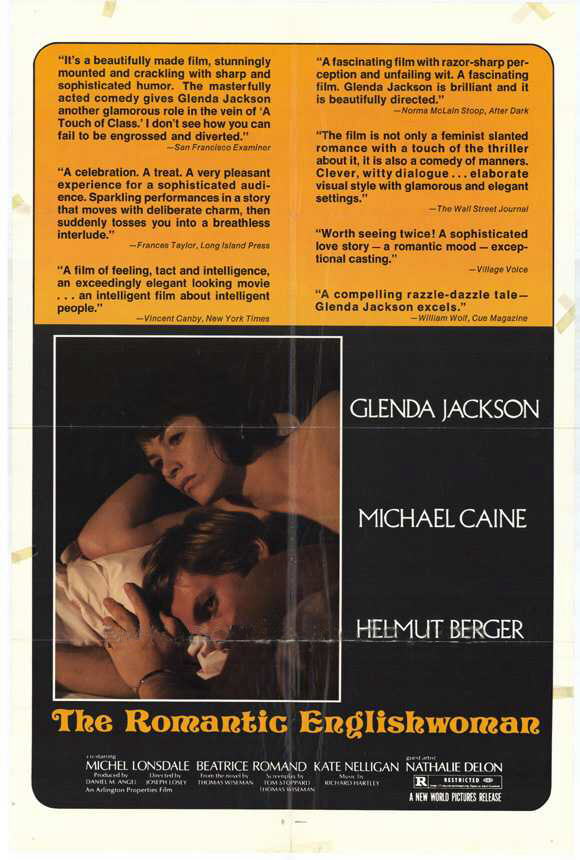
Films of Michael Caine #25: The Romantic Engishwoman

Cast: Glenda Jackson (Elizabeth), Michael Caine (Lewis), Helmut Berger (Thomas), Michael Lonsdale (Swan), Beatrice Romand (Catherine), Kate Nelligan (Isabel), Nathalie Delon (Miranda), Rene Kolldehoff (Herman), Anna Steele (Annie), Marcus Richardson (David).

Crew: Joseph Losey (director), Daniel M Angel (producer), Tom Stoppard and Thomas Wiseman (writers), Richard Hartley (music), Gerry Fisher (cinematography), Reginald Beck (editor), Richard MacDonald (production designer).

Synopsis: Bored English housewife Elizabeth goes on holiday to Baden-Baden in Germany. She meets Thomas, a handsome young gigolo who smuggles drugs. Elizabeth’s husband Lewis is a writer. He imagines her having an affair. Elizabeth returns home but her attempts to reconcile with Lewis are always interrupted. Thomas sees a man called Swan looking for him and flees Germany. The gigolo writes to Lewis and mentions meeting Elizabeth. Lewis invites the German to dinner, to Elizabeth’s annoyance. Lewis lets Thomas stay with them, employing the gigolo as a secretary. The writer bases a character in his new screenplay on Thomas. Lewis finds Elizabeth and Thomas having sex in the conservatory. The lovers flee to France, where Thomas resumes being a gigolo. He calls Lewis and tells him where Elizabeth is. Lewis drives to France, where he is followed by Swan. Swan finds Thomas and leads him away. Lewis takes Elizabeth back to Weybridge…

+++++++++++++++++++++++++++

Thomas Wiseman’s novel The Romantic Englishwoman was first published in 1971. The author collaborated with American-born director Joseph Losey on adapting the book. Losey had helmed noted pictures like The Go-Between (1970) and Accident (1967). Playwright Tom Stoppard then joined the project at the director request. ‘He hardly changed the structure … but he largely rewrote the dialogue,’ Losey told Sight & Sound in 1975.

For his leads the director cast Caine and double-Oscar-winner Glenda Jackson. Caine told Viva magazine he took the role to work with Losey and Jackson. He praised the latter as one of the most brilliant actresses in the world, but added: ‘You only enjoy it professionally with Glenda. She’s charming – but she doesn’t go to lunch, if you know what I mean.’ Losey proved even harder work. Caine bet £10 that he could make the director laugh at least once during filming. He lost the bet. The actor said the part of Lewis was unlike anything he had done before. ‘There was nothing of myself I could bring to that role, so I had to construct the character from the ground up. It was pure performance.’

The picture was filmed in England during Autumn 1974, with location work in Germany and France. Because the movie was being made during the wrong season, Losey shot the middle section first, then the ending and lastly the opening, to get the environments he wanted. This created some discomfort for Jackson, who had to appear naked outside at night for one scene. ‘A film set can be a very draughty place,’ she said in the film’s press book, ‘and a garden in the middle of November isn’t much fun either.’

In his autobiography Caine wrote that Jackson and her on-screen lover, Helmut Berger, seemed to hate each other on sight. Caine found himself acting as intermediary. The production was not a happy experience for him, nor was the end result: ’The film was not only very convoluted it was also downright grim...’ Losey’s first cut ran to 145 minutes, but the director removed near half an hour from this during editing.

The Romantic Englishwoman was released in British cinemas with an AA rating in 1975. Critics were underwhelmed and the response was just as poor in America, where it was rated R. The movie was released on video in 1986, reclassified as a 15, but has since been deleted. The film is available on Region 2 DVD.

Reviews: ‘The most complicatedly trivial film … a highly polished humbug.’ – Observer
‘Caine does well, very well indeed, as the sarky husband, considering that he’d fairly well limited to looking continuously irritated, exasperated and infuriated.’ – Evening Standard

Verdict: Near the beginning of this picture, a film producer describes a screenplay about a woman who goes off in search of herself. Michael Caine’s character describes it as pretentious, derivative and very boring – neatly summing up this movie. The Romantic Englishwoman is a domestic melodrama that tries your patience beyond belief. The three central characters are people you would never want to meet – let along spend two hours watching. Caine gets to shout and play drunk but injects no life into dull, tepid material. The film induces terminal ennui with its witless verbosity and drab visuals. Avoid.

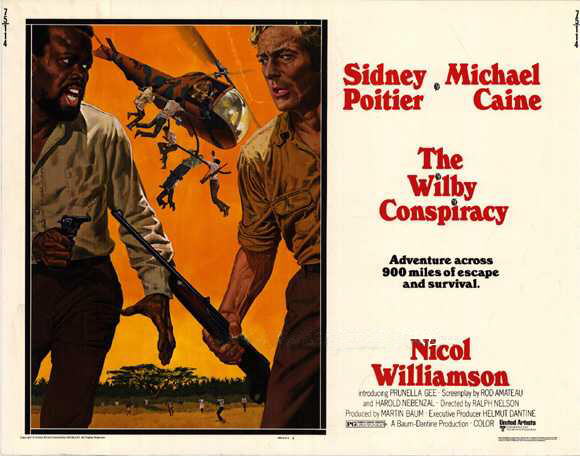
Films of Michael Caine #24: The Wilby Conspiracy

Cast: Sidney Poitier (Shack Twala), Michael Caine (Keogh), Nicol Williamson (Horn), Prunella Gee (Rina), Saeed Jaffrey (Mukarjee), Persis Khambatta (Persis), Ryk de Gooyer (Van Heerden), Rutger Hauer (Blane), Patrick Allen (District Commissioner), Joe De Graft (Wilby).

Crew: Ralph Nelson (director), Martin Baum (producer), Rod Amateau and Harold Nebenzal (writers), Stanley Myers (music), John Coquillon (cinematography), Ernest Walker (editor), Harry Pottle (production design).

Synopsis: In Capetown political prisoner Shack Twala is released after ten years in a South African jail, thanks to his lawyer Rina Van Niekirk. But within minutes the police try to arrest Shack and attack Rina when she tries to stop them. The pair escape with help from Rina’s new boyfriend, a British mining engineer called Jim Keogh. Shack and Keogh have to flee South Africa, but Shack insists on travelling via Johannesburg, 900 miles away. The fugitives are stalked by Major Horn from the Bureau of State Security. He murders a white man who helps the pair and dumps the body in their car boot. Keogh realises Shack is vice-chairman of Black Congress, a political group fighting against apartheid. The fugitives reach Johannesburg where Shack enlists the aid of Indian doctor Mukarjee to recover £750,000 of uncut diamonds. The stones will be used to further Black Congress’s cause. Keogh and Shack are reunited with Rina. She blackmails her estranged husband Blane into flying them across the border into Botswana. They land safely and are welcomed by Wilby, the chairman of Black Congress. But Horn arrives, intent on abducting Wilby and taking him back to South Africa to stand trial. Horn says Shack and Keogh were allowed to escape so they would lead him to Wilby. The uncut diamonds are just fakes. The Black congress members foil Horn’s plan and kill all his men. Keogh realises he can no longer be neutral and murders Horn…

+++++++++++++++++++++++++++

Peter Driscoll’s political thriller about racism in South Africa, The Wilby Conspiracy, was first published in 1972. Screenwriters Rob Amateau and Harold Nebenzal adapted it for the big screen, downplaying the political content and heightening the more cinematic chase element. Ralph Nelson was hired to direct the film, having twice helmed films starring Sidney Poitier. Their first collaboration, Lilies of the Field (1963), had won Poitier a best actor Oscar – the first black actor to be awarded this accolade. Poitier was chosen for the role of political activist Shack Twala, while Caine came on board as British tourist Jim Keogh.

Caine had experienced apartheid while filming Zulu on location in South Africa during 1963, and soon learnt to abhor them. Several years later he also experienced the effects of racism while shooting Hurry Sundown (1967) in the US state of Louisiana. The actor had no time for such attitudes, as his mixed race marriage to Shakira Baksh in 1973 showed. When the chance arose to star in an anti-apartheid thriller, Caine grabbed it.

The Wilby Conspiracy was unable to shoot in South Africa because of the film’s political content. Instead Kenya and Nairobi were used for seven weeks of location work during 1974, with studio sequences lensed at Pinewood back in Britain. The picture was Rutger Hauer’s first English-speaking role and gave a film debut to English actress Prunella Gee. In 1975 she told Film Review about making the movie. ‘As it was my first film, it was a bit of a strain. But Michael kept me doubled up with laughter most of the time. He is so funny. It was quite difficult to do some of the scenes for laughing.’

In Kenya Caine frequently found himself ignored while Poitier received all the adulation. But both actors almost made headlines for the wrong reason. They were filming a high speed scene in a jeep with a camera mounted to the front of the vehicle. The £35,000 camera jolted loose and flew through the empty windscreen, narrowly missing them.

The Wilby Conspiracy was released in Britain during the spring of 1975, rated AA. The picture got a mediocre reception from critics, uneasy at the mixture of politics and action. It reached America in July that year, rated PG. The Wilby Conspiracy was released on video 12 years later, reclassified as a 15. The tape has long been deleted in Britain but can still be found in the US. No DVD edition has yet been issued. {Update: The Wilby Conspiracy is now available as a Region 1 DVD.]

In his autobiography Caine said the picture was worthwhile, even without box office success: ‘This film was my first foray into that very risky realm of “message” pictures, and as such proved to be a bit ahead of its time, but I am still proud that I made it anyway.’ More than 20 years after The Wilby Conspiracy, Caine and Poitier were reunited to play the title characters in Mandela and de Klerk, a 1997 TV project about the end of apartheid in South Africa. The situation portrayed in their 1975 film had become part of history.

Reviews: ‘Somehow the story comes out too much of a pot-boiler undeserving of the fine work that Williamson, Caine and Poitier put into it.’ – Variety
‘Michael Caine has never been better, carrying off his role with a sense of humour that never interferes with the seriousness of the escapade.’ – Daily Express

Verdict: The Wilby Conspiracy is a curious mixture of chase film, buddy movie and political diatribe. It tackles the issue of racism with fervour, but loads the dice by portraying the white racists as evil sadists. There is also a crudity to the picture, with gratuitous nudity thrown in simply to titillate. But the strengths of the three leads and a sardonically humorous script ensure the film is never less than watchable. Nicol Williamson delivers a delightfully eccentric performance as the hunter Horn, while Caine and Poitier spark off each well as the fugitives whose fates are inextricably linked. The Wilby Conspiracy is an enjoyable movie, even if it employs a sledgehammer to make its point.

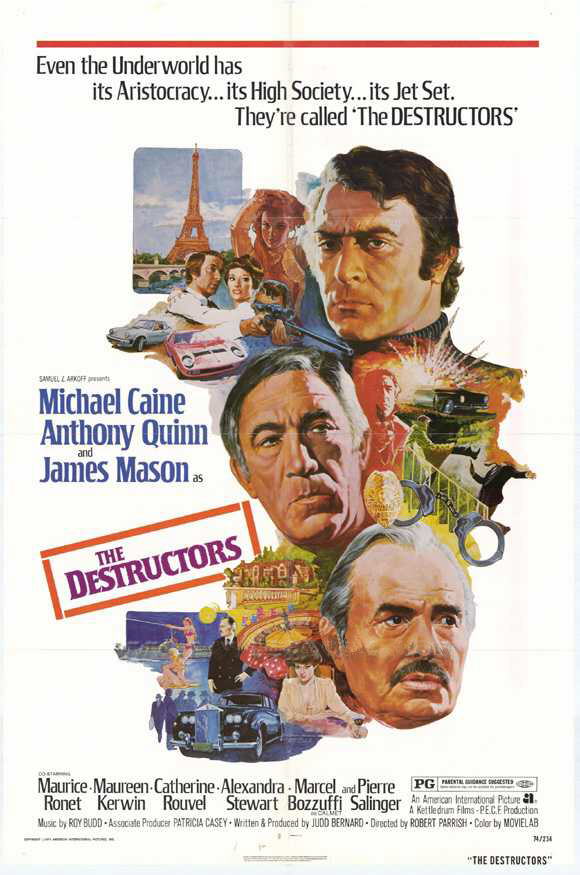
Films of Michael Caine #23: The Marseille Contract

(US title: The Destructors)
Cast: Michael Caine (John Deray), Anthony Quinn (Steve Ventura), James Mason (Jacques Brizard), Maurice Ronet (Briac), Alexandra Stewart (Rita Matthews), Maureen Kerwin (Lucienne Brizard), Catherine Rouvel (Brizard’s mistress), Marcel Bozzuffi (Calmet), Patrick Floerscheim (Kovakian), André Oumansky (Marsac), Georges Beller (Minierini).

Crew: Robert Parrish (director), Judd Bernard (producer and writer), Roy Budd (music), Douglas Slocombe (cinematography), Willy Kemplen (editor), Willy Holt (production designer).

Synopsis: In Marseilles an undercover agent for the American Drug Enforcement Agency (DEA) is murdered while trying to infiltrate the organisation of drug smuggler Jacques Brizard. The crime boss has political connections within France that protect him. The DEA boss in Paris, Steve Ventura, decides the only way to get Brizard is hire a professional assassin. French police inspector Briac arranges a meeting for Ventura with such a killer. The DEA man is surprised to find the hitman is an old friend, John Deray. Ventura gives Deray $50,000 to kill Brizard. The assassin infiltrates Brizard’s family by romancing the drug dealer’s beautiful daughter. Ventura learns Brizard is receiving a massive shipment of drugs soon. Brizard discovers Deray is an assassin and tries to have him eliminated. Deray and Ventura collaborate to bring down Brizard as he oversees the drugs shipment. Briac intervenes, planning to kill Brizard and steal the drugs. Briac and Deray die in a shootout but Brizard escapes. Ventura finds and silently murders Brizard…

+++++++++++++++++++++++++++

In the winter of 1973 producer Judd Bernard approached Caine with an offer – five weeks in a warm climate shooting a thriller with Anthony Quinn and James Mason. ‘It was just after my daughter [Natasha] was born, and to get her out of London in the winter into the south of France was wonderful,’ Caine told Time Out in 1992. ‘I never even read the script. I said: “I’ll fucking do this! I’m out of here!”’

The Marseille Contract was a $2 million movie written by Bernard and directed by American Robert Parrish, who had won an Oscar for editing Body and Soul (1947) before moving behind the camera. Caine said The Marseille Contract was a bad film ‘where I had the best bloody time in my life. We started off in Nice, went to Cannes, St Tropez and wound up in Paris.’ The picture was shot almost entirely on location, with post-production at Pinewood in England. It reunited Caine with cinematographer Douglas Slocombe and stunt driver Remy Julienne, both of whom had worked with him on The Italian Job (1969).

In his 1988 book Hollywood Doesn’t Live Here Anymore, Parrish recalled making the film. ‘It was a pleasure working with James Mason, Michael Caine, and Anthony Quinn. We all tried, but sometimes you win and sometimes you lose.’ The director also wrote about a studio representative on the film insisting that a main character share his initials. The representative demanded the actor playing that character be dressed in expensive monogrammed shirts, and possess a nine-piece set of monogrammed luggage from Louis Vuitton. The representative acquired all of these when shooting concluded.
The BBFC required cuts before passing the film with an A certificate in August 1974. Critics were less than impressed by the results. In America the picture was cryptically renamed The Destructors and rated PG, but also failed to catch fire. It was released on video in 1984 in the US and two years later in Britain, reclassified as a 15. Both tapes have long since been deleted and the film is not available on DVD.

Reviews: ‘A thriller that throws most of the current clichés – crashing cars, bouncing motorbikes, vigilante cops – into one uneasy story and comes up with not very much.’ – Sunday Telegraph
‘The plot … allows Mr Caine to make love and shoot a few people. But judging by his one expression, I’m not sure which he preferred.’ – Daily Mirror

Verdict: The Marseilles Contract is cut-rate thriller material laced with first-rate actors. A slight script never engages you while the actors meander through the action, waiting for their pay packet to arrive. Slocombe’s cinematography gives the picture a look far better than the production’s limited budget or imagination deserves. There’s a spectacular sequence arranged by Julienne with two speeding vehicles playfully duelling on a tight, twisting mountain round that is replicated in the James Bond film Goldeneye (1995). Otherwise, this film offers little of interest. Caine may play an assassin dressed like Jack Carter, but he spends much of his time on-screen grinning like a Cheshire cat. You will probably not share his enthusiasm.

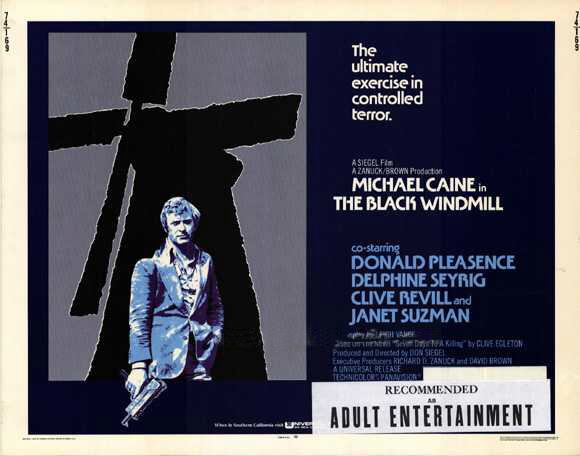
Films of Michael Caine #22: The Black Windmill

Cast: Michael Caine (Major John Tarrant), Donald Pleasence (Cedric Harper), Delphine Seyrig (Ceil Burrows), Clive Revill (Alf Chestermann), John Vernon (McKee), Joss Ackland (Chief Superintendent Wray), Janet Suzman (Alex Tarrant), Catherine Schell (Lady Julyan), Joseph O’Conor (Sir Edward Julyan), Dennis Quilley (Bateson).

Crew: Don Siegel (director and producer), Leigh Vance (writer), Roy Budd (music), Ousama Rawi (cinematography), Antony Gibbs (editor), Peter Murton (art direction).

Synopsis: Major John Tarrant is an MI6 operative trying to infiltrate a ring of saboteurs run by Ceil Burrows and a man called McKee. They kidnap Tarrant’s young son David and demand a ransom of £517,057 in uncut diamonds. That is exactly the amount previously purchased earlier by Tarrant’s boss, Harper. The only people with knowledge of the diamonds are Tarrant, Harper and the General Purposes Committee, headed by Sir Edward Julyan. Burrows and McKee plant evidence to frame Tarrant. The government refuses to pay the ransom so Tarrant steals the diamonds and takes them to a rendezvous in Paris. The major is knocked out and drugged, losing the diamonds. Tarrant is found by French police, lying unconscious beside Burrows’ corpse. He is charged with her murder. McKee helps Tarrant escape custody and tries to have him killed. Tarrant returns to London and traces his son to a black windmill in Sussex. Realising one of the committee members must be involved, Tarrant calls all of them with a message that will lure the traitor to Sussex. Sir Julyan takes the bait. Tarrant storms the windmill, kills McKee and rescues his son…

+++++++++++++++++++++++++++

The Black Windmill began life as Seven Days to a Killing, a 1973 novel by Clive Egleton. Leigh Vance adapted it into a screenplay for American director/producer Don Siegel. He came to England in 1973 to make The Black Windmill after 30 years helming high calibre action films, such as Invasion of the Body Snatchers (1956) and Dirty Harry (1971). he director a film that explored the archetype again. In the movie’s press book, Siegel stated his first and only choice for the part of Tarrant was Caine. ‘There are actors who are tougher, more handsome, more emotive, but there was only one with a centre solid enough to convey the very complex undertones of this role.’

Caine took the film for the opportunity to work with Siegel. ‘I grew up with his films,’ the actor said in the press book interview. ‘The Black Windmill is a dramatic, suspense plus love story.’ The 11-week shoot began in August 1973, using the working title Drabble. Filming was predominantly location-based at sites in England and France, with some studio work at Twickenham. The picture reunited Caine and Donald Pleasance, who had worked together on Kidnapped (1971).

The Black Windmill was released in 1974, rated A in the UK and PG in the US. Critics considered it one of Siegel’s lesser works. Emma Andrews’ 1978 book The Films of Michael Caine quotes the actor on why the picture did not live up to its promise: ‘I think the gentility of England rubbed off on Don Siegel… It became too sentimental and convoluted.’ The film has never been available on VHS or DVD in Britain, but an American video was released in 1986. [Update: a REgion 2 DVD was released in 2005.]

Reviews: ‘Don Siegel’s filmmaking takes a dip in The Black Windmill … the production fizzles in its final half hour.’ - Variety
‘Slick, craftsmanlike but general undistinguished thriller … Siegel has done better.’ – Maltin’s

Verdict: The Black Windmill is a routine espionage thriller that never surprises. Siegel’s direction is efficient and workmanlike, while Caine gives a taut, controlled performance as Tarrant. But the film’s attempts to create suspense and misdirect the viewer’s suspicions never grip or convince. The Roy Budd music reeks of the 1970s and strongly evokes a later British TV espionage series, The Professionals. Bodie and Doyle would not have looked out of place in The Black Windmill and might well have enlivened the film. This is a minor work in the careers of almost everyone involved.

Wednesday, November 29, 2006

Let's talk about collaboration

Creative writing tends to be a solitary endeavour. Novelists bash away at their manuscripts for weeks, months, even years largely in isolation. Some have a group of acquaintances they invite to read the book and offer comments, observations, opinions. Some have agents who act as in a way not dissimilar to editors, offering feedback. And then there are editors, copy editors and the like. But - for the most part - writing novels is a solitary occupation. There may be a few writing partnerships, often on what's derisively known as chick lit, but there aren't many truly collaborative novels.

The same applies to many other areas of creative writing - plays, radio drama, screenplays, comics and graphic novels, poetry - you know it, chances are the vast majority of people doing it are doing it solo. They're probably using both hands and ideally all of their fingers, but it's still a lonely activity. [I'm talking about writing here - please, people, try to focus.] True collaboration, the act of multiple scribes writing something together, that's rare in the UK.

Not so when it comes to TV writing in North America. Sitcoms and dramas across the Atlantic generally use a writers' room system, whereby the plot and structure of an episode are bashed out by a collective. This is often known as breaking the story, identifying its individual beats and finding the best order for these to appear. [If anybody owns the Region 1 DVD release of The Shield Season Three, there's a cracking fly on the wall documentary that shows the cop drama's writing staff breaking the story strands for that year's finale - fascinating stuff.]

There have been a few attempts to import this technique to the UK, with limited success. It's perhaps more easily applied to sitcoms, where the need to generate gags and laughs can sometimes be better fed by a collective than an individual or a pair of writers staring at a screen until their eyes bleed. The BBC adopted the writers' room system for its sitcom My Family, which has proved a long-running success with viewers, if not critics. The BBC was also looking to apply the writers' room approach to a new drama called Merlin, but the series did not secure a commission.

Having spent the past six years alone in a room writing for the most part, I would love to experience life inside a writers' room environment. The radio drama writers' lab I went on this month reminded me how much I enjoyed the company of other writers and the creative energy that multiple scribes can generate in a room together. I know that the gender split can sometimes be an issue - we had five male writers and three female - and create it's own dynamic, not always for the better. At the lab the facilitators were very good at managing the room so that never became an issue.

It was fascinating to work alongside writers who are character-led storytellers and literary novelists. They brought a depth of emotion and a richness of language to their writing that tends to be beyond me - it's certainly not something that comes naturally. By comparison, my years in journalism, comics and writing commercially for a living seemed to give me an edge when it came to structure, tautness of prose and self-editing. All the writers quickly came to respect each other's strengths and there were no obvious them-and-us gender divisions.

Of course, while the writers' lab had eight working writers in a room, the focus was on writing for radio, not collaboration. We were each creating our own scenes and ideas, not attempting to marry them al together as a collaborative effort. [That was something we did on the previous, two-day radio drama lab I did. It was frustrating at times, but also creating an over-arching narrative I doubt any of us would have ever stumbled upon working by ourselves.]

There's an interesting piece in The Guardian newspaper today about five female playwrights who were brought together to collaborate on a joint effort. The resulting play, Catch, opens this week at the Royal Court in London. The initiative was inspired by a previous effort in the early 70s, when seven male playwrights collaborated on a play called Lay By. [Back then the men had a female secretary to take notes - times have changed a little.] It sounds as if all the women gained a lot from the experience of writing collaboratively. I just wish there were more opportunities for this to happen within British TV, particularly TV drama. Maybe one day...

Tuesday, November 28, 2006

Glasgow meets Peanuts

This is genius: the first Peanuts cartoon, given new dialogue as if the characters were from Glasgow - courtesy of Talking Pish. Warning: not for the easily offended!

In esteemed company, with Ghost Who Walks

I regularly write scripts for The Phantom, a costumed comic hero who's been fighting injustice, piracy and tyranny for nearly 500 years. This character - known as the Ghost Who Walks - started life as a newspaper adventure strip in 1936 and he's still going strong. My stories are published across Scandinavia in various languages by Egmont, and reprinted into English by Australia's Frew Comics. But Egmont is not the only companies that originates new comics starring The Phantom. America's Moonstone Books also publishes new tales featuring the character.

Now Moonstone is putting together an anthology of prose stories starring The Phantom and I was lucky enough to have a tale included in the book. Other scribes in the time include Craig Shaw Gardner, Jim Alexander, Mike Bullock, Ron Fortier, Steven Grant, Clay Griffith, Susan Griffith, C. J. Henderson, Nancy Kilpatrick, Len Kody, David Michelinie, Will Murray, Mike Oliveri and Martin Powell. Above you can see the stunning cover art by Doug Klauba. The book's out next May and you can order the regular paperback version or a special limited edition hardcover from Amazon.com now.

Who you calling Clint Flicker?

Anybody who's ever worked in comics will tell you it can be a dangerous medium. Not dangerous in a firefighter walking into a burning building kind of way. Not even in a rescuing a kitten from a high tree kind of way, come to think of it. Alcohol poisoning at comics conventions can sometimes a problem, and there was the case of the creator so unpopular people wrote obscenities on his forehead in indelible ink while he was insensible from drink - but nothing especially life threatening.

[There was the case of the famous comics artist who thought it hilarious to hide in his work an incredibly libellious accusation about a famous British pop singer who's had hits for fifty years. It got into print but, fortunately, nobody outside the editorial office noticed. The offending text has since been scratched off all copies of the relevant films, to prevent the libel being reprinted. Not exactly dangerous, but it could have been very, very expensive for somebody.]

No, the danger stems from the fact most comics are lettered in UPPER CASE i.e. all the dialogue and text inside caption boxes tends to appear in CAPITAL LETTERS. How could this be dangerous, you ask? Well, for the longest time comics were a mass market medium, printing cheap to be sold cheap.  There's still a tendency for lettering to blob together sometimes, particularly when I follows L.

As a consequence there are two words [plus their variants] in comics dialogue and caption boxes that can get you into all sorts of trouble if you're not careful. Never used the word FLICK or its variants, and never, ever, ever call a character CLINT if you can possibly avoid it. Those of you with deft imaginations or dirty minds will already know where I'm going with this. For those of you that don't here's a classic example from an Avengers comics, where Captain America calls Hawkeye a very rude name indeed. [You kiss your mother with that mouth, Cap?] Look no further if easily offended...

Monday, November 27, 2006

Scotland recognises native comics greats

Next February Edinburgh's Waverley Books is published a full colour graphic novel adaptation of Robert Louis Stevenson's classic tale Kidnapped, written by Alan Grant and illustrated by Cam Kennedy. It's part of Edinburgh’s UNESCO City of Literature programme that's kicking into gear and an exciting project all round. Well, the news keeps on getting better. The National Library of Scotland - one of the snootiest and least helpful libraries I've ever been inside - has bought Cam's stunning artwork for the nation! Will wonders never cease?

Chris Weston, fiendishly talented

The fiendishly talented Chris Weston has blogged about how he was supposed to be the cover artist for my Fiends of the Eastern Front novels, and even put on display one of the rough images [see below] he'd been developing for the project. check out his blog, it's full of juicy bits and bobs. And what a fertile young man he is too, with a third child due in about a month. How does he find the time?

I heart dinnerladies

"You always get a custard cream, but you don't always gets a Garibaldi." By rights that line of dialogue shouldn't be funny - but it is. If you don't recognise it, the line comes from an episode of Victoria Wood's exemplary sitcom, dinnerladies. The show ran for two series, with six episodes in the first and ten in the second. Wood wrote and starred in the show, but decided to pull the plug with the second series. It breaks my heart there'll never be anymore, but those 16 episodes live on thanks to the joys of DVD. Whenever a blue mood overtakes the house or someone needs cheering up, there's a simple solution - watch some dinnerladies.

Long before Jamie Oliver was singing the praises of such women, Victoria Wood was immortalising them in one of the most touching sitcoms of recent times. Besides being bloody funny, Wood makes you care about the characters. You come to love their quirks and idiosyncracies, rejoice in their little triumphs and smile as they battle against the odds to achieve the mundane. dinnerladies never reaches for the obvious laugh, isn't afraid to exchange comedy for situation and always stay true to its bittersweet tone. It's among my favourite shows of the past ten years. If you don't already own it, go and find the complete boxed set now. The likes of HMV are frequently flogging all 16 episodes for ten quid and that's a bargain in anyone's money.

The Nightmare that never was


A couple of years back I wrote a novel based in the film franchise world of A Nightmare on Elm Street. Suffer the Children seemed to be well received and I decided to pitch another, bringing back some of the characters from my first effort and resolving what had happened to the heroine, a plucky teen called Alex. When last seen she was trapped in an asylum, blamed for a spate of gruesome murders committed by nightmare serial killer Freddy Krueger and - worst of all - apparently carrying Freddy's child. My first Elm Street novel had trodden some fairly well worn ground for the franchise, and I wanted to do something different for the second. One question had arisen while I was writting Suffer the Children - why was Freddy so obsessed with one particular house on Elm Street? I decided answering that question would be the central quest of my new proposal. I wrote it up, Black Flame's editorial team of the time liked the results and it got forwarded to New Line for approval.

Encouraging noises were being made but, alas, it seems sales on the New Line imprint were not enough. The various ranges - Elm Street, Final Destination, Friday the 13th - got wound down and my new book never got commissioned. So, just for fun, here's what I was planning to do in it. Obviously, the final novel might well have differed significantly from this. I suspect the influence of films like The Haunting and Legend of Hell House are all too blatant in this plot synopsis, so that would need to have been addressed. But I thought there were some nice twists and turns in the narrative. Anyways, for whatever it's worth, here's my lost Elm Steet proposal...

Title: HOUSE OF 100 MANIACS

He cursed him in sleeping, that every night,
He should dream of the devil, and wake in a fight…


For decades Freddy Krueger, bastard son of a hundred maniacs, has tormented and slain the children of Springwood in their dreams. Now his doorway to our world, 1428 Elm Street, is due for demolition – but few believe this will lift the killer’s curse from their town.
A team of investigators agrees to spend one night inside the house to discover why Krueger has claimed it as his domain. The team includes a priest, a psychic, a scientist, a psychotherapist and the sole survivor of Freddy’s worst killing spree. A trio of teenagers sneaks into the house on a dare, determined to prove themselves.
But one night within these walls will seem like an eternity in hell!

Characters, Settings:
ALEX CORWIN: Twenty two-year-old survivor from Suffer the Children. She was blamed for the murders of eight people, murders for which Freddy Krueger was responsible. Declared clinically insane, Alex was committed for life to maximum security psychiatric care. Pregnant with Krueger’s child, Alex was effectively catatonic. But she regained her senses after the baby was delivered by Caesarean section, and has been undergoing psychotherapy. Five years on, Alex believes none of it was real – Freddy, the baby, the deaths of her friends. But truth will out.

VINCENT MORTIMER: Alex’s psychotherapist, he came to Springwood after a messy divorce. Vincent arrived at Westin Hills Psychiatric Hospital two years and has made remarkable progress with Alex. He is certain taking Alex back to her old home at 1428 Elm Street is the final step towards recovery. Vincent does not believe in the legend of Freddy Krueger, and certainly places no credence in the idea of a curse. He is a man of science and he is walking into deadly territory.

MIKE WILLIAMS: Former sheriff of Springwood, he was obliged to resign after Suffer the Children. His life has been plagued by Krueger. Now dying of cancer, Williams wants to see an end to Freddy’s poisonous influence on this town, to lift the curse of Krueger from the house at 1428 Elm St. He persuades the town elders to fund an intervention at the house, using his own life savings to help bring together the team of investigators in the hope of cleansing the property.

FATHER DERMOT KELLY: An Irish Catholic priest, fond of the bottle, gambling and numerous other vices. He is a man of god, but a weak man, a man who has lost his faith. He is brought in to perform an exorcism on 1428 Elm Street and finds himself face to face with the devil incarnate. Can he rediscover his belief in God before everyone inside the house is damned to spend eternity in hell?

BARBARA STEWART: A scientist who specialises in debunking notions like ESP and contact with the afterlife. Barbara would be beautiful if she didn’t hide behind her glasses and her lab coat, preferring people to notice her talent instead of her looks. Insecure about herself, she is ill prepared for the reality of what lies buried within the soul of the building on 1428 Elm Street, the true horror of that house.

MORGANE ASH: A self-proclaimed medium and psychic, Morgane says she can commune with the dead and see into the future. She agrees to join the team investigating the Krueger cruse, despite a vision of her own death inside the house on Elm Street. What she discovers inside could tear her soul apart.

JENNY ANDERSON: An 18-year-old student at Springwood High who accepts a dare to spend a night inside 1428 Elm Street. The only girl among five siblings, she has had to fight for everything. Jenny claims she isn’t afraid of anyone, but for five years has been haunted by nightmares of a monster coming to get her – a monster with knives for fingers. Now her nightmares are about to come true.

TERRI SHARP: This 17-year-old is the opposite of her best friend Jenny. A spoiled only child, Terri can have anything she wants anytime she wants. Jenny stood up for Terri in the playground on their first day of grade school and the pair have been unlikely friends ever since. Terri is heading for an almighty fall.

GARY CHAMBERS: Terri’s trouble-making boyfriend is a 19-year-old high school drop-out who wants to have fun now and worry about the future later. He’s had brushes with the law but is braver and smarter than his bad boy image suggests.

FREDDY KRUEGER: The star of the show, he gets off on pain and fear, it makes him stronger. He has a special affinity for the house at 1428 Elm Street, the place where so many of his victims have lived, where so many of his greatest slay-rides have begun. His very essence has impregnated the property and the ground on which it stands, turning 1428 Elm Street into his domain, his territory. Woe betide anyone who dares challenge Freddy Krueger on his home ground…

Plot Synopsis:
CHAPTER ONE: A psychotherapy session between Vincent Mortimer and his patient Alex Corwin, using hypnosis to make her relive the events of ‘Suffer the Children’. Vincent believes she must confront the demons of her past otherwise she will never be free of them. Alex comes face to face with Freddy again. Thanks for the wake-up call, bitch! Alex escapes the nightmare, but she knows Krueger is waiting for her. She still has unfinished business with that bastard…

CHAPTER TWO: A disparate group assembles in Springwood - Catholic priest Father Kelly, noted medium Morgane Ash, scientist Barbara Stewart and psychotherapist Vincent Mortimer - all brought together by former sheriff Mike Williams. The town will pay each of them a considerable sum of money to spend 24 hours inside 1428 Elm Street, if they emerge with an answer to one question: why links Freddy Krueger to that property and how can he be purged from it? Williams is throwing in his own life savings to make this happen. For Williams, this is his last roll of the dice - lung cancer will claim him soon and, if he's going to hell, he wants a clearer conscience when he gets there. He doesn't want to spend eternity in the company of Freddy Krueger. Barbara and Morgane clash immediately, their belief systems are utterly opposed to one another. Father Kelly has little wish to be part of such freak show, but he needs the money after embezzling charitable funds from his parish.

CHAPTER THREE: For Alex, returning to Elm Street is the final step on her path to recovery. Vincent had almost convinced her the events of five years ago were a psychotic episode, nothing more - there is no Freddy Krueger, she must face the consequences of what she did. When they happens, she will be able to live the rest of her life free from nightmares and psychoses. She agrees to go back to her old home on Elm Street, but not because she believes Vincent anymore. She knows Freddy is waiting for her there, she must face him or remain cursed for life. Across town, high school student Jenny Anderson is playing truth or dare with her friends Terri Sharp and Gary Chambers. When Terri asks Jenny if she is still a virgin as her truth question, Jenny opts for the dare instead - sneak inside 1428 Elm Street and bring back a piece of murder memorabilia. Okay, she agrees, but only if you two come with me. Terri and Gary are both up for it.

CHAPTER FOUR: The adults arrive at the front of Alex's old home: it's boarded up, abandoned, awaiting demolition. She feels a shudder of pain and anguish, but Vincent assures her it will be alright. She has to believe in him, believe in the truth - there is no Freddy Krueger. Morgane faints after seeing a vision - they are all going to die inside that house, it's a death trap. For years she has had visions of her own death in just such a place. But she agrees to go inside: better to face your fears than be conquered by them. Father Kelly helps Barbara get her scientific equipment inside, and the others venture in through the front door too. Williams padlocks the front door. Nobody gets in or out for the next twenty-four hours, that was the agreement. I've had the water and electricity supply reconnected for the duration. After midday tomorrow the wrecking ball will be tearing through this place. Let's find some answers.

CHAPTER FIVE: Round the back of 1428 Jenny, Terri and Gary break in through a window and conceal themselves in the basement to avoid being seen by the adults. Williams blocks their exit, so now the trio of teenagers are stuck inside too. Jenny is startled to find a young boy in the basement, his name is Ricky. He can't remember how he came to be there or where his family is. He asks her to look after him, in case the scary man comes again. The scary man? His face was all burned and he had fingers for knives. Jenny is shaken - since puberty her nightmares have been stalked by the same man, clad in a battered fedora and a jersey with red and green horizontal stripes. How could Ricky know that? Could they have been sharing the same nightmares?

The adults soon find the teenagers, but Williams refuses to let anyone out until the deadline is up. Jenny tries calling out on her mobile but is getting no signal. The same is true of all the others. They are cut off, the nine of them. Ten, you mean, Terri says - don't forget Ricky. Ricky? Who's Ricky? The little boy is vanished, no trace can be found of him. The former sheriff says there's long been rumours of a ghost who sometimes appears to residents on Elm Street, the spirit of a boy murdered by Krueger whose body was never found. Perhaps his bones are still inside this house, perhaps that explains why Krueger comes back here.

CHAPTER SIX: Barbara sets up her equipment and begins to run tests on the house. She detects high levels of peculiar energy, the like of which she’s never seen before. If I didn’t know better, I’d say this house was impregnated with… pure hatred. Morgane says it is and holds a séance, calling to Krueger in the afterlife, asking what he wants of them. I want you to die, he snarls in reply, and I’m going to enjoy making it happen. None of you will leave my domain alive. Williams argues with Vincent about Alex. Vincent pleads with the former sheriff not to undo all the good work done in therapy. There’s one thing missing from the official files – whatever happened to Alex’s baby? It was adopted, is all Williams will say. I pray to god that child never finds out the identity of its parents…

CHAPTER SEVEN: Outside, the sun sets and darkness falls. This is when he comes, Morgane whispers. He lives in dreams and nightmares, they are his domain. As the people of Springwood fall asleep, so his strength begins to grow. If one of us should fall asleep within these walls, he will use their subconscious as a conduit to get to us all. The nine of them agree that nobody can fall asleep, for all their safety. But Gary dozes off, having spent all the previous night riding around on his motorcycle. Then the terror begins. Alex has visions of being sliced open from the inside by Freddy's fingerknives, the monster escaping from her womb before going on to kill. Gary's sliced and diced body is discovered and Williams accuses Alex of the killing - it's started, just like it did before.

CHAPTER EIGHT: When the others try to get out, they find they can't - the doors and windows are sealed shut by some inexplicable power. Barbara tries to come up with a reason, but Morgane tells her to accept that science is no match for the power buried inside this house. The supernatural is what we're dealing with now. Freddy begins another killing spree, claiming the inhabitants of 1428 one by one: Father Kelly tries to exorcise the dream demons from this place, but finds his communion wine has turned to human blood - he bleeds to death from stigmata, the others unable to staunch the wounds in the priest's hands, feet and side.

CHAPTER NINE: Alex begins to regress into a catatonic state, unable to cope with her carefully constructed belief system being torn apart - everything Vincent taught her to doubt is coming true again. Barbara and Vincent turn to each other for support and have sex in the master bedroom. But when Vincent goes for a piss he is cut to ribbons by the bathroom mirror exploding - how's that for having a slash? Morgane's tarot cards come to life when she falls asleep and is tortured by their symbols before dying in horrific pain and torment. Terri is next. She sees Ricky and runs after him, down into the basement, then down into the boiler room, down into Freddy's nightmarish domain. He creates a suitably grotesque end for her superficial lifestyle, withering her body to that of an old woman before making her bones shatter like brittle china cups.

CHAPTER TEN: By now there are only four survivors left: Barbara, the catatonic Alex, Williams and Jenny. The former sheriff says all those who got away from Krueger talked about him luring them down into a boiler room. It wasn't so much a place as a state of mind. If you want to find him, that's where the monster will be. His health is fading fast, he can't go with them. He'll stay here, keep watch over Alex. Barbara and Jenny venture down into the boiler room where Krueger is waiting for them. He taunts them with their worst fears, visions of horror and loathing. Upstairs in 1428, Williams meets the boy Ricky. Do you want to play a game, the child asks sweetly? It's called hide and seek. Williams agrees and goes off to hide, leaving Alex in her vegetative state. She drifts in and out of dreams, appearing and disappearing in the boiler room.

CHAPTER ELEVEN: Barbara and Jenny play cat and mouse with Krueger, who wounds each of them and then murders Barbara - slicing out her eyes: she blinded me with science! Ricky finds Williams, who says he isn't feeling well. I guess this isn't going to make you feel any better, the child replies, and stabs Williams through the stomach with miniature fingerknives. Alex wakes up to find Williams staggering into the room, bleeding to death. He collapses, gasping a last message: Ricky... Rick... Frederick... Freddy... Ricky was Krueger all along? How is that possible? In the boiler room, Jenny keeps one step ahead of Freddy. She finds Ricky and tries to protect him, not realising his true identity…

CHAPTER TWELVE: Alex remembers what happened five years ago: how Freddy gave her empathic powers, the baby he put in her body, the Caesarean section to remove it – but what happened to the baby? It grew up to become Ricky! In the boiler room Jenny is attacked by Ricky, who turns into Freddy, growing older and scarred before her eyes. As Krueger is about to finish her off, Alex appears – it’s time we finished this, you and me, once and for all.

CHAPTER THIRTEEN: Alex and Freddy do battle in the dreamscape, Alex using her empathic abilities to get inside Krueger’s mind, to witness his memories – Ricky is Freddy as a child. He lived here at 1428 Elm Street. His father used to beat him in the basement, used to burn him, cut him – little Frederick thought that was how fathers loved their children – it twisted his psyche forever – that’s why he always comes back to this house, why he calls Elm Street home…

Freddy snaps out of his memories, furious that Alex has seen into him – normally he prays on the worst fears and memories of others! Alex tells Jenny Krueger’s secret: he’s a scared little monster, he only a child – he can’t hurt them. Taking their power from each of those who died in the house – Morgane’s supernatural abilities, Gary’s courage, Vincent’s belief, Father Kelly’s faith – Jenny and Alex turn this on Krueger, regressing his to the child he was, trapping him in his own childhood memories. The boiler room is flooded with white light, then is gone.

EPILOGUE: Alex and Jenny wake up on the grass outside 1428 Elm Street. The wrecking crew is waiting to start work demolishing the house. It’s over, at last. The two women don’t notice the small boy playing on the other side of the road, wearing a t-shirt of red and green strips. He finds a worn leather glove with rusty knives protruding from each of the fingers and slips it on: a perfect fit. Come inside now, the boy’s mother calls out. Come inside, Ricky…

THE END.